A submartingale has a nonnegative conditional expected increase, not rising paths. A squared fair walk shows the difference and the role of convexity.
Submartingale
A submartingale is an integrable, adapted stochastic process whose conditional expected future value is at least its current value. It describes upward movement in conditional expectation, while allowing individual paths to fall. In quant finance, this distinction explains how a convex exposure to a fair underlying can have increasing expected value without delivering a guaranteed gain.
The comparison always uses a specified probability measure and filtration—the information available at each time. Changing either can change the classification.
The inequality that matters
On a filtered probability space, a process (Xt) is a submartingale under P if:
It is adapted: Xt is measurable with respect to Ft.
It is integrable at each time: EP[∣Xt∣]<∞.
For every pair of deterministic times s≤t,
EP[Xt∣Fs]≥Xsalmost surely.
“Almost surely” allows exceptions on events of probability zero. The conditional expectation compares the current value with an average over futures consistent with the information then available. It does not compare two realised observations on every path.
In discrete time, checking every adjacent step suffices; the tower property extends the inequality to later times. Equality gives a martingale, which is also a submartingale. Reversing the inequality gives a supermartingale. Thus “sub” does not mean “below zero” or “strictly increasing.”
A fair move, squared
Consider a synthetic cumulative move St starting from zero. At each integer step it independently adds or subtracts USD 1, with probability 1/2 each. This is a teaching model, not observed market data. Let Ft reveal all signs through time t, and define
Xt=St2.
St is measured in USD; Xt is measured in USD squared. Squaring changes the quantity being measured, not just its expected direction.
After one step, S1 is either plus or minus USD 1, so X1=1USD2. After two steps:
Sign sequence
S2 (USD)
X2 (USD squared)
Probability
Up, up
2
4
1/4
Up, down
0
0
1/4
Down, up
0
0
1/4
Down, down
−2
4
1/4
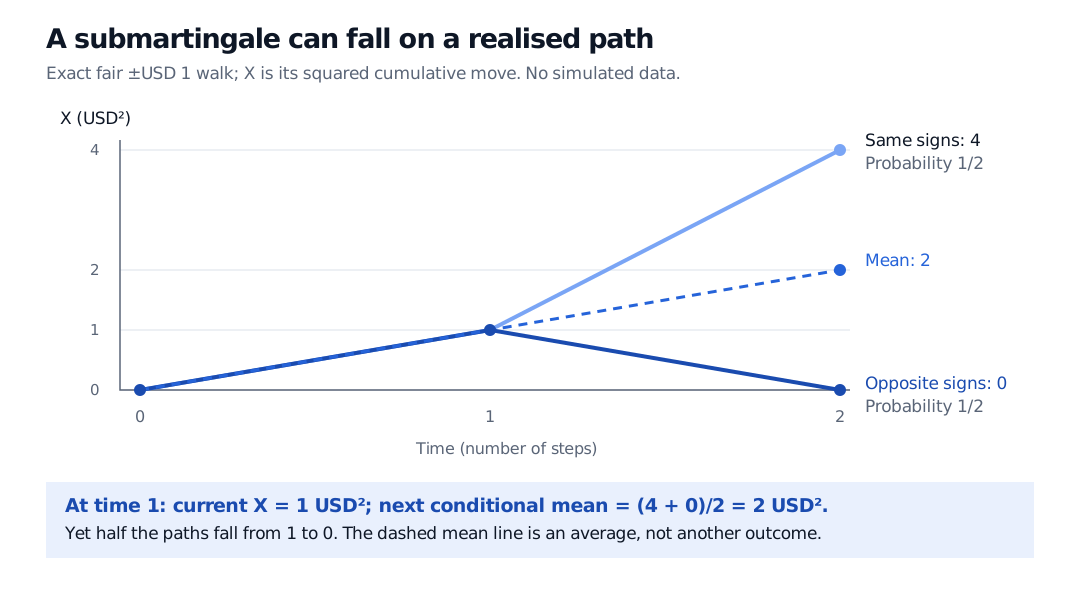
After either first sign, the next squared value is 4 or 0 with equal conditional probabilities. Its conditional mean is therefore 2USD2, above the current 1USD2. Yet an up-then-down path falls from 1 to 0. Both statements are true.
Squared fair random walk: X starts at 0 USD squared, is 1 after one step, and ends at 4 for equal signs or 0 for opposite signs, each with probability one half. Its mean is 0, 1, 2 at times 0, 1, 2; half the paths fall from 1 to 0.
Original exact finite-state example. Solid lines show the two possible squared trajectories; the dashed line joins unconditional means. The conditional mean after either first sign is 2 USD squared, although half the paths fall.
The same calculation works beyond two steps. Write the next independent increment as εt+1, taking values ±1USD. Expanding the square gives
At each finite time the process is bounded, hence integrable, and its value is known from the observed signs. It meets all three requirements. Its unconditional expectations at times 0, 1 and 2 are 0, 1 and 2 USD squared.
Subtract the accumulated conditional increase and the residual becomes a martingale:
Mt=St2−t(1USD2),t=0,1,2,….
Here t counts steps. The predictable increasing part is At=t(1USD2), with A0=0. This is a concrete discrete Doob decomposition: X=M+A. The increasing part tracks conditional mean growth; it does not make the full process increasing along every path.
Why convex exposures appear
The square is one instance of a general mechanism. If S is a martingale and φ is a real-valued convex function, then φ(St) is a submartingale provided the transformed values are integrable at every time. Conditional Jensen's inequality gives
E[φ(St)∣Fs]≥φ(E[St∣Fs])=φ(Ss).
For the square, this requires finite second moments of St; integrability of St alone does not suffice. A convex transform of an arbitrary submartingale needs additional care: the standard preservation result also requires the transform to be nondecreasing. Squaring is convex but is not nondecreasing on the whole real line.
This mechanism is useful when reasoning about convex payoffs and exercise incentives. It does not automatically establish a statement about a discounted option's price: the chosen measure, cash flows and discounting still matter. In the example, St2 is a squared-move statistic, not an investable wealth process. Even for a traded submartingale, the conditional mean inequality permits losses and supplies no guaranteed trading profit.
To build the averaging machinery used here, the Conditional Expectation lesson develops conditional means and the tower property. The public page is a preview; the full lesson requires membership.
Practice: is a rising average enough?
Let Y0=0. A fair coin sets Y1 to USD 2 or minus USD 2, and Y2 is always USD 1. The filtration reveals the coin at time 1. The unconditional means are USD 0, USD 0 and USD 1. Is Y a submartingale?
Answer. No. After observing Y1=2USD, the next conditional mean is 1USD<Y1. The process is adapted and integrable, but fails the conditional inequality on an event of probability 1/2. Nondecreasing unconditional means are necessary for a submartingale, not sufficient.
Sources
Steven E. Shreve, Stochastic Calculus and Finance, CMU lecture notes prepared by Prasad Chalasani and Somesh Jha, 25 July 1997, §2.4 (martingales and conditional inequalities) and §7.1, Lemma 1.23 and Theorem 1.24 (conditional Jensen and convex transforms). This is the 1997 lecture-note text, not the later textbook. The numerical examples and figure above are original.