A sinking fund bond requires scheduled retirement of an issue. See why falling aggregate principal does not promise proportional repayments to every holder.
Sinking fund bond
A sinking fund bond is a bond whose terms require the issuer to retire specified amounts of the issue over time. Instead of leaving the whole debt to be refinanced on one final date, the issuer reduces the amount outstanding along the way. For an investor, however, a scheduled reduction in the issue's principal does not necessarily mean a scheduled part-payment on their bond.
The requirement belongs to the bond's indenture, the contract governing the debt. It can retire the entire issue by maturity or leave a final balance. The dates, amounts, redemption prices and permitted methods matter more than the label.
How the debt is retired
Two common mechanisms, described in Fabozzi's Bond Markets, Analysis, and Strategies, are:
Redemption through the trustee. The issuer provides the required cash; bonds are selected for redemption under the contract's allocation rules, which may involve a lottery. Selected principal is repaid at the applicable redemption price, and interest on it stops at redemption.
Purchase and delivery. Where the terms permit it, the issuer buys bonds in the market and delivers them to the trustee to satisfy the retirement requirement. The face amount retired and the cash spent buying it are different quantities if the purchase price differs from par.
An issuer may therefore have flexibility over how to meet a mandatory obligation. That is different from an unrestricted choice over whether to retire any debt. Separately, the terms may allow extra retirements or an optional call. The SEC's Callable or Redeemable Bonds distinguishes scheduled sinking-fund redemption from optional redemption.
A shrinking issue, viewed across all holders
Take a fictional issue with 1,000 USD aggregate face value. Its terms retire 200 USD face at par at each of five year-ends, with the last payment on maturity. The annual coupon rate is 6% on face outstanding during the year. Interest is paid immediately before each retirement. Assume all payments occur as promised, no extra retirements and no fees or taxes.
Year-end
Opening issue face (USD)
Interest (USD)
Face retired at par (USD)
Aggregate cash paid (USD)
Closing issue face (USD)
1
1,000
60
200
260
800
2
800
48
200
248
600
3
600
36
200
236
400
4
400
24
200
224
200
5
200
12
200
212
0
If Bt−1 is the opening face outstanding, that year's aggregate interest is 0.06Bt−1 and the closing face is Bt=Bt−1−200. The coupon rate stays fixed while the total coupon amount falls.
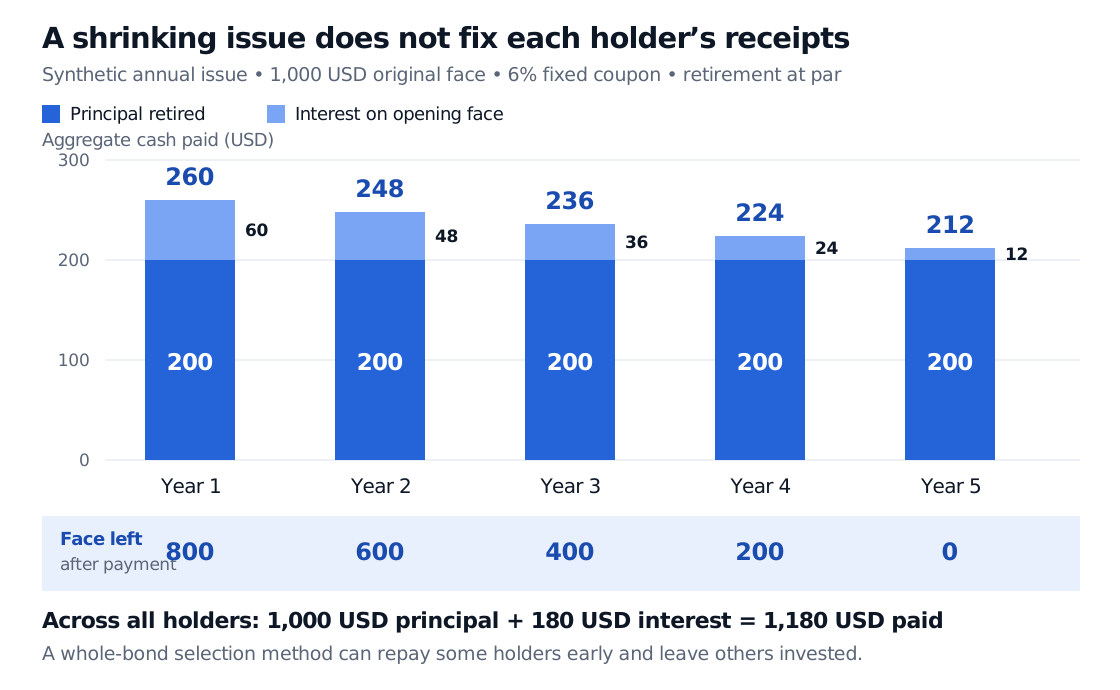
Synthetic 1,000 USD issue retires 200 USD face annually over five years. Closing face is 800, 600, 400, 200 and zero USD; aggregate annual interest is 60, 48, 36, 24 and 12 USD.
Original synthetic issue-level schedule in USD. Each year-end pays interest, then retires 200 USD face at par. The columns show total principal and interest across all holders, not each holder's entitlement.
Principal retired totals 1,000 USD; interest totals 180 USD; aggregate payments total 1,180 USD. The original face is returned once. It must not be added again as a separate final repayment. Nor is the 180 USD an investment return percentage: that would require the investor's purchase price and actual receipt dates.
Why an individual holder sees a different schedule
Suppose retirement is by selection of whole bonds. A bond selected early receives its redemption payment and stops earning coupons. An otherwise identical bond that is not selected continues earning coupons until its own redemption or maturity. Neither holder is automatically entitled to one fifth of their original principal each year. The aggregate table cannot identify which holder gets which receipt.
An amortising bond, by contrast, specifies instalments of principal on the instrument itself. Proportional allocation of a sinking-fund redemption can sometimes produce a similar holder-level pattern, but that conclusion requires the actual allocation rules. Market purchases provide another distinction: holders who do not sell are not repaid merely because the issuer buys bonds from someone else.
For cash-flow modelling, first decide whether the position represents the entire issue or a particular holding. A deterministic issue-level retirement schedule alone is insufficient to assign an individual holding a deterministic repayment path. Check allocation procedures, denominations, purchase credits and any acceleration rights before turning a sinking-fund schedule into a valuation input.
A reserve account is a separate object
“Sinking fund” can also mean an account into which cash is accumulated for future debt service. A transfer into that account does not by itself extinguish principal or deliver money to investors. The MSRB's Principal Repayment explanation covers both predetermined retirement schedules and redemptions driven by funds accumulated for that purpose. Distinguish the account balance, the legal retirement obligation and the actual repayment event.
A sinking-fund requirement reduces the debt left to repay if it is performed. It does not remove default risk, guarantee the reserve's adequacy, or make the remaining bond price stable. Earlier redemption also creates reinvestment risk: returned capital may earn less, particularly if rates have fallen. Mandatory retirement and an issuer's optional call can coexist, so inspect both schedules.
For the broader contractual setting, the Credit-Sensitive Bonds lesson places sinking funds alongside covenants, redemption provisions and credit risk. Its preview is public; the full lesson requires membership.
Sources
Frank J. Fabozzi, Bond Markets, Analysis, and Strategies, 9th edition (Pearson, 2016), Chapter 7, pp. 148–149, “Sinking fund provision”: scheduled issue retirement, balloon balances, trustee redemption, market purchases and accelerated retirement provisions.
Municipal Securities Rulemaking Board, Principal Repayment, “Sinking Fund Redemption” and “Mandatory Redemption”: municipal bond retirement schedules and accumulated-fund mechanisms.
U.S. Securities and Exchange Commission, Investor.gov, Callable or Redeemable Bonds: mandatory sinking-fund versus optional redemption, cessation of coupons and reinvestment risk.