A puttable bond lets its holder demand early repayment under specified terms. Compare redemption with continuation value, keeping coupons and exercise deadlines straight.
Puttable bond
A puttable bond gives its holder the right to require early repayment at a specified price on specified dates or when stated conditions are met. The right can soften the loss from rising interest rates: instead of selling a depressed bond in the market, the investor may be able to redeem it under the contract. Exercising ends the investor’s claim to the bond’s later payments.
The holder chooses whether to exercise. That is the opposite allocation of control from a callable bond, where the issuer chooses early redemption. The put price is often face value, but the specified price and exercise conditions must be read from the issue’s terms. The MSRB’s description of put-option bonds identifies the required notice, exercise dates or events, and the party obliged to purchase the bonds.
Compare values at the same instant
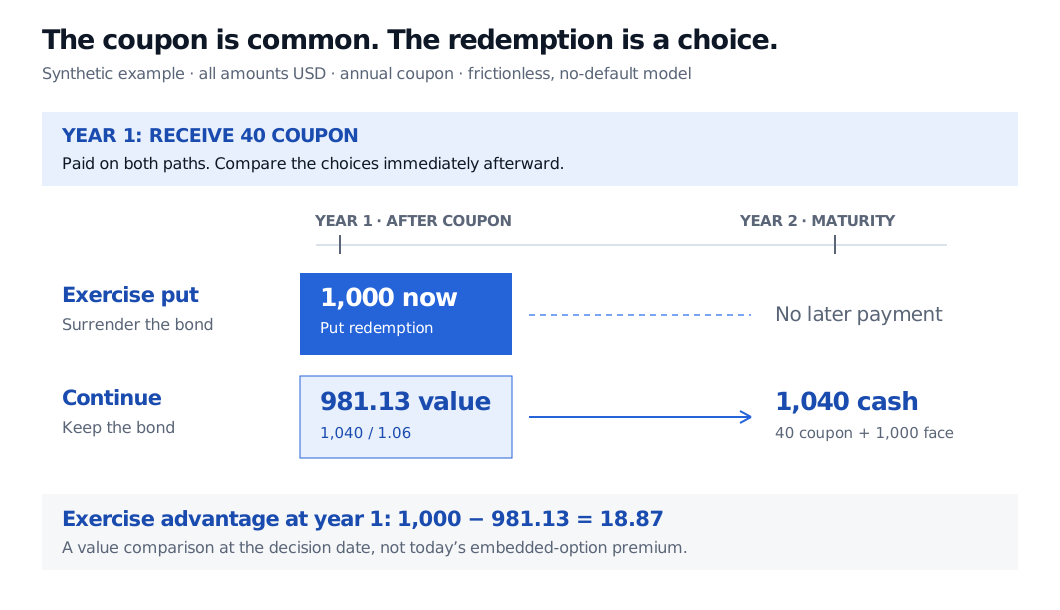
Consider a synthetic two-year bond with USD 1,000 face value and annual coupons of USD 40. The holder may put it for USD 1,000 immediately after receiving the year-one coupon. For this illustration, all payments occur as promised, exercise is frictionless, and the remaining year is discounted at a stipulated 6% annual-effective rate.
At the decision time, the choices are:
Choice
Cash immediately after the year-one coupon
Cash at year two
Exercise the put
USD 1,000
None: the bond has been surrendered
Continue holding
None
USD 1,040: coupon plus face value
The continuation value is the present value of that remaining payment:
Vcont=1.061,040≈USD 981.13.
Under these assumptions, exercising is worth USD 18.87 more at the decision date:
1,000−1.061,040≈USD 18.87(rounded).
The year-one USD 40 coupon has already arrived under both choices. Adding it only to the put alternative would count a common payment as an extra benefit. Equally, comparing USD 1,000 now directly with USD 1,040 next year would ignore the time value of money.
Year-one coupon of USD 40 is paid on both paths. Afterward, exercise pays USD 1,000 now; continuing pays USD 1,040 at year two, valued at USD 981.13 at 6% annual-effective discounting. Exercise has a USD 18.87 advantage at year one.
Original synthetic exercise-date ledger. Values are in USD; the coupon is paid before the choice. The USD 18.87 difference is a decision-date exercise advantage, not the put option’s premium at issuance.
For the discounting foundation behind this comparison, Bonds and Yields separates contractual payments from their discounted value. Its public preview is available without membership; the full lesson requires membership.
A valuable right, with a calendar
At an eligible exercise date, a simple no-default model applies the holder’s choice as
Vτ=max(Kτ,Vcont,τ),
where both values exclude any coupon already paid and Kτ is the contractual redemption amount. The continuation value includes any later contractual put opportunities. If continuation is more valuable, the holder keeps the bond. When rates rise and fixed promised payments become less valuable, the put can become more useful. It does not reset the coupon.
For otherwise identical terms and credit assumptions, the holder’s embedded put option adds value relative to a bond without that right. Investors can therefore accept a lower yield for the same cash-flow promises and credit exposure. Valuing the right before exercise requires the possible future continuation values and the permitted exercise schedule; one exercise-date subtraction is insufficient.
The put price is not an unconditional market-price floor before an eligible date. The investor may have to wait, meet notice and delivery deadlines, or satisfy an event condition. Credit risk remains: a contractual obligation does not ensure the obligated party can fund repayment. The issuer or liquidity provider also has to plan for cash demands when holders exercise.
Read the exercise price, coupon/accrual treatment, notice deadline, delivery requirements and identity of the payment obligor together. The MSRB’s 1985 delivery interpretation describes historical municipal-bond cases where late delivery prevented the buyer from using the anticipated put. It illustrates the economic importance of the exercise process; current procedures depend on the particular security and applicable rules.