Differentiate a product as f′g + fg′. Separate payment growth from extra discounting, check units and signs, and distinguish maturity comparisons from passing time.
Product rule
The product rule differentiates two functions multiplied together. If f and g are differentiable at the point in question, then
dxd[f(x)g(x)]=f′(x)g(x)+f(x)g′(x).
The derivative has two contributions: change in the first factor, weighted by the current second factor, and change in the second factor, weighted by the current first factor. This matters whenever a valuation is a product and both factors depend on the variable being changed. A larger future payment can raise value while a smaller discount factor lowers it.
In Leibniz notation the same rule is
dxd(uv)=vdxdu+udxdv.
It is sometimes called the Leibniz product rule. The derivative is not f′(x)g′(x). For example, (x⋅x)′=2x, whereas multiplying the two derivatives gives 1. OpenStax's differentiation rules state and prove the rule under differentiability.
Why the two contributions add
Let the factors change by Δf and Δg when x changes by h. Multiplying out gives the exact identity
Δ(fg)=gΔf+fΔg+ΔfΔg.
For differentiable factors, both changes are of order h. The last term is therefore of order h2: after division by h, it vanishes as h tends to zero. The first two terms survive. This is why multiplying the two derivatives misses the mechanism: it keeps only the interaction of the changes and discards the two leading contributions.
If one factor is constant, its derivative is zero and the product rule reduces to the constant-multiple rule. It still applies; one of its contributions simply disappears.
A larger payment, discounted for longer
Consider a hypothetical family of contracts, all valued today. A contract with stipulated maturity T≥0 years pays a single certain amount
C(T)=100+10TUSD
at that maturity. The intercept is USD 100 and the payment grows by USD 10 for each additional year of stipulated maturity. Assume a flat, fixed 5% per year continuously compounded discount rate, with no default, fees or interim payments. Its discount factor and present value are
D(T)=e−0.05T,V(T)=C(T)D(T)=(100+10T)e−0.05T.
The rate 0.05 has units of inverse years, so the exponent is dimensionless. Continuous compounding is part of the assumption; an annual effective rate would require a different discount expression.
Differentiate each factor. The exponential needs the chain rule: differentiating its inner exponent supplies the factor −0.05.
At T=2, the payment is USD 120 and today's value is USD 108.580490. The derivative separates as follows:
Effect of increasing stipulated maturity
Contribution to V′(2), USD per year
Payment increases, weighted by today's discount factor: C′(2)D(2)
+9.048374
Discount factor decreases, weighted by the payment: C(2)D′(2)
−5.429025
Net effect
+3.619350
The displayed contributions are rounded separately; the total is calculated before rounding. Both terms have units of USD per year: C′ is USD per year and D is dimensionless, while C is USD and D′ is inverse years. Multiplying C′D′ would instead give USD per year squared, another way to spot the wrong rule.
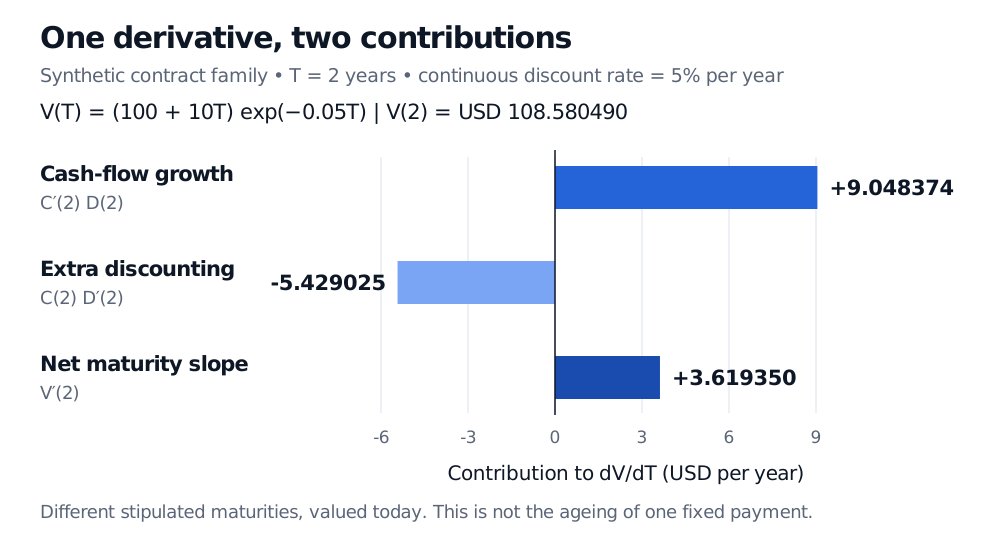
At maturity two years, payment growth contributes plus USD 9.048374 per year, extra discounting contributes minus USD 5.429025 per year, and their sum is plus USD 3.619350 per year. Present value is USD 108.580490.
Original synthetic contract family, valued today at a fixed 5% continuously compounded annual rate. The bars decompose the maturity derivative, in USD per year; they are not cash flows.
The positive slope means that near a two-year maturity, increasing stipulated maturity slightly raises today's value within this family. It does not mean that discounting raises value: that component is negative. Nor does it mean longer always means more valuable. Here the two effects balance at T=10 years; beyond that, V′(T)<0 despite the increasing payment.
Specify what changes before differentiating
Comparing this family changes both the contractual amount and its payment date. It is different from waiting while holding one existing contract paying a fixed USD 120. For the latter, the amount stays constant as remaining time falls, so there is no payment-growth term. The positive V′(2) above should therefore not be read as a calendar-time gain or an option's theta.
A useful working habit is to name the differentiation variable, write each factor as a function of it, and list what is held fixed. Then write both product-rule terms before simplifying. For further derivations and examples, see the product-rule section of The Product Rule, Quotient Rule, and Derivatives of Trigonometric Functions. The full lesson requires membership; its public page provides a preview.
Sources
James Stewart, Single Variable Calculus: Early Transcendentals, 6th edition, Thomson Brooks/Cole, 2008, §3.2, “The Product and Quotient Rules,” and §3.4, “The Chain Rule.”
John C. Hull, Options, Futures, and Other Derivatives, 9th Global Edition, Pearson, 2018, §4.2, “Measuring Interest Rates,” subsection “Continuous Compounding.”