Private equity performance multiples: TVPI DPI and RVPI
Reconcile private equity distributions and residual NAV to paid-in capital, then compare net fund TVPI with deal MOIC and a dated public benchmark.
Private equity performance multiples: TVPI DPI and RVPI
Private equity performance multiples express the value a fund has distributed, still holds, or both, per dollar of paid-in capital. DPI is distributions to paid-in capital, RVPI is residual value to paid-in capital, and TVPI is total value to paid-in capital. The split matters to a limited partner (LP) deciding how much of a fund’s reported value has actually come back. GIPS Standards Handbook for Firms, Provision 7.A.4
One denominator, two sources of value
At the reporting cutoff, let P be capital contributed since inception, D be distributions since inception, and V be the LP’s share of the remaining net asset value (NAV). Use the same investor scope, currency and cutoff for all three. With positive paid-in capital, the reconciliation is
DPI=PD,RVPI=PV,TVPI=PD+V=DPI+RVPI.
Paid-in capital comes from contributions. An unfunded capital commitment is still a promise to fund future calls. Distributions can include securities paid out in kind. Under the GIPS convention, a recallable distribution counts when paid out, and the amount drawn again counts as another contribution. GIPS Standards Handbook for Firms, Provision 7.A.4
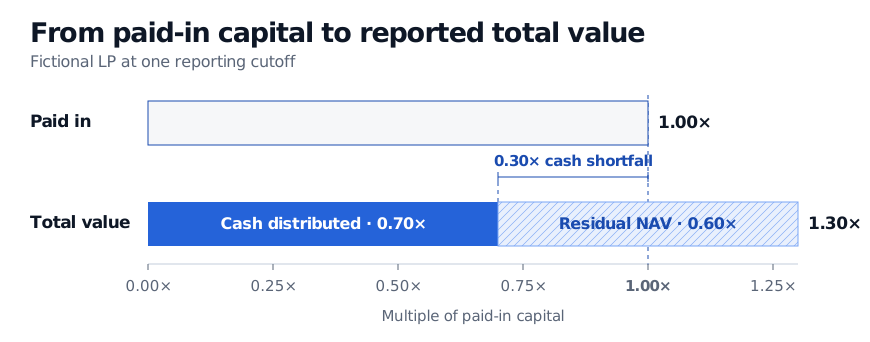
A fictional LP has paid in 100 USD, received 70 USD in cash and has 60 USD of remaining NAV. That gives 0.70× DPI, 0.60× RVPI and 1.30× TVPI. The LP is still 30 USD short of recovering its contributions in cash. If the manager marks NAV down from 60 to 40 USD with no new cash flows, TVPI drops to 1.10× and DPI stays at 0.70×.
Fictional LP paid in 1.00 times capital. The value bar stacks 0.70 times cash distributed and 0.60 times residual NAV to reach 1.30 times. Cash distributed falls 0.30 times short of paid-in capital.
The cash shortfall is visible at the paid-in line. Reported total value clears it only because residual NAV contributes to TVPI.
What sits behind the headline multiple?
Check whose cash flows went in. Net fund TVPI uses the LP-side ledger. Paid-in capital includes contributions for fees and expenses, and the distributions and NAV reflect the LP’s position after fund costs and carried interest. Gross deal MOIC (multiple of invested capital) uses the fund’s investment in the deal, proceeds received and any value it still holds, before fund-level fees and carry. MOIC can also label a fund-level multiple, so check the cash-flow and fee basis and whether the figures include the effects of a subscription credit line. ILPA Performance Template Definitions, pp. 8–10
Suppose the same LP contributed 100 USD when a USD total-return index was at 100, received the 70 USD at index level 110 and reached the cutoff at index level 120. At the cutoff the indexed contribution is worth 120 USD, and the indexed distribution is worth about 76.36 USD. Add the 60 USD of ending NAV to the indexed distribution and divide by the indexed contribution to get about 1.14× KS-PME. Moving the distribution to the cutoff while holding NAV fixed gives (70+60)/120≈1.08 instead. TVPI stays 1.30× in both cases.