A subscription credit line is a typically short-term, revolving loan facility that a private fund secures with the uncalled capital commitments of its limited partners (LPs). The fund can draw on the line to close a deal or pay expenses before it collects investor cash. A later capital call can repay the lender. That delay changes the dates used to calculate the LP’s internal rate of return (IRR). ILPA Principles 3.0, definitions of bridge financing and subscription lines of credit
The collateral is the fund’s right to call capital against those commitments. The loan documents can give the lender rights to call capital on default. A NAV-based facility draws its backing from the fund’s existing portfolio investments and their proceeds. A subscription line can therefore fund a purchase before the fund has much of a portfolio. ILPA Principles 3.0 · ILPA NAV-Based Facilities Guidance, overview
One exit, two funding dates
A fictional fund buys an asset for 100 USD at year 0 and sells it for 120 USD at year 2. With direct funding, the LP contributes 100 USD at purchase. With the line, the fund borrows 100 USD at purchase, then calls 102 USD at year 1 to repay principal and 2 USD of financing cost. In both cases the LP receives the full 120 USD at exit. There are no other cash flows, fees, taxes or carried interest.
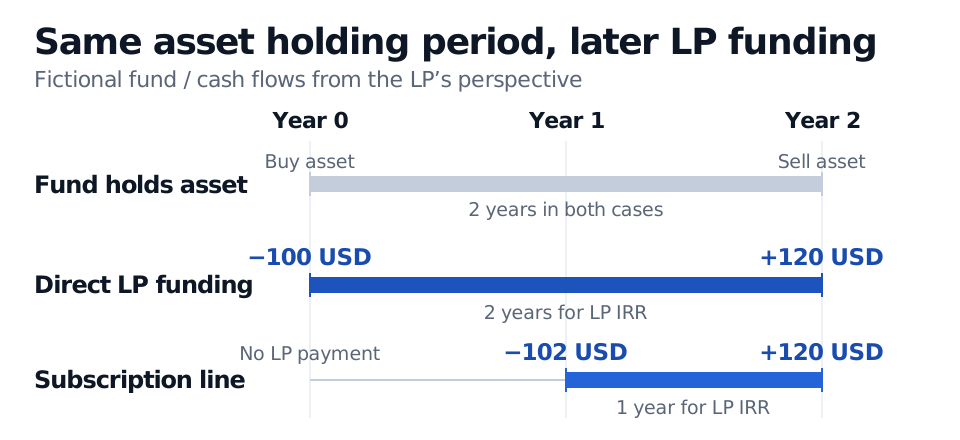
The two-year investment is the same. Borrowing cuts the time between the LP’s payment and distribution from two years to one.
The LP earns 20 USD in nominal cash profit with direct funding and 18 USD with the line. With a single contribution and a single distribution in each case, the annual effective IRRs are
The shorter interval raises IRR in this example despite the financing cost. With enough interest or a weaker exit, the line can lower the IRR. For the LP’s overall result, the return on cash reserved for the later call also matters.
Reading the two reported returns
The Institutional Limited Partners Association (ILPA) recommends its current Performance Template for funds starting operations on or after 1 January 2026. It shows net IRR and total value to paid-in capital (TVPI) with and without the impact of fund-level subscription facilities. The “with” IRR uses actual fund-to-investor cash flows. The “without” calculation also includes lender flows. It places a synthetic contribution on the draw date and offsets the later repayment of principal against the corresponding call. In the example, direct funding avoids the 2 USD charge. In a report, the adjustment to principal and timing is separate from the treatment of interest and fees. ILPA Performance Template · ILPA Template FAQ v1.1, pp. 12–13 · ILPA Granular Methodology, pp. 9–10
The return figures answer a different question from when the next call is due. A fund can use the line to combine several investment calls into one payment. For an LP with several funds, those larger calls can cluster as facilities mature. ILPA’s subscription-line disclosure guidance calls for the outstanding balance, typical time each draw is outstanding and the portion of each LP’s unfunded commitment financed through the line. ILPA Subscription Line Disclosure Guidance, pp. 3–6
Sources
- ILPA Principles 3.0, June 2019. Definitions of bridge financing, capital calls and subscription lines.
- ILPA NAV-Based Facilities Guidance, July 2024. How the collateral bases differ.
- ILPA Performance Template. Current versions and recommended implementation timeline.
- ILPA Performance Template Suggested Guidance, Granular Methodology v1.1. Fund-level metrics and transaction mapping.
- ILPA Template FAQ v1.1, April 2025. How subscription drawdowns and repayments enter the adjusted return.
- ILPA Subscription Line Disclosure Guidance, June 2020. LP liquidity, reporting and the effect of delayed calls.