In a private equity fund structured as a limited partnership, the general partner (GP) is the partner with authority to run the fund under the limited partnership agreement (LPA). A limited partner (LP) typically commits capital as an investor and receives distributions under that agreement. The distinction matters for cash planning. The LP promises capital up front and keeps cash available for future capital calls, which the GP can issue for the purposes and within the limits set by the LPA. ILPA model agreement, Articles 3, 4 and 6
Who can act for the fund?
The GP can be a legal entity, such as an LLC. An affiliated investment manager may handle investment work such as sourcing deals and managing the portfolio under a separate management agreement. For example, Delaware law generally allows the GP to delegate management powers unless the LPA provides otherwise. The GP and manager can share a brand while acting in different legal capacities. Delaware Code, §§ 17-402 and 17-403
LPs generally stay out of day-to-day investment decisions. They may have voting rights on specified matters, such as removing the GP. The limited partner advisory committee (LPAC) is a separate group of investor representatives that can review conflicts or give consent when the LPA requires it. For instance, the Institutional Limited Partners Association’s model LPA calls for committee consent before the fund knowingly enters a transaction involving a covered conflict. Delaware law treats serving on a committee and exercising certain consent rights as distinct from participating in control for purposes of its LP liability rule. The rights themselves come from the fund documents or another legal basis. ILPA model agreement, §§ 9.5, 10.1 and 13.2 · Delaware Code, § 17-303
The GP can issue a call and pay part of it
Consider a fictional fund with one LP committed for 99 USD and a GP committed for 1 USD. Neither has paid anything yet. The LPA in this example splits the first investment call of 20 USD in proportion to commitments, with no exceptions, fees or other adjustments. Each partner funds 20 cents for every dollar committed. The LP pays 19.80 USD and the GP pays 0.20 USD. The GP issues the call in its governance role and contributes in its capacity as an investor.
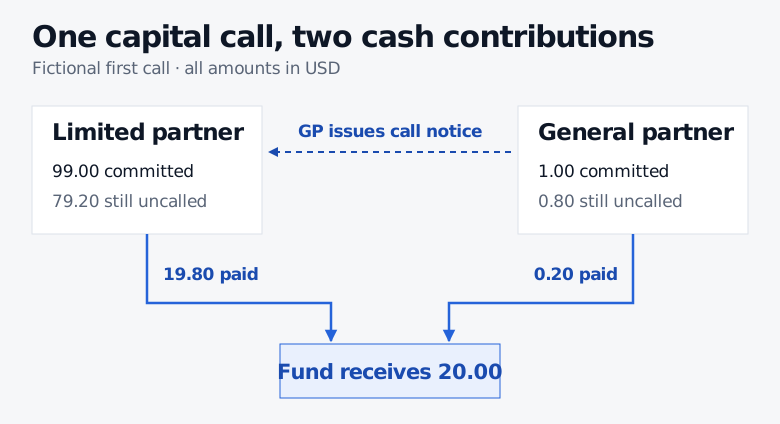
The notice goes to the LP. Both contributions go to the fund. The uncalled amounts remain available for future draws under the stipulated terms.
A GP commitment puts the GP’s or its affiliates’ own capital at risk and gives them an investment interest on the terms of that commitment. A management fee compensates the manager for its services and can accrue even when the fund has yet to realise any profits. Carried interest is a share of profits allocated to a sponsor entity under the distribution waterfall. To model the LP’s net cash flows, track amounts paid on calls and received in distributions. Use the fee provisions and the waterfall to determine the charges and how much of the exit proceeds the LP actually receives. ILPA model agreement, §§ 4.2, 6.2, 8.3 and 14.3
Sources
- ILPA Model Limited Partnership Agreement (Whole-of-Fund Waterfall), July 2020. Model provisions for governance, commitments, drawdowns, fees, conflicts, removal, advisory committee rights and distributions.
- Delaware Revised Uniform Limited Partnership Act, Subchapter III. Section 17-303 on liability to third parties and enumerated LP activities.
- Delaware Revised Uniform Limited Partnership Act, Subchapter IV. Sections 17-402 through 17-404 on GP entities, powers, delegation and contributions.