Carried interest, or carry, is the share of investment profits that a private fund’s sponsor is entitled to under the fund agreement, typically through the general partner (GP). A distribution waterfall sets the order in which available proceeds are paid to the limited partners (LPs) and the GP. The carry percentage alone tells you little about the cash from a particular exit. The waterfall determines how much cash reaches the carry tier and when. A recurring management fee has its own calculation and payment terms. ILPA whole-of-fund model LPA, §§ 8.3 and 14.3
Allocate one distribution
Suppose a fictional fund has 150 cash units available for a single distribution between one LP and the GP. The LP has 100 units of contributed capital still to recover and 8 units of accrued, unpaid preferred return. The example takes both balances as given. The agreement in this example returns capital first, pays the preference second, then splits any remaining cash 80% to the LP and 20% to the GP. It has no catch-up tier.
| Tier | Paid to LP | Paid to GP | Cash left |
|---|---|---|---|
| Return capital | 100 | 0 | 50 |
| Pay preferred return | 8 | 0 | 42 |
| Split the residual | 33.6 | 8.4 | 0 |
| Total paid | 141.6 | 8.4 |
Here the 20% carry applies to the 42 units left after both LP tiers are paid. With the balances fixed and units of cash available, the GP receives
With 105 units available, the LP receives all 105, including 5 units toward the preference. Even at 108, there is zero carry. Only cash above 108 reaches the residual split.
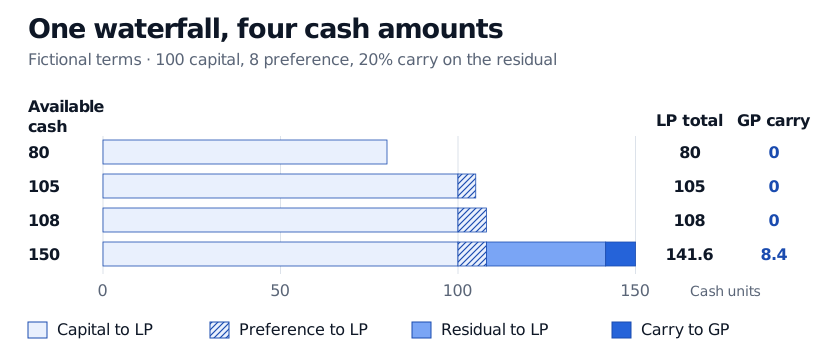
The four bars hold the LP balances fixed and vary the cash available. Capital and preference absorb the first 108 units before the residual is split.
The 8 units in this example are a cash balance. A quoted hurdle rate requires an accrual convention before it yields an amount. For example, the ILPA whole-of-fund model defines a capital base, start and stop dates, daily calculation and annual compounding. ILPA whole-of-fund model LPA, definition of preferred return
When can a profitable exit pay carry?
In a whole-fund waterfall, an exit is tested against fund-wide balances. The ILPA whole-of-fund model requires the LP to recover its aggregate contributions and preferred return before carry. A successful sale can therefore fund LP repayments while carry waits. ILPA whole-of-fund model LPA, § 14.3
In a deal-by-deal waterfall, a profitable sale can trigger carry sooner. Which costs and losses the sale proceeds must cover still depends on the agreement. The ILPA deal-by-deal model includes the costs of the current and previously realised investments, specified unrealised losses, and contributed amounts used for fund expenses in its capital-return tier. Earlier carry can change the LP’s dated cash flows and its internal rate of return. ILPA deal-by-deal model LPA, § 14.3
A GP catch-up changes the split just after the preference is paid. The ILPA whole-of-fund model directs a larger share of that tier to the GP until the GP has received its target share of the combined preference and catch-up distributions. The waterfall then switches to the residual split. A clawback is a later check. If subsequent losses leave the GP with more cumulative carry than the agreement permits, it can require the GP to return an amount under the contract’s calculation and limits. The ILPA deal-by-deal model provides for both final and specified interim checks. ILPA whole-of-fund model LPA, § 14.3.3 · ILPA deal-by-deal model LPA, § 14.7