Private credit is privately negotiated lending to businesses by nonbank investment vehicles such as private debt funds and business development companies. Direct lending is a private credit strategy in which one lender or a small group negotiates and originates a corporate loan directly with the borrower and typically holds the loan. Private credit also includes strategies such as asset-based lending and private real estate debt. A direct lender can earn more contractual interest when the loan’s benchmark rises, even as the borrower becomes less able to service the debt. Federal Reserve, Introducing Private Credit, §§2 and 4, Federal Reserve, Private Credit and Leveraged Loan Markets
From negotiation to monitoring
Before funding the loan, the lender models the borrower’s ability to pay interest and principal under weaker operating conditions. The parties negotiate the rate, repayment schedule, collateral and covenants. A direct loan can use a unitranche structure. After closing, the lender reviews the borrower’s results and checks any maintenance covenants on the agreed dates. A failed test can bring the parties back to the table while payments are still current. The agreement determines what rights the lenders have at that point. Carlyle Secured Lending, Form 10-K, Items 1 and 1A
Same spread, less headroom
Suppose a fictional borrower owes USD 10 million on a floating-rate direct loan. At the first reset, the benchmark is 4% and the fixed contractual spread is 5 percentage points. With no floor or fees, the nominal annual rate for that interest period is
The agreement uses simple Actual/360 accrual and pays all interest in cash. For a 90-day period with principal unchanged, cash interest is USD 10 million times 9% times 90/360, or USD 225,000. At the next reset the benchmark is 5%, so the rate is 10% and interest is USD 250,000 for another 90-day period.
Assume this is the borrower’s only debt and its agreement requires quarterly interest coverage of at least 1.40×, defined here as quarterly EBITDA divided by cash interest. With EBITDA unchanged at USD 337,500, coverage falls from 1.50× to 1.35×. The higher coupon is due under the agreement, and the borrower falls below the threshold without any drop in EBITDA. For an actual loan, use the covenant’s own definitions and testing period.
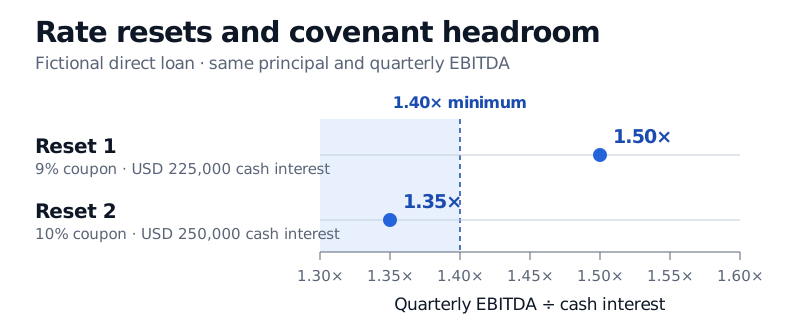
The same spread and EBITDA produce different covenant outcomes once the benchmark resets.
What the lender can earn and what the loan is worth
The reset rate sets contractual interest for one period. A lender’s realised return depends on its entry price, fees it receives and the timing and amount of the cash it collects, including any prepayment or recovery after default. If the agreement allows payment-in-kind interest, that interest can increase principal while producing no cash for the lender in the period. Carlyle Secured Lending, Form 10-K, Items 1A and 8
Banks typically distribute broadly syndicated leveraged loans to many investors. Those loans usually have a more active secondary market than direct loans. A direct lender may need time to find a buyer, and a model-based mark gives no assurance of the price available on a sale. With few trades to observe, a valuation may discount projected payments using comparable market yields and assess recoveries if repayment is in doubt. The loan’s value can fall when expected collections deteriorate or comparable yields rise, even while the borrower still pays the higher coupon. Federal Reserve, Private Credit and Leveraged Loan Markets, Table 1, Carlyle Secured Lending, Form 10-K, Item 8, Note 3