How one borrower-facing loan combines senior and junior financing while lender agreements can split interest and recovery.
Unitranche debt
Unitranche debt combines senior and subordinated financing in a single borrower-facing loan facility, typically secured by a first lien. In the classic structure, the borrower negotiates one set of loan terms and pays one blended rate. The lenders can agree to different rates and payment priorities. A credit model therefore uses the blended rate for the borrower’s interest expense and the lender-specific terms for each position’s cash flows and recovery. BC Partners Lending, 2025 Form 10-K, Item 1A, Sixth Street Specialty Lending, 2025 Form 10-K, Item 1
Which agreement sets which terms?
The credit agreement sets what the borrower owes, when payments are due and which financial covenants apply. A separate agreement among lenders (AAL), where used, can specify how lenders divide interest, which events change the order of distributions, and who can direct remedies or approve changes. When the agreed priority rules apply, first-out lenders receive the covered proceeds before last-out lenders. One first lien can secure the facility even when the lenders have different payment priorities among themselves. That differs from raising a first-lien loan alongside a separate mezzanine facility, which gives the borrower a second set of debt terms. Sixth Street Specialty Lending, 2025 Form 10-K, Item 1, Filed intercreditor provisions, §§2–4
A fictional borrower draws USD 100 million at a fixed annual rate of 8%. The full principal stays outstanding for one year. Assume simple interest, full cash payment and zero fees. The borrower pays USD 8 million of interest. The AAL stipulates these allocations, with amounts in USD millions.
Lender position
Principal funded
Annual rate on its share
Cash interest received
First-out
60
6%
3.6
Last-out
40
11%
4.4
Total
100
8% blended
8.0
The split reconciles to the borrower’s bill because the blend weights each rate by principal.
10060(6%)+40(11%)=1003.6+4.4=8%.
The last-out lender earns more contractual interest on a smaller position. The higher rate comes with greater exposure to a shortfall if the priority rules take effect.
What changes when the waterfall applies?
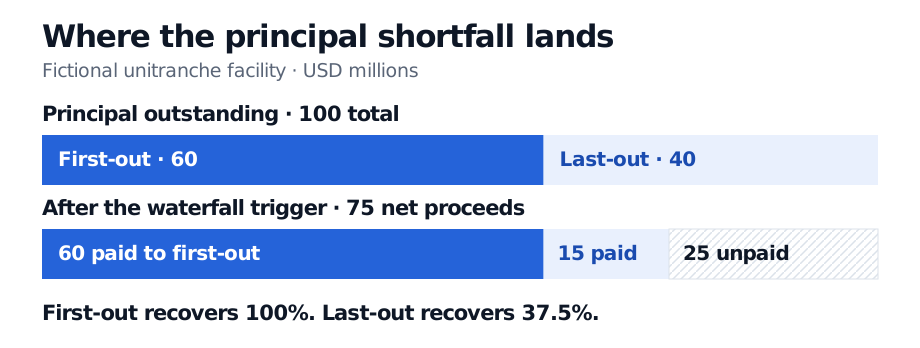
Suppose that, just after the year’s interest is paid, the borrower fails to repay principal when due. Assume that this event activates the fictional AAL’s payment waterfall, USD 75 million of net proceeds are available to this facility, and principal is all that remains due. First-out receives its full USD 60 million. Last-out receives the remaining USD 15 million against its USD 40 million claim. The facility recovers 75% of principal overall, but the last-out position recovers 37.5% and bears the entire USD 25 million shortfall.
Fictional unitranche facility with USD 100 million of principal. Of USD 75 million in net proceeds, first-out receives USD 60 million on USD 60 million of principal. Last-out receives USD 15 million on USD 40 million, leaving USD 25 million unpaid.
Once the stipulated waterfall applies, the first-out claim is filled before the remaining proceeds go to last-out.
For a lender estimating recovery, the relevant inputs are the proceeds available to the facility, which payments the priority rules cover, and which event activates those rules. The borrower’s first lien describes the facility’s claim on collateral. The AAL describes how the relevant proceeds are divided within the lender group. Separate provisions can govern who directs enforcement and whose consent is needed. Sixth Street Specialty Lending, 2025 Form 10-K, Items 1 and 1A, Filed intercreditor provisions, §§2–4