Mezzanine debt is borrowing that ranks below senior debt and ahead of equity in the capital structure. A payment-in-kind (PIK) note pays some or all of its interest by adding to outstanding principal or issuing additional notes. Mezzanine describes the priority of the claim. PIK describes how the interest is paid. In a leveraged buyout, the two can be combined to fill a financing gap while preserving cash for operations or senior debt service. The trade-off is a larger debt balance to repay or refinance. Federal Reserve glossary, “Mezzanine Financing”
How the junior claim arises
Contractual subordination makes a debt claim junior to specified obligations under agreed terms. A junior lien can separately put a lender behind the senior lien on the same collateral. Structural subordination comes from which entity owes the money. A parent-only lender relying on the parent's equity stake in an operating subsidiary has access to the residual value after the subsidiary's own creditors are paid. A subsidiary guarantee can give that lender a direct claim under its terms. Check the obligors, guarantees and intercreditor agreement before estimating recovery. The junior position typically commands a higher promised return, sometimes including warrants or a conversion right if the deal provides for one. Federal Reserve data dictionary, Evergy prospectus supplement, “Ranking” and “Subordination”, Federal Reserve glossary
Two years of 8% PIK
A fictional borrower issues a two-year note at par for USD 100. It capitalises the entire 8% coupon annually, with zero fees and no cash payments before maturity. The first coupon adds USD 8 to principal. The second is USD 8.64 because it includes USD 0.64 of interest on that first USD 8.
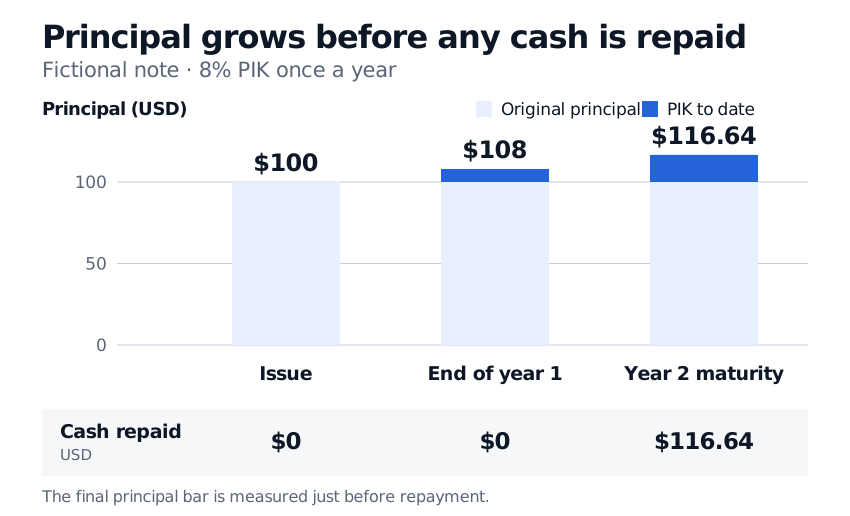
Each PIK coupon increases the principal the borrower must repay at maturity.
The borrower owes a single cash payment of USD 116.64 at maturity. If paid in full, that schedule gives an annual internal rate of return of 8% on the original USD 100. For the debt model, track cash interest for near-term liquidity, then carry capitalised interest into the balance used for leverage and refinancing. A larger claim still depends on the borrower's ability to pay and its priority if the borrower defaults.
What the toggle actually lets the issuer do
A PIK toggle gives the issuer a choice under the contract. Some notes require PIK for a period, while a toggle can allow cash, PIK or a mix, subject to its terms. Stem's June 2025 indenture is an example of a senior secured toggle. It specified annual rates of 11% in cash and 12% in kind, payable semiannually. The issuer had to give notice at least five business days before the record date. Without timely notice, interest was payable in cash. The issuer could elect PIK only to the extent total note principal would stay at or below USD 160 million. Interest beyond that limit was payable in cash. Additional PIK notes shared the stated 2030 maturity or the same earlier date if a springing maturity trigger applied. Stem indenture, §2.14 and Exhibit A
The stated coupon rate and the issuer's accounting effective interest rate can also differ. Stem's 2025 accounts reported a 17.2% effective interest rate at issuance for the secured notes. Its interest expense included amortisation of debt discount and issuance costs alongside contractual interest. Stem 2025 Form 10-K, Note 11
For a longer calculation, try Exercise 3 in Credit-Sensitive Bonds. The full exercise and solution require membership.