A leveraged loan is a corporate loan to a borrower with elevated credit risk, typically a below-investment-grade borrower in U.S. syndicated loan-market usage. A syndicated loan is a loan that several lenders extend to one borrower under a common credit agreement. Syndication describes who provides the financing. Leveraged describes the credit segment. Investment-grade companies can also borrow through syndicates. For a credit analyst, the distinction separates the borrower’s ability to repay from the amount of that exposure each lender holds. LSTA, U.S. corporate loan market background
One borrower, several lenders
The borrower requests the loan and owes principal and interest. The lead arranger structures the deal with the borrower and assembles the lender group. The administrative agent handles servicing under the agreement, including processing draw requests, maintaining the lender register and routing payments to lenders. An institution can serve in more than one capacity. In QXO Building Products’ July 2026 amendment, the cover names Goldman Sachs Bank USA as administrative agent and lists a separate group of joint lead arrangers for the incremental term loan. LSTA market background, QXO credit agreement amendment, cover and §§2–3, and amended agreement §§2.18 and 9.04
Suppose a fictional borrower draws its full USD 100 million term facility at par. Lenders A, B and C fund USD 40 million, USD 35 million and USD 25 million, respectively. The borrower receives USD 100 million before fees and owes USD 100 million of principal. Assume all three lenders are in the same tranche and scheduled principal payments are pro rata. Their claims differ in size and have the same rank under these assumptions. Each lender is exposed to the same borrower.
The initial allocation funds the loan in the primary market. Once outstanding, a share can trade in the secondary market. Banks can retain some of a deal while distributing institutional term-loan shares to funds and collateralised loan obligations. Some initial allocations settle by assignment after closing, so an assignment can be part of primary distribution. Federal Reserve Bank of New York, Do Lead Arrangers Retain Their Lead Shares?, §2.2, Federal Reserve, Private Credit and Leveraged Loan Markets
An undrawn revolving commitment is a promise to lend subject to the agreement. It becomes funded principal to the extent the borrower draws it. The Federal Reserve’s syndicated-loan portfolio tables track term loans, drawn credit lines and undrawn commitments separately. Federal Reserve, Syndicated Loan Portfolios
Who holds the claim after a sale?
Consider two separate ways for A to transfer the economics of USD 10 million of its loan to investor D. Assume the transfer is permitted, completed before any repayments and covers the principal and related interest on that slice.
- Assignment. D takes over the assigned lender rights and obligations. When the assignment becomes effective under the agreement, the agent’s register shows A at USD 30 million and D at USD 10 million. QXO’s agreement, for example, requires recording in the register and sets out eligibility, consent and documentation conditions. QXO amended credit agreement, §9.04(b) and (d)
- Participation. A remains the lender of record for USD 40 million. D is entitled to its share of the loan cash flows under a separate contract with A, so D relies on A to pass the payments through. In QXO’s agreement, A would remain responsible to the borrower and the agent, and would retain direct enforcement rights. The participation contract can give D consent rights over certain decisions by A. QXO amended credit agreement, §9.04(b) and (d)
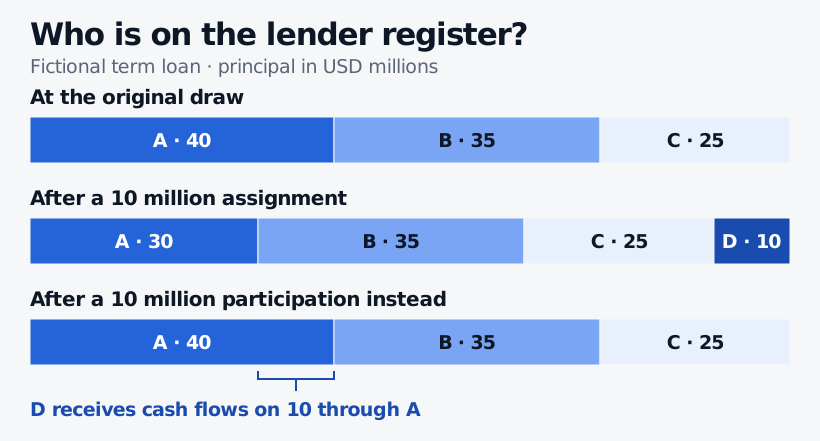
Each row shows the lender register for the same USD 100 million loan. Only the assignment gives D its own entry.
If D buys the assignment at 97 per 100 of face value, it pays A USD 9.7 million for the USD 10 million principal claim, ignoring accrued interest and settlement adjustments. The borrower receives no sale proceeds and still owes USD 100 million across the syndicate. A portfolio analyst therefore tracks purchase price, contractual principal and lender-of-record exposure separately.
How leverage, interest and index eligibility fit together
Borrower leverage. Debt divided by EBITDA is one way to compare debt with earnings. Check the numerator and the EBITDA definition before comparing multiples. In the QXO agreement, net total leverage starts from defined consolidated debt, while net first-lien leverage starts from specified first-lien debt. Both measures apply contractual exclusions and subtract qualifying cash and investments before dividing by defined EBITDA. QXO uses these distinct measures in different tests for taking on additional debt. The same company can have several leverage figures, each answering a different covenant question. QXO amended credit agreement, §§1.01 and 6.01(q)–(s)
Contractual interest. For QXO’s Term Benchmark borrowings, interest is Term SOFR plus the contractual margin, with a floor applied to the benchmark as defined in the agreement. When the benchmark resets, cash interest can rise even if the contractual margin stays fixed. An investor’s return also depends on the price paid and the timing and amount of payments received. QXO amended credit agreement, §§1.01 and 2.13
Index coverage. The March 2026 methodology for the Morningstar LSTA US Leveraged Loan Index screens for USD-denominated senior secured loans syndicated in the U.S. from its institutional term-loan universe. Its eligibility tests include a minimum initial spread of 125 basis points over the base rate, a minimum initial issue size of USD 50 million and an initial term of at least one year. The index weights loans by market value at rebalancing and uses average bid marks for daily pricing. The spread threshold is an index inclusion rule. To compare the index with a loan book, first check whether the book contains facilities the index screens out, such as undrawn revolvers. Morningstar, Leveraged Loan Indexes Methodology, pp. 5–7
Sources
- LSTA, U.S. corporate loan market background, comment letter §I
- Federal Reserve, Syndicated Loan Portfolios of Financial Institutions
- Federal Reserve, Private Credit and Leveraged Loan Markets
- Federal Reserve Bank of New York, Do Lead Arrangers Retain Their Lead Shares?
- QXO Building Products, Incremental Assumption and Amendment Agreement No. 2 and amended credit agreement, 1 July 2026
- Morningstar Leveraged Loan Indexes Methodology, March 2026