A payment-in-kind (PIK) note pays some or all of its contractual interest with more debt. For the PIK portion of the coupon, the issuer increases outstanding principal or issues additional notes, as specified in the indenture. This settles that period’s PIK interest when done on the terms the note requires. That preserves cash on the coupon date and leaves more debt to repay or refinance. A PIK toggle note gives the issuer a choice between cash and PIK where the contract permits it. CKE Holdings indenture, §4.01 and Exhibit A
What the investor receives
Consider two fictional two-year notes, each issued at par for USD 100, with 10% annual interest on opening principal, no fees or interim principal repayments, and full repayment at maturity. One capitalises all interest at both year ends, immediately before repayment in year two. The other pays both coupons in cash.
The PIK note adds USD 10 to principal at the end of year one. Its second coupon is USD 11 because the rate applies to the new USD 110 balance. The final principal is therefore . The cash-pay note pays USD 10 at each year end and repays USD 100 at maturity.
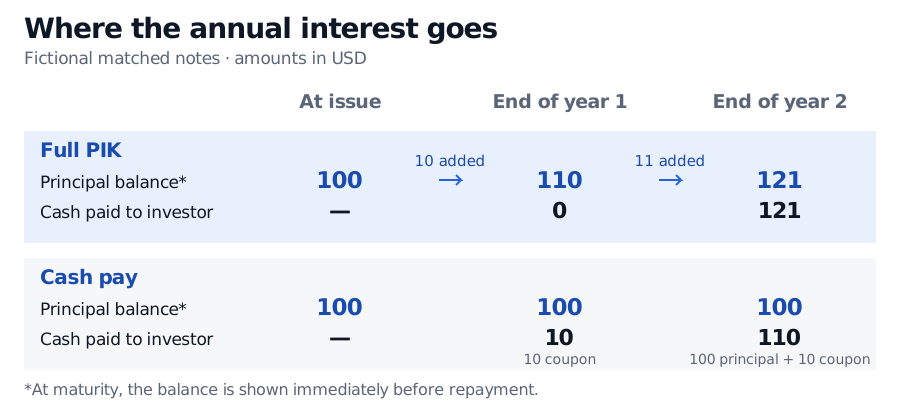
The cash-pay note distributes the first coupon. The PIK note carries it into the balance that earns interest in year two.
At the issue price both schedules have a 10% annual yield to maturity. The PIK borrower retains USD 10 in year one and needs USD 11 more cash at maturity. The extra dollar is year-two interest on the first year's capitalised coupon.
The election depends on the indenture
Some notes require PIK for specified periods. Where a toggle is available, the indenture sets the election deadline, the outcome if the issuer gives no notice, and any periods or amounts that must be paid in cash. CKE Holdings' 2011 indenture required the first payment to be PIK. It then allowed cash, PIK or specified mixes, with notice to the trustee before the interest period and PIK applying if the issuer made no election. The annual rate was 10.50% on the cash portion and 11.25% on the PIK portion. CKE Holdings indenture, Exhibit A
Track income and cash separately
An investor can recognise PIK interest income before collecting cash. Barings BDC, for example, describes recording contractual PIK as interest income while it is added to loan principal. Its policy generally stops recognising PIK on a loan placed on non-accrual and writes off uncollected accrued PIK it deems uncollectible. Barings BDC Form 10-Q, “Payment-in-Kind Income”
In a credit model, separate the cash available to service debt today from the balance that must be paid at maturity. If the borrower defaults, recovery depends on the value available and the claim's priority. The PIK provision governs the form of interest, while the note's ranking and collateral terms govern where it sits among creditors. Mezzanine debt and PIK note
For a three-year calculation with a worked solution, see Exercise 3 in the SelfMadeQuant lesson on credit-sensitive bonds. The full exercise requires membership.