A positive definite matrix gives a strictly positive quadratic form in every nonzero direction. Test covariance risk, distinguish singular PSD matrices, and understand the numerical limits.
Positive definite matrix
A positive definite matrix is a real symmetric matrixA whose quadratic form is strictly positive in every nonzero direction:
x⊤Ax>0for every x∈Rn∖{0}.
For a portfolio covariance matrix, this means every nonzero exposure vector has positive return variance. There is no exact zero-variance combination hiding among the assets. The zero vector is deliberately excluded: its quadratic form is always zero.
This article uses the real symmetric convention, also called symmetric positive definite or SPD. For an arbitrary real matrix, the quadratic form depends only on its symmetric part (A+A⊤)/2. Consequently, the eigenvalue tests below must not be applied to a nonsymmetric matrix without their symmetry assumption.
A risk matrix with no flat direction
A risk desk proposes the following synthetic covariance for two assets' one-year simple returns, measured in decimals:
Σ=(0.040.010.010.09).
The diagonal entries imply one-year volatilities of 20% and 30%. For exposure vector x=(x1,x2)⊤, its return variance is
This completed square proves strict positivity for all nonzero exposures. If x2=0, the second term is positive; if x2=0 and x1=0, the first is positive. Checking only a few portfolios would not establish the definition.
For a fully invested 60/40 portfolio, variance is 0.0336 decimal-return-squared and volatility is 0.0336≈18.33%. Even the offsetting exposure (1,−1)⊤ retains variance 0.04−0.02+0.09=0.11. Positive definiteness tests every direction, including positions with short exposure and weights that do not sum to one.
Three equivalent certificates
For a real symmetric matrix, any of these establishes positive definiteness:
Every leading principal minor is strictly positive: the determinants of the top-left 1×1,2×2,…,n×n submatrices.
Cholesky
A=LL⊤, where L is lower triangular with strictly positive diagonal entries.
For the risk matrix, the leading minors are 0.04>0 and detΣ=0.04(0.09)−0.012=0.0035>0. Its eigenvalues are
λmin=20013−29≈0.0381,λmax=20013+29≈0.0919.
Why do eigenvalues settle every direction? Write A=QΛQ⊤ with orthonormal eigenvectors and set c=Q⊤x. Then x⊤Ax=∑iλici2. Every nonzero vector has a nonzero coefficient, so positive eigenvalues force a positive sum. Among unit-length vectors, the smallest quadratic form equals the smallest eigenvalue.
A positive determinant alone is insufficient: −I2 has determinant +1 and is negative definite. Positive entries are insufficient too:
(1221)
gives −2 along (1,−1)⊤ and cannot be a covariance matrix.
Covariance needs PSD; PD is the stronger condition
This assumes the return vector has finite second moments. PD additionally requires that no nonzero linear combination of the centred returns is zero almost surely. Individual assets having positive variance is not enough.
Suppose two assets have identical uncertain returns, each with variance 0.04. Their covariance is
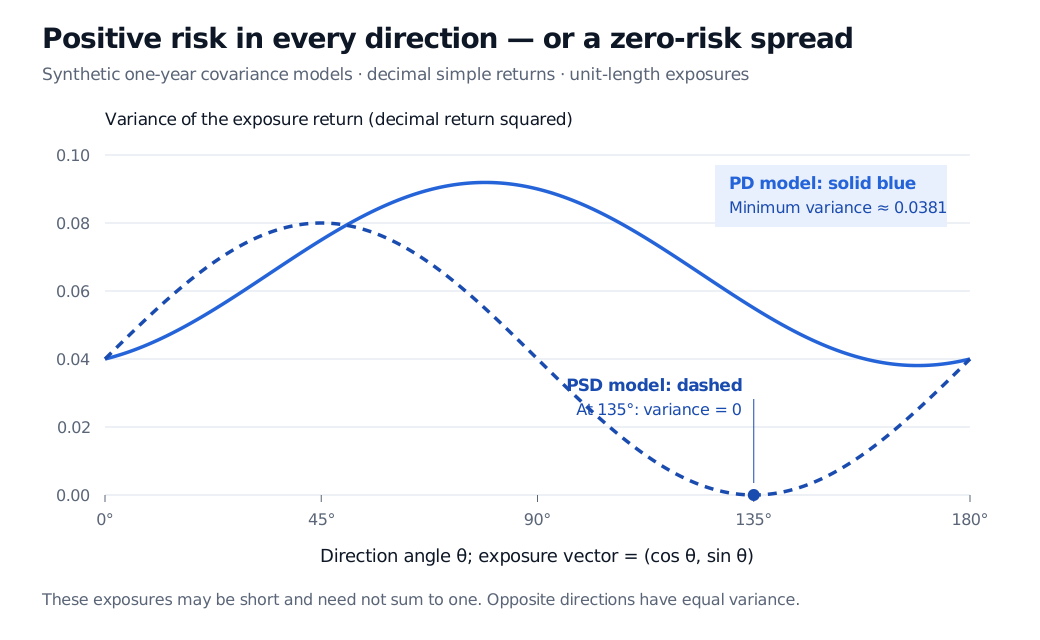
Σ0=(0.040.040.040.04),x⊤Σ0x=0.04(x1+x2)2.
Its eigenvalues are 0.08 and zero. The spread (1,−1)⊤ has zero variance: it cancels the same source of uncertainty. This is a valid singular covariance, although it is not PD. Zero variance means a deterministic return combination under the model; it does not establish a profitable, executable arbitrage.
Variance across unit-length two-asset exposures for synthetic one-year decimal-return covariance matrices. The positive definite matrix with rows 0.04, 0.01 and 0.01, 0.09 has variance at least 0.0381 approximately. The singular positive semidefinite matrix with every entry 0.04 reaches zero at 135 degrees, the offsetting long-short direction.
Original synthetic covariance comparison. Exposures are (cos θ, sin θ), with squared length one, and may include short positions; they are not constrained to sum to one. The solid curve stays positive; the dashed curve touches zero.
Do not turn Sylvester's PD test into a PSD test by simply replacing >0 with ≥0 on the leading minors. For example, diag(0,−1) has both leading minors zero but is not PSD. The corresponding PSD criterion requires all principal minors to be nonnegative, as explained in Parrilo's MIT notes, §6. A principal minor selects the same index set of rows and columns; it need not start at the top-left corner.
What the condition buys a quant
PD guarantees that the matrix inverse exists and that an unconstrained positive quadratic risk objective is strictly convex. On a nonempty closed convex feasible set, a PD quadratic risk objective has a unique minimiser. PSD objectives can also have a unique constrained minimum; full-space PD is sufficient, rather than necessary, because constraints can remove flat directions.
Cholesky decomposition provides efficient solves and a factor for correlated simulation. A singular PSD matrix can still be simulated using an eigenvalue factor with zero modes. An unpivoted Cholesky routine requiring positive diagonal entries will not accept that singular case.
Finally, PD is not a guarantee of numerical stability. A tiny positive eigenvalue produces a large condition number and potentially sensitive inverse-based weights. Check symmetry, scale and tolerances when a computed factorisation fails or a reported eigenvalue is slightly negative. Materially negative variance directions invalidate a covariance model; silently adding a diagonal adjustment changes that model.
For further study, Positive Definite Matrices develops the covariance and Gram-factor connections, while Cholesky Factorisation works through factor construction and triangular solves. Both offer public previews; full lessons require membership.
Sources
Gilbert Strang, Introduction to Linear Algebra, 5th edition (Wellesley-Cambridge Press, 2016), §6.5, “Positive Definite Matrices”: quadratic forms, eigenvalues, leading-minor tests and full-rank Gram factors.
Pablo A. Parrilo, MIT 6.972, Lecture 5, scribe Noah Stein, 23 February 2006, §6, printed p.5-6: leading versus all principal minors and the failure of the relaxed leading-minor test for PSD matrices.