A determinant measures signed volume scaling and tests square-matrix invertibility. See a two-state payoff solve, geometric collapse, and why size alone says little about stability.
Determinant
The determinant is a scalar associated with a square matrix. For a real linear map, its magnitude is the factor by which the map scales area in two dimensions, or volume in higher dimensions; its sign records whether orientation is preserved or reversed. A zero determinant means the map collapses at least one dimension. In a square payoff system, that is the dividing line between a unique portfolio for every modelled payoff target and a system with missing or redundant directions.
A rectangular matrix has no ordinary determinant. It can still have independent columns or a unique solution for a particular system; those questions require rank, rather than applying this square-matrix test.
Two contracts, two terminal states
Imagine two hypothetical contracts, each paying at the same future date. The model contains exactly two possible states. Payoffs are in USD per unit of contract, and fractional holdings and short positions are allowed.
Model state
Contract 1
Contract 2
Target claim
State 1
2
1
7
State 2
1
3
6
Put contracts in columns and states in rows. If x1,x2 are units held, matching the target means
(2113)(x1\x2)=(76).
The determinant is 2×3−1×1=5. Because it is nonzero, the matrix has an inverse, and every two-state target has exactly one algebraic solution:
Three units of contract 1 plus one unit of contract 2 pay 3(2)+1=7 in state 1 and 3(1)+3=6 in state 2. The determinant tells us why these holdings are unique: the columns point in independent directions, so neither contract duplicates the other's payoff profile.
This is a statement about the specified payoff system. It does not supply today's contract prices, establish an arbitrage, fund the purchase or cover states omitted from the model. Trading constraints could also rule out an algebraically valid solution. If the entries were local factor sensitivities instead of terminal payoffs, the same calculation would match those sensitivities, not necessarily the entire future payoff.
What the number 5 looks like
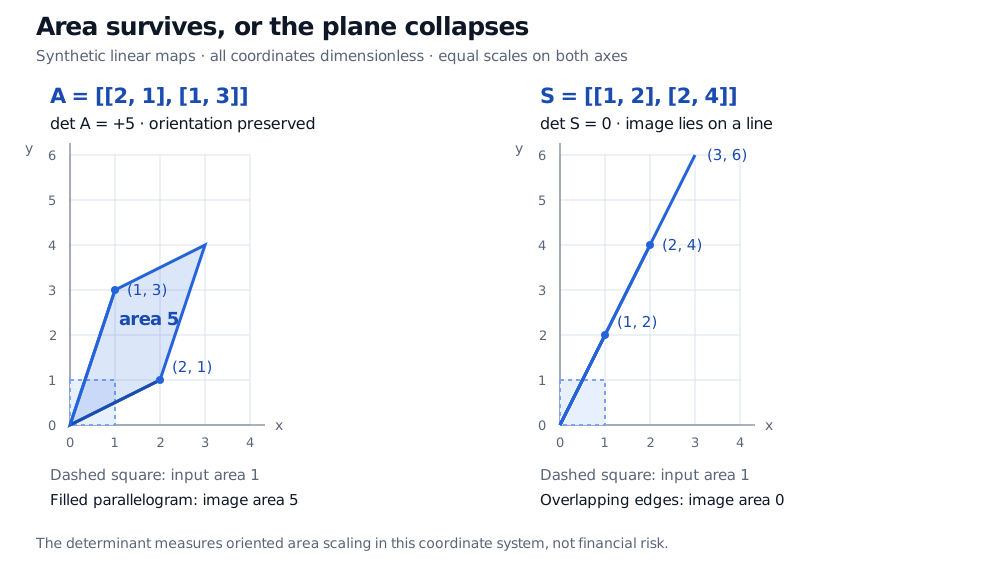
To isolate the geometry, now treat the same numerical matrix as a map between dimensionless coordinate planes. It sends (1,0) to (2,1) and (0,1) to (1,3). The unit square becomes the parallelogram with corners (0,0),(2,1),(3,4),(1,3).
Its area is 5. The ordered image edges turn counterclockwise, as the original coordinate axes do, so the determinant is positive. Swapping the columns would reverse the edge order and give determinant −5, with the same unsigned area. A negative determinant does not mean negative financial value or negative risk.
Dimensionless maps with equal axis scales: A with columns (2,1) and (1,3) sends the area-1 unit square to an area-5 parallelogram and preserves orientation. S with columns (1,2) and (2,4) collapses the square to a line segment ending at (3,6), with area zero.
Original synthetic maps in dimensionless coordinates. Dashed squares have area 1; the images have areas 5 and 0. This geometry makes no claim about financial risk.
For the second map,
S=(1224),detS=1(4)−2(2)=0.
Its second column is twice its first: linear dependence. Every output is a multiple of (1,2), so the plane collapses to a line. A reachable target has infinitely many solutions; a target outside that line has none. A zero determinant does not mean every target is impossible.
The Determinants as Volume, and Cramer's Rule lesson develops this geometry, the product rule and determinant ratios for solving systems. Its full text requires membership; the public page provides a preview.
Useful rules, with the scaling trap attached
For square matrices of the same size:
Operation
Determinant rule
Identity map
detI=1
Compose two maps
det(AB)=det(A)det(B)
Reverse an invertible map
det(A−1)=1/detA
Swap two rows or two columns
Change the sign
Multiply one row by k
Multiply the determinant by k
Add a multiple of one row to another
Leave the determinant unchanged
Multiply an entire n×n matrix by k
det(kA)=kndetA
The final rule matters whenever a dataset changes units. Quote both payoff rows in cents rather than dollars and the matrix becomes 100A. Its determinant becomes 1002×5=50,000. The economic contracts did not change. Determinant magnitude depends on the chosen coordinate units and scaling; it is not a unit-free score of diversification or hedge quality.
Nor is it a numerical reliability score. The matrix 0.001I in two dimensions has determinant 0.000001 but Euclidean condition number 1. By contrast, diag(1000,0.001) has determinant 1 and condition number 1,000,000. Its very unequal directional scales can amplify relative input errors. Exact nonzero determinant establishes invertibility; it does not establish a stable numerical solve.
For larger systems, solve directly with an appropriate factorisation rather than explicitly forming the inverse or evaluating a separate determinant for each holding. Elimination can also compute a determinant from pivot products while tracking row exchanges. With rounded financial inputs, examine scaling, singular values and conditioning rather than interpreting a floating-point determinant as a proof of exact dependence.
Sources
Gilbert Strang, Introduction to Linear Algebra, 5th edition, Wellesley–Cambridge Press, 2016, §5.1, “The Properties of Determinants,” and §5.3, “Cramer's Rule, Inverses, and Volumes.”