A policy rate is an interest rate, or a target for an interest rate, that a central bank uses to steer monetary conditions. It anchors short-term funding conditions and influences borrowing costs and asset values. It is not automatically the rate on a mortgage, a business loan or a government bond.
A decision is different from a market observation
The label depends on the central bank’s operating framework. A policy announcement may specify a target level, a target range, or an administered rate paid on central-bank deposits. Read the name of the instrument before comparing two countries’ “policy rates.”
In Australia, the RBA sets a cash rate target for overnight interbank borrowing. The cash rate is the market rate it seeks to influence; the announced target and the observed rate are conceptually distinct. The RBA explains the settlement balances, facilities and operations used to implement that target in its implementation explainer.
In the United States, the FOMC announces a target range for the federal funds rate. Under the ample-reserves framework, administered rates, principally interest on reserve balances, steer overnight rates. The effective federal funds rate is an observed transaction-based benchmark: the New York Fed calculates a volume-weighted median of overnight federal funds transactions. It is neither the range itself nor necessarily its midpoint. See the New York Fed’s implementation explanation.
A floor supplied by a central-bank facility helps support eligible institutions’ lending incentives; it does not guarantee that every market participant can invest at that rate or that every market quote lies above it.
Read the size of the move correctly
Suppose a fictional central bank raises its target from 4.00% to 4.25%. These are annual rate quotes, not returns earned overnight. This is a teaching example, not an actual decision or current rate.
| Description | Calculation | Result |
|---|---|---|
| Difference in percentage quotes | 4.25 − 4.00 | +0.25 percentage points |
| Difference in basis points | 0.25 × 100 | +25 basis points |
| Relative increase in the quoted rate | (4.25 − 4.00) / 4.00 × 100 | +6.25% |
A basis point is one hundredth of a percentage point. “A 25 basis point rise” describes the direct rate difference. It does not mean that the quoted rate rose by 25% of its old value.
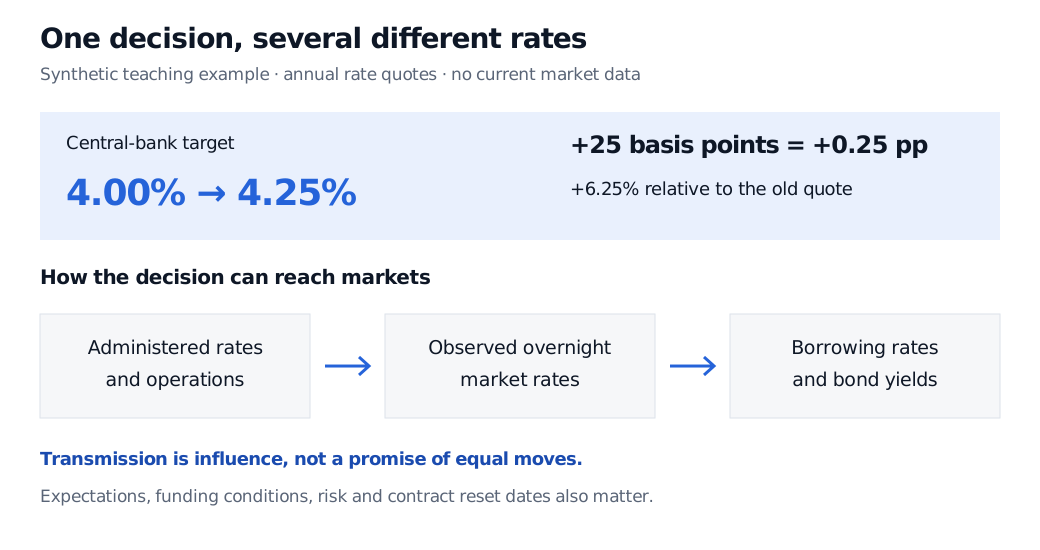
Original schematic and synthetic rate change. Arrows indicate influence, not equal changes, a fixed timetable or a market forecast.
Why borrowing rates and bond prices can respond differently
Higher short-term funding costs can feed into banks’ deposit and lending rates. Competition, credit risk, funding mix and contract reset dates affect the size and timing of that transmission. A fixed-rate borrower’s existing contractual rate does not reset merely because the policy rate changes. The RBA explicitly explains why deposit and lending rates do not always move in lockstep with its target.
For a bond with fixed promised cash flows, higher required discount rates reduce its present value, holding those cash flows unchanged. But a policy-rate rise does not imply that every bond yield rises by the same amount. Longer yields reflect expected future short rates and risk compensation; credit spreads can also change. Markets may have priced in the decision before its announcement.
The useful question is therefore: which rate changed, for which horizon, and how much of the news was already expected? A policy decision supplies one input to that analysis, not a mechanical bond-price forecast.
Sources
- RBA: How the Reserve Bank Implements Monetary Policy.
- New York Fed: Monetary Policy Implementation.
- RBA: About Monetary Policy — transmission to the economy.
- John C. Hull, Options, Futures, and Other Derivatives, ninth Global Edition (Pearson, 2018), Chapter 4, pp. 100–101, for the overnight funding-market distinction. Current central-bank sources above govern the implementation description.