Friday to Monday is still overnight
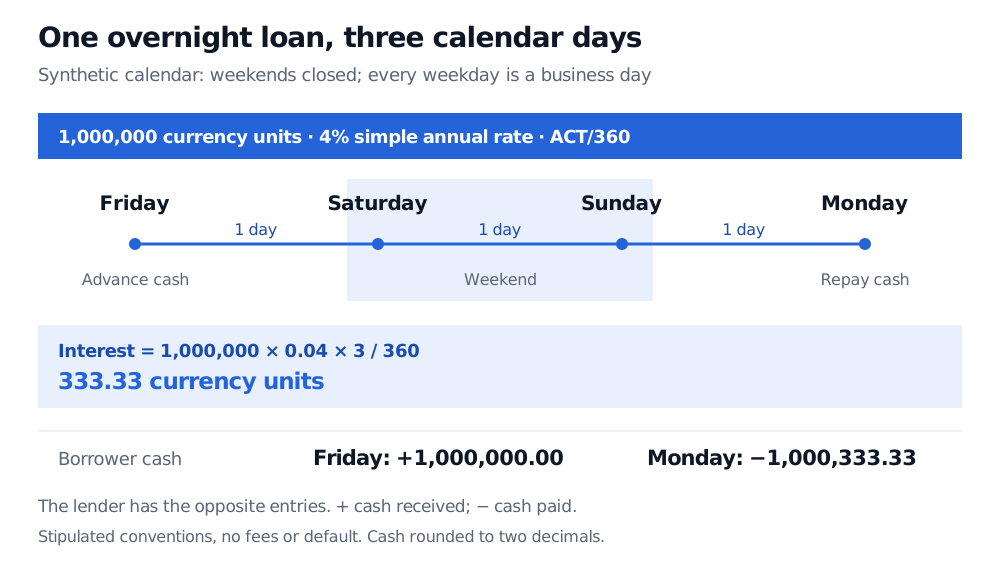
The borrower receives principal on Friday and pays principal plus interest on Monday. The lender has equal and opposite cash entries on each date. The lender's net cash receipt over the loan is 333.33; the borrower's net payment is the same amount. Those entries reconcile the loan cash flows, without treating promised interest as a riskless present-value profit.
Real transactions use their specified calendars, value dates, day counts and rounding rules. The example does not establish a universal weekend rule or an ACT/360 convention for every overnight market.
Which overnight market?
An overnight tenor does not tell you who borrows or what protects the lender. Three published benchmarks illustrate the distinction:
| Benchmark | What its methodology measures |
|---|---|
| US SOFR | Overnight cash funding against US Treasury securities through eligible repo transactions. The New York Fed calculates a volume-weighted median. |
| Sterling SONIA | Eligible unsecured sterling deposits of one business day maturity. The Bank of England uses a trimmed volume-weighted mean. |
| Australian cash rate, also called AONIA | Unsecured overnight interbank funding, measured under the RBA's methodology. |
Secured borrowing supplies collateral; unsecured borrowing relies on the borrower's promise. Collateral mitigates credit exposure but introduces valuation and liquidation considerations. Neither “secured” nor “overnight” means every transaction is free of credit, settlement or operational risk. A published benchmark also does not guarantee that a particular borrower can obtain funding at that rate.
A policy target is a different object
This matters when matching data to a trade. A policy announcement, a benchmark fixing and an executable loan quote are different inputs, even when their numerical values happen to coincide.
Today's rate does not secure tomorrow's funding
A desk financing a longer-lived asset with overnight borrowing must repeatedly renew its funding. The next loan's rate is not locked by today's quote, and the lender may decline to renew. This is both rate exposure and funding liquidity risk.
Likewise, a compounded overnight rate over a month combines overnight observations under specified accrual rules; it is not simply today's overnight quote held constant for a month. An overnight indexed swap exchanges fixed and overnight-linked interest cash flows. It can hedge a matching rate exposure, but does not itself supply the principal needed to keep a position funded or promise that future lenders will renew.
Sources
- John C. Hull, Options, Futures, and Other Derivatives, 9th edition, Global Edition, Pearson Education Limited, 2018, Chapter 4, §4.1, pp. 99–101, and Chapter 9, §9.2, pp. 224–226. Secured/unsecured funding and the distinction between rolling overnight funding and term lending; contemporary benchmark definitions follow the administrators below.
- Federal Reserve Bank of New York: Secured Overnight Financing Rate.
- Bank of England: SONIA key features and policies.
- Reserve Bank of Australia: Cash Rate Methodology — Overview and Cash Rate Target Overview.