An interbank rate is an interest rate at which banks borrow from and lend to one another. It helps determine the cost of funding a bank's cash shortfall. In unsecured interbank lending, the lender relies on the borrowing bank's promise to repay rather than receiving pledged securities.
There is no single worldwide interbank rate. A useful quote needs a currency, borrowing period, settlement dates and interest convention. It also needs an instrument: an unsecured deposit and a loan backed by collateral expose the lender to different risks. An individual bank's agreed borrowing rate need not equal a published market benchmark.
Follow the cash
Suppose Bank A lends Bank B 1,000,000 currency units for 30 days at a fixed 4% simple annual rate. Stipulate an accrual fraction of ; this is an illustrative contract convention, not a rule for every currency or interbank market. Assume repayment in full, with no fees.
The promised interest is
Here is principal, the annual simple rate and the year fraction. The annual quote does not mean Bank B owes 4% of principal for this short loan: the accrual fraction scales the payment. Principal plus interest is 1,003,333.33, rounded to two decimals.
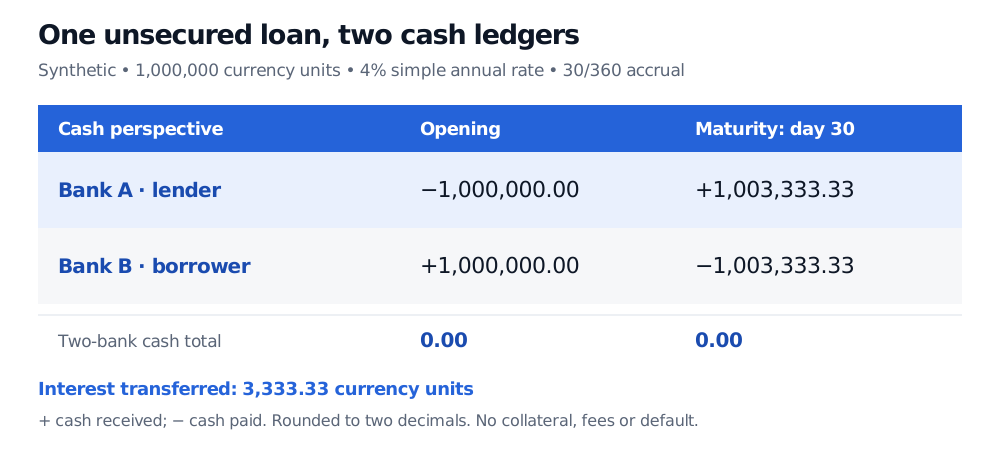
Original synthetic two-bank cash ledger. Amounts in currency units, rounded to two decimals; simple interest and a stipulated 30/360 accrual fraction. No collateral, fees or default.
Bank A pays cash at opening and receives it at maturity; Bank B has the opposite entries. Their combined cash transfer is zero on each date. Across the loan's life, Bank A receives net interest of 3,333.33 and Bank B pays that amount. These are cash movements, not the banks' complete balance sheets or a present-value profit calculation. Until repayment, Bank A bears credit risk: the promised payment may not arrive.
Four labels that should not be swapped
| Label | What it tells you |
|---|---|
| Unsecured interbank rate | The price of bank-to-bank cash funding without pledged collateral; identify its currency and maturity. |
| Actual overnight market rate | A rate for overnight borrowing, potentially summarised across eligible transactions by a benchmark administrator. It does not lock in funding for a longer term. |
| Central-bank target | A monetary-policy setting that influences market funding rates; it is distinct from the rates actually transacted. |
| Secured repo benchmark | A measure of borrowing against securities. SOFR, for example, measures overnight cash borrowing collateralised by US Treasury securities. |
Australia gives a concrete example of the target-versus-market distinction. The RBA sets a policy-rate target for the cash rate, while its cash-rate benchmark measures unsecured overnight interbank funding under a published methodology, including fallbacks when transaction data are insufficient. The target and measured rate are different objects. See the RBA's cash-rate explanation and benchmark methodology.
An overnight loan also differs from term funding. Repeatedly renewing overnight borrowing leaves future funding rates and availability uncertain. A fixed-rate term loan agrees its rate for the stated term. Do not substitute today's overnight rate for a term quote merely because both are annualised.
Likewise, SOFR is based on repurchase agreements, rather than unsecured interbank loans. Secured and unsecured rates can respond differently to collateral demand, bank credit conditions and liquidity. Their difference is not automatically a pure measure of default risk.
Reading an older reference to LIBOR
LIBOR was a family of interbank offered-rate benchmarks, not a synonym for every interbank rate. All LIBOR settings have ceased: the final synthetic settings were published on 30 September 2024, as confirmed by the FCA. This does not establish the status or methodology of another currency's IBOR. For an existing contract, identify its named benchmark, tenor and fallback provisions before calculating a payment.
For the broader funding context, SelfMadeQuant's Money Markets lesson compares deposits, bills and repo and explains quotation differences. Its public page is a preview; the full lesson requires membership.
Sources
- John C. Hull, Options, Futures, and Other Derivatives, 9th edition, Global Edition, Pearson Education Limited, 2018, Chapter 4, §4.1, pp. 99–101. Rate taxonomy and secured/unsecured distinction; historical benchmark descriptions require the updates above.
- Reserve Bank of Australia: Cash Rate Target Overview and Cash Rate Methodology — Overview.
- Federal Reserve Bank of New York: Secured Overnight Financing Rate.
- Financial Conduct Authority: The end of LIBOR, 1 October 2024.