Compare benchmark and seasoned Treasury yields, match DV01 and follow a 12-to-7 bp narrowing through both legs before repo, borrow and roll costs.
On-the-run/off-the-run spread
The on-the-run/off-the-run spread is the yield difference between a recently issued benchmark Treasury security and a comparable seasoned Treasury. It measures relative pricing within the same sovereign market: a quant can use it to study the value of tradability and collateral availability, or the risk of a relative-value trade.
On-the-run means the newest benchmark issue in a maturity sector; off-the-run means an older issue displaced by a newer benchmark. The convention in this article is:
sbp=10,000(yoff−yon),
where both yields are annual decimals on the same quotation basis and one basis point is 0.0001. A positive spread means the seasoned security yields more. A desk using the reverse subtraction will report the opposite sign; establish the convention before interpreting “widening.”
What the benchmark premium buys
New nominal Treasury benchmarks commonly trade at richer valuations and lower yields than otherwise comparable seasoned securities. For fixed cash flows, price rises when yield to maturity falls. Across two different bonds, however, comparing their raw dollar prices does not isolate that premium: their coupons and payment dates can differ. The San Francisco Fed’s discussion explains the trading and repo convenience behind the premium and why cash-flow adjustments matter.
Liquidity is one service investors buy. A benchmark may be easier to transact in size, hedge with or resell. The New York Fed’s 2026 study of aging Treasuries reports declining trading activity and wider effective bid–ask spreads after benchmark status is lost, with futures-deliverable seasoned securities an important exception. Those are trading-cost spreads; they are distinct from the yield spread defined above.
A raw yield gap is therefore not a pure liquidity measurement. Nearby Treasuries are comparable claims, not identical cash-flow portfolios. Remaining maturity, coupon, curve exposure and security-specific demand can influence their yields. An empirical liquidity-premium estimate needs controls or a fitted cash-flow valuation benchmark. The sign and size are observations to explain, not constants that every Treasury pair must obey.
A five-basis-point move through two positions
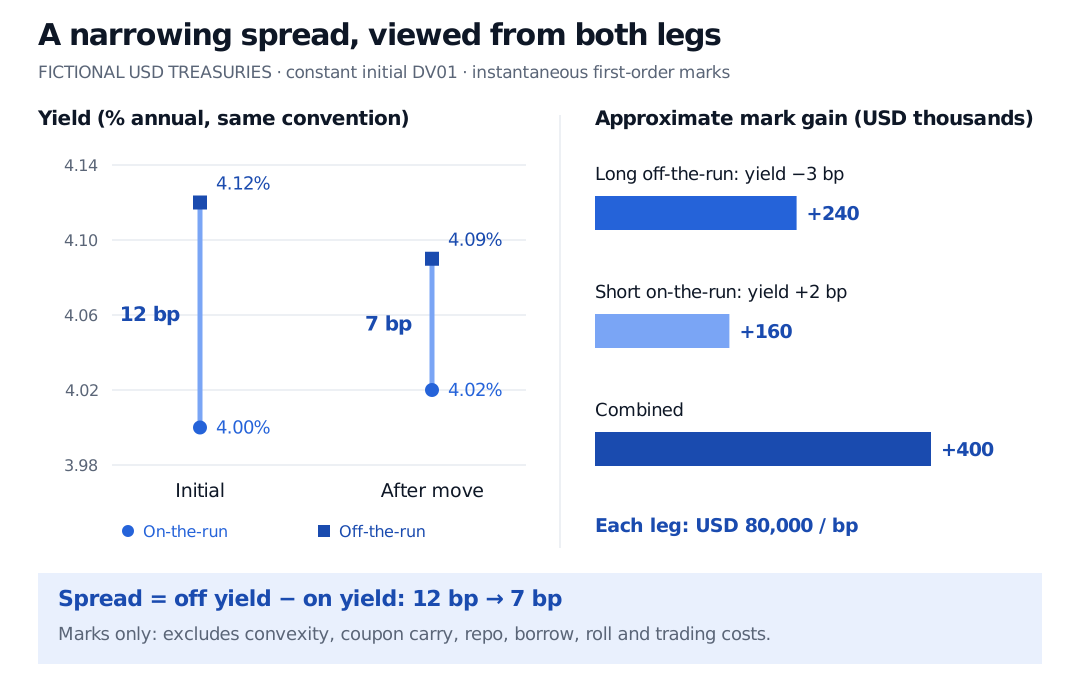
Consider a fictional pair of nominal USD Treasuries with annual nominal yields compounded semiannually. Initially the on-the-run yields 4.00% and the off-the-run yields 4.12%, so the spread is 12 bp. These are stipulated examples, not current market yields.
Buy the off-the-run and short the on-the-run. Stipulate that each position has an initial market value of USD 100 million and modified duration of 8 with respect to its own quoted yield. Its positive dollar sensitivity magnitude is:
K=DV01=100,000,000×8×0.0001=USD 80,000 per bp.
DV01 matches here because the inputs were chosen to make it match. Equal face notionals, or even equal market values, would not generally achieve that. For example, duration 10 on USD 80 million gives the same DV01 as duration 8 on USD 100 million; face amounts would also depend on each bond’s price.
Now take an instantaneous scenario with fixed initial sensitivities, ignoring convexity and all cash-flow, funding and execution effects:
Leg
Initial yield
Scenario yield
Yield change
First-order position mark
Long off-the-run
4.12%
4.09%
−3 bp
+USD 240,000
Short on-the-run
4.00%
4.02%
+2 bp
+USD 160,000
The long gains when its bond price rises; the short gains when the benchmark price falls. The ending spread is 7 bp, giving 5 bp of narrowing and an approximate combined mark gain of USD 400,000.
Fictional Treasury pair: off-the-run yield falls from 4.12% to 4.09% while on-the-run yield rises from 4.00% to 4.02%. The yield spread narrows from 12 to 7 bp. With USD 80,000 per bp on each leg, the long gains USD 240,000 and the short gains USD 160,000, before carry and costs.
Original fictional scenario. Initial market value USD 100 million and modified duration 8 per leg; USD 80,000/bp each. The USD 400,000 total is a first-order instantaneous mark change, excluding convexity, carry, repo, borrow, roll and trading costs.
For equal initial DV01 magnitude K and yield changes measured in bp:
ΔΠ≈−KΔyoff,bp+KΔyon,bp=−KΔsbp.
A common parallel move cancels in this linear approximation. A widening from 12 to 17 bp instead produces an approximate USD 400,000 loss. Matching one sensitivity does not match convexity or exposures to different points on the yield curve; it also drifts as prices and time change.
The short benchmark has a financing price
A repo can finance the long bond; a reverse repo can obtain the particular security needed to deliver a short sale. A security trades special when its repo rate is below the general-collateral rate. The holder can raise cash cheaply against it, while a borrower seeking that security gives up interest on cash supplied. ICMA’s special-repo explanation interprets that rate difference as an implicit securities-borrowing fee. Thus the on-the-run bond’s low yield and its financing value can be connected; the quoted yield gap is not automatically profit available to its short seller.
Over an actual holding period, the account also includes coupon carry, accrued interest, long financing, short-borrow economics, bid–ask costs and any rehedging. Avoid charging specialness twice if it is already incorporated in the reverse-repo economics. Funding can roll at worse terms, a short borrow may cease to be available, and haircuts or margin calls can require cash while the yield spread widens.
The benchmark itself rolls: when a new issue becomes on-the-run, yesterday’s benchmark becomes seasoned. Tracking two fixed securities and repeatedly replacing them with the latest benchmark define different trades and different historical series. Neither guarantees that the original pair’s yield gap reaches zero on a chosen date.
The owned lesson Liquidity and Limits to Arbitrage develops executable-price bands, funding constraints and forced-exit risk. Its preview is public; the full lesson requires membership.