Longevity risk is the risk that people live longer than assumed. A defined benefit pension plan or lifetime annuity provider then has more instalments to pay. If survival probabilities rise relative to those used in its actuarial projections, the present value of promised benefits rises for a given payment formula and discount curve. Unexpected improvements in mortality can lift survival across a whole cohort, so pooling more members still leaves exposure to that shared change. OSFI, Longevity Insurance and Longevity Swaps, Introduction and Actuarial Valuation Implications
A longevity swap exchanges a predetermined payment schedule for cash flows tied to realised survival or mortality. A pension plan hedging lifetime benefits pays the fixed leg and receives a floating leg designed to pay more when the referenced population lives longer. The fixed amounts can vary by date even though the schedule is agreed in advance. The fixed leg can include a charge for taking the risk, and payment timing and fees depend on the contract. OSFI, Longevity Risk Hedging Contracts
One payment period
A fictional plan owes USD 1,000 per surviving covered member for this period. The swap's fixed schedule allows for 800 survivors, so the plan owes USD 800,000 on the fixed leg. At the measurement date, 850 covered members are alive. The floating leg matches their benefits, so the plan receives USD 850,000. Assume the two legs settle on the same date and set aside fees and collateral flows.
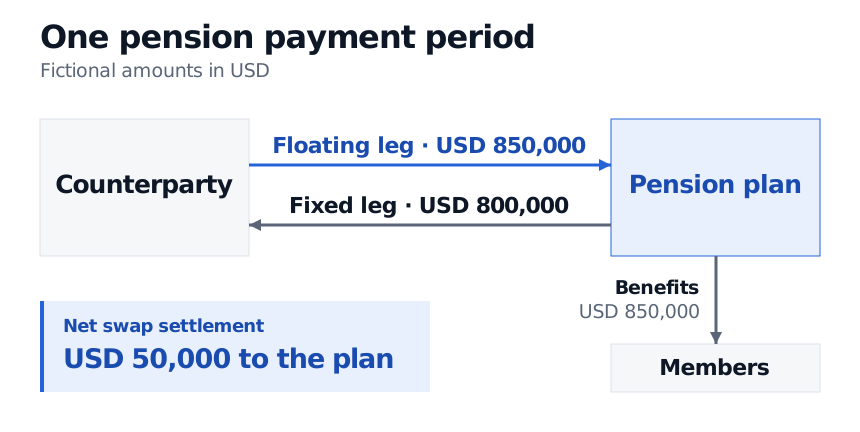
The arrows show the two gross swap legs and the separate benefit payment. If the swap legs settle net, only USD 50,000 changes hands between the counterparties.
The plan still pays USD 850,000 to members. After the swap receipt, its outflow is USD 800,000 for these combined cash flows. If the floating leg comes in below the fixed leg, the plan pays the swap difference. Babcock International Group Pension Scheme disclosed just such a net payment for the year to March 2021 under a swap whose floating leg broadly tracked the covered pension payroll. Babcock International Group Pension Scheme, Annual Report and Accounts 2021, Investment Report and note 19
The Finance Primer lesson Swaps works through the same receive-minus-pay calculation for an interest rate swap. The full lesson is available with a free account.
What determines the hedge?
A bespoke, indemnity-based swap references the scheme's covered members and the benefits specified in the contract. A hedge of the payroll needs to reflect the amounts at stake. When benefits differ, survival among members with larger pensions moves the payroll more than the same number of survivors among members with smaller pensions. An index-linked swap uses an outside reference population. If the scheme's pensioners live longer than expected but the index stays near its assumed path, the scheme can face higher benefit payments with little extra coming in from the swap. That mismatch is basis risk. IFoA and LLMA, Longevity Basis Risk, Appendix F.3
Even a close match to the payroll depends on the counterparty performing. Collateral can reduce counterparty credit risk, and a contract that requires the plan to post it can create a liquidity need. The plan continues to pay benefits and manage its investments and other exposures, including interest rates and inflation. In a UK pension buy-out, the insurer takes direct responsibility for paying the insured members. The Pensions Regulator, Insurance solutions
Sources
- Office of the Superintendent of Financial Institutions. Longevity Insurance and Longevity Swaps, 2014.
- Babcock International Group Pension Scheme. Annual Report and Accounts 2021, Investment Report and note 19.
- Institute and Faculty of Actuaries and Life and Longevity Markets Association. Longevity Basis Risk, Appendix F.3, 2014.
- The Pensions Regulator. New models and options in defined benefit pensions schemes, Insurance solutions, 2025.