Pension risk transfer shifts some or all of the risks of paying a defined benefit (DB) pension from the scheme to an insurer. In a buy-in, the scheme buys a bulk annuity policy that pays it amounts designed to match specified benefits. The scheme holds the policy as an asset, and its trustees still owe the pension payments to members. In a completed buyout, the insurer owes the insured benefits directly to members under individual policies. The distinction matters when projecting what the scheme must pay and which assets it can use to fund those payments. The Pensions Regulator, Insurance solutions
Follow one payment
On a fictional payment date, a scheme owes members £1,100. Its buy-in policy pays the scheme £900, exactly matching the covered benefits due that day. The scheme pays the full £1,100 and finds the remaining £200 from its other assets. That £200 is the cash needed outside the policy on this date. A funding deficit is measured by comparing scheme assets with the value of the pension obligations.
To isolate what a buyout changes, suppose the contractual and legal steps have been completed for just the benefits represented by the £900. The insurer now owes and pays that £900 to members directly. The scheme still owes the £200 outside the policy. This split illustrates who owes each benefit. A full scheme buyout must address the rest of the benefits before wind-up can be completed. The Pensions Regulator, Insurance solutions
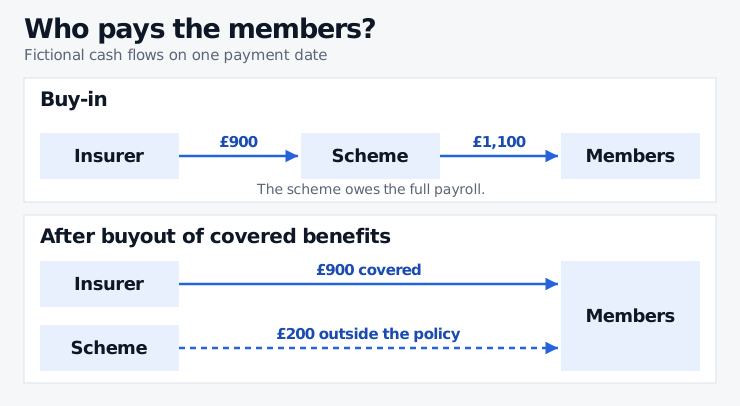
Members receive the same £1,100 in both panels. The covered payment takes a different route because the party that owes it changes.
From insurance cover to direct responsibility
A buy-in can match payments that change as members live longer or as covered pensions rise with inflation. Within the policy terms, the insurer takes on the cost of those changes and the investment risk of funding the payments. A longevity swap targets the survival risk and leaves other exposures, such as inflation or interest-rate risk, to be managed separately. Paying the buy-in premium can leave the scheme with fewer liquid assets. The remaining liquid assets still have to cover items such as uninsured payments, operating expenses and any collateral calls. The Pensions Regulator, Insurance solutions
A full buy-in can be a stage on the way to buyout. Trustees and the insurer may first reconcile member records and confirm benefit specifications, then issue individual policies and hand over payment administration. Legal discharge depends on the jurisdiction and the completion steps. In Great Britain, section 74 of the Pensions Act 1995 provides for discharge of liabilities in a qualifying occupational scheme wind-up through the purchase of qualifying annuities under prescribed arrangements. Legal & General, How a buy-out works and Pensions Act 1995, section 74
A missed dependant or an incorrect inflation rule in the benefit data can leave a gap between the insured payment and the scheme promise. Who bears the cost of correcting it depends on the applicable discharge, policy terms and any separate residual-risk cover or indemnity. The Pensions Regulator, Insurance solutions
Sources
- The Pensions Regulator. New models and options in defined benefit pensions schemes, published 3 June 2025.
- UK Parliament. Pensions Act 1995, section 74, revised text.
- Legal & General. Buyout, including policy issuance and administration.