A defined benefit (DB) pension promises a retirement benefit set by plan rules, often using pay and years of service. A defined contribution (DC) pension builds an individual account from employer or employee contributions, investment gains or losses, and fees. For a pension analyst, the distinction determines what to model. In a traditional DB plan, estimate the present value of the promised payments and compare it with plan assets. In a DC plan, project the member's balance and how much income it can support. U.S. Department of Labor, What You Should Know About Your Retirement Plan, chapter 1
What changes when markets move?
Suppose a fictional DB plan pays an annual benefit equal to 1.5% of final-average salary for each credited year of service. With 20 credited years and a final-average salary of USD 80,000, the annual benefit under the formula is
Hold those formula inputs fixed. A weak investment year can reduce plan assets and worsen the plan's funded status even though the promised benefit stays at USD 24,000 a year. The sponsor of a traditional employer-backed DB plan generally bears that funding risk. PBGC, How are benefit amounts determined?
In a separate fictional DC plan, start with USD 100,000 and add USD 5,000 at year-end, after applying the year's return net of fees. A return of −10% leaves USD 95,000 in the account, while +10% leaves USD 115,000. The member bears this investment risk even if a fund manager makes the investment decisions.
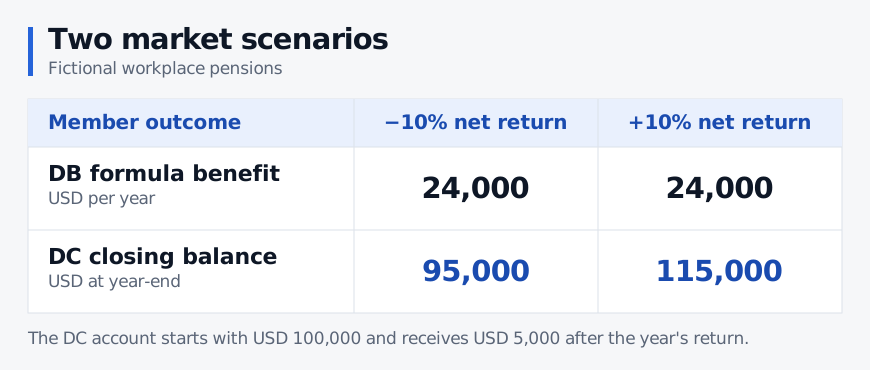
The DB result is an annual income amount. The DC result is a balance from which retirement income can be drawn.
Who bears the risk in retirement?
When DB benefits are paid for life, the plan bears the cost if retirees as a group live longer than projected. The plan can use pension risk transfer to shift specified obligations or cash-flow risks to an insurer. A DC retiree drawing from an invested account bears market risk and longevity risk. Poor returns early in retirement can leave fewer assets to recover while withdrawals continue, and the account can run out during the retiree's lifetime. Buying a conventional lifetime annuity with DC savings can transfer both risks on the covered income to the insurer. Taking a DB lump sum, where offered, puts those risks on the retiree if they invest and draw it down themselves. PBGC, Forms of benefit and ASIC Moneysmart, Annuities
The SelfMadeQuant lesson Fund Management and Retirement Investing in Australia works through what happens when the same returns arrive in a different order during drawdown. The preview is public and the full lesson requires membership.
If the sponsor fails or the member changes jobs
In the US, if an insured private-sector DB plan terminates without enough assets to pay promised benefits, the Pension Benefit Guaranty Corporation can cover eligible benefits up to statutory limits. Coverage and limits depend on the plan and benefit. PBGC, Your guaranteed pension
For US private-sector plans, a job change often leaves an earned traditional DB benefit with the former employer's plan until it becomes payable. Departing DC members can often roll eligible balances into an individual retirement account or a new employer's plan that accepts rollovers. Some DB plans permit eligible lump-sum rollovers too. U.S. Department of Labor, What You Should Know About Your Retirement Plan, chapter 5
A US cash-balance plan can look like DC on a benefit statement. It is a DB plan because the displayed balance comes from the plan's pay and interest credits, which are defined by its formula. Changes in the value of the plan's investments do not directly change that promised balance. U.S. Department of Labor, Cash Balance Pension Plans Compliance FAQs
Sources
- U.S. Department of Labor. What You Should Know About Your Retirement Plan, chapters 1 and 5.
- U.S. Department of Labor. Cash Balance Pension Plans Compliance FAQs
- U.S. Pension Benefit Guaranty Corporation. How are pensions and 401(k)s different?
- U.S. Pension Benefit Guaranty Corporation. Your guaranteed pension: Single-employer plans
- Australian Securities and Investments Commission, Moneysmart. Annuities