A leveraged recapitalization is a transaction in which a company borrows to pay shareholders, typically through a one-time special dividend or a share buyback. Shareholders receive cash now and the company takes on debt that future cash flows must service. A dividend pays eligible holders per share, while a buyback pays the holders who sell. The debt funding is what distinguishes a dividend recap from a special dividend funded out of cash reserves. Damodaran, Capital Structure, “Recapitalization”
Follow the cash through closing
Suppose a fictional company starts with 100 of debt and 300 of book equity, with amounts in USD millions. Debt is its only liability. It borrows 100 at face value, then declares and pays a special cash dividend of 100. Assume no fees, taxes or other balance-sheet changes.
- Borrow 100. Cash and debt each rise by 100. Total assets temporarily rise from 400 to 500.
- Pay out 100. The dividend reduces retained earnings by 100, and payment sends 100 of cash to shareholders. Cash and total assets return to their opening levels.
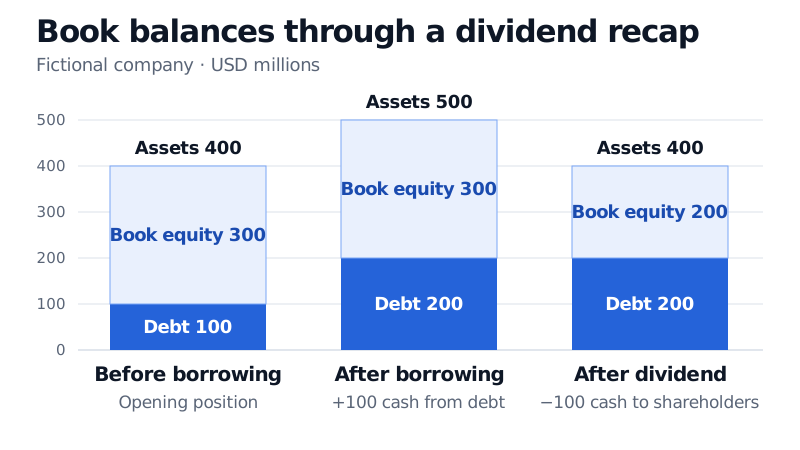
The extra cash sits on the balance sheet between borrowing and payment. After the payout, debt funds half of the same 400 in book assets.
Once both steps settle, the company's net cash flow from the transaction is zero. In a US cash flow statement, the borrowing is a financing inflow and the dividend payment is a financing outflow. Neither contributes to operating cash flow. Book debt as a share of debt plus equity goes from 25% to 50%. That measure tracks the book funding mix. A credit model still needs an interest and principal schedule and a forecast of cash available to meet it. Damodaran, A Primer on Financial Statements · SiteOne, financing cash flows
Value the cash and the remaining shares
For a pro-rata cash dividend, compare the original shareholders' market wealth just after the payout with their wealth in the same firm without the recap, using the same valuation date. Let and be aggregate market equity in those two cases. Before investor taxes, the difference is
Under the no-tax Modigliani–Miller benchmark, hold operating cash flows fixed, issue the new debt at fair value and assume the value of existing debt stays fixed. The 100 dividend is then offset by a 100 decline in market equity. In an actual deal, the value of interest tax shields, fees, expected distress costs and any repricing of existing debt can affect how much the original shareholders gain or lose. The closing book equity of 200 alone leaves that question open. Modigliani and Miller, Proposition I · Damodaran, Capital Structure lecture notes
For a traded share, include the special dividend in total return. For a forecast, keep it separate from the recurring stream under the company's dividend policy. The SelfMadeQuant lesson shows how dividend entitlement and adjusted prices enter a return series. The full lesson requires membership. Equities, Indices and Corporate Actions
Read the filing for the uses of the loan
On May 2, 2016, SiteOne Landscape Supply paid a USD 176.0 million special cash dividend funded from a new USD 275.0 million term loan facility. The proceeds also repaid the prior term loan and part of an asset-based facility and covered refinancing costs. In its nine-month cash flow statement, SiteOne reports USD 272.3 million of term-loan borrowings and a separate USD 176.0 million dividend outflow. The credit agreement lists the special distribution among the uses of the new loan and limits restricted payments. SiteOne, 2016 Form 10-Q, Note 1 and financing cash flows · 2016 credit agreement, sections 5.16 and 8.2
For a recap model, trace debt retired, cash paid to owners and fees separately, then test post-deal interest coverage and debt capacity under the actual debt terms.
Sources
- Aswath Damodaran, NYU Stern. Capital Structure: The Financing Details, chapter 9, A Primer on Financial Statements and Capital Structure lecture notes.
- Franco Modigliani and Merton H. Miller (1958). The Cost of Capital, Corporation Finance and the Theory of Investment.
- SiteOne Landscape Supply, Inc. Form 10-Q for the quarter ended October 2, 2016 and Amended and Restated Credit Agreement dated April 29, 2016.