Jensen's free cash flow hypothesis predicts that managers with cash beyond what they need to fund every project with positive net present value (NPV) may spend the surplus on investments that destroy value. Jensen tests projects at the relevant cost of capital. For a valuation analyst, this makes management’s likely use of the next dollar of cash as important as the amount the business generates. Jensen (1986), p. 323
The free cash flow metric in a company filing often subtracts cash capital expenditure from operating cash flow. That calculation records what the firm spent. Jensen’s economic surplus depends on what it could profitably invest. A firm can have high reported free cash flow and still need much of it for worthwhile projects it has yet to start. SEC staff, Non-GAAP Financial Measures, Question 102.07, Jensen (1986), p. 323
What can the last 30 million buy?
A fictional packaging firm has generated 100 million USD available today after covering operating and existing contractual cash needs. It can fund two independent projects. All incremental cash receipts arrive in one year, and 10% is the appropriate annual discount rate for each proposal in this example.
| Proposal | Cash cost today | Expected cash in one year | Present value of receipts | NPV |
|---|---|---|---|---|
| Retrofit a production line | 40 | 55 | 50 | +10 |
| Automate quality checks | 30 | 44 | 40 | +10 |
| Buy a small competitor | 30 | 27.5 | 25 | −5 |
These are the only identified proposals. The retrofit and automation are both worth funding and require 70 million today. The economic surplus is million. With the two projects funded in either case, a payout delivers 30 million in cash today. The acquisition uses the same 30 million to buy future receipts worth 25 million today, leaving shareholders 5 million worse off than the payout before any payout costs or taxes.
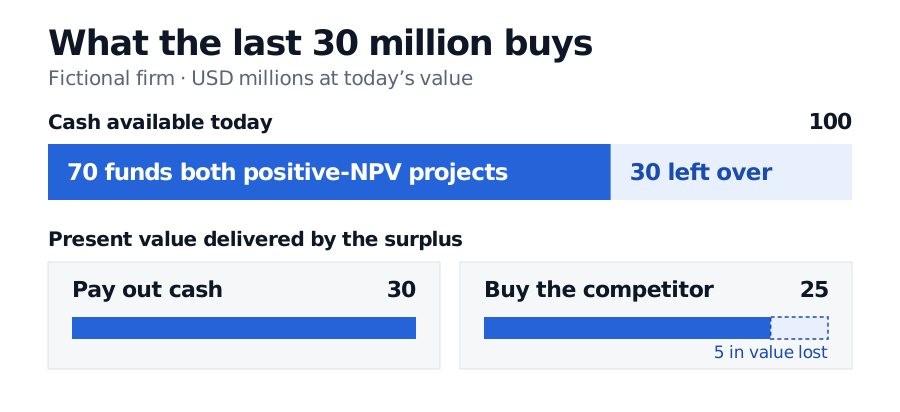
Both choices fund the two worthwhile projects. The difference comes from what shareholders get for the last 30 million.
A manager whose pay rises with sales or whose influence grows with headcount can still favour the acquisition. Paying it from internal cash also avoids asking outside investors to finance the deal. This is an agency cost when the manager’s private benefit leads to a loss for shareholders. Jensen (1986), pp. 323, 328
When does committing the cash help?
A dividend or buyback reduces the cash managers control today. Borrowing and distributing the proceeds can also commit future cash to interest and principal. That commitment is harder to reverse than a dividend policy because missing a required debt payment can trigger default. The mechanism is strongest in Jensen’s account for businesses that consistently generate cash and have few worthwhile ways to reinvest it. Jensen (1986), §I
Cash can also preserve valuable flexibility. If a time-sensitive project appears when outside funding is expensive or unavailable, a cash reserve can make it possible to proceed. Heavy debt service can absorb that reserve and raise expected financial distress costs. When evaluating a payout or a leveraged recapitalization, compare the waste the commitment could prevent with the value of the investments it could make harder to finance. Jensen (1986), §I, Froot, Scharfstein and Stein (1993), §II.A
The external-financing scenario in Exercise 1 follows a pharmaceutical company that may have to delay a profitable clinical trial if its cash runs short. The preview is public, and the full lesson requires membership. Why Manage Financial Risk?
Sources
- Michael C. Jensen (1986), Agency Costs of Free Cash Flow, Corporate Finance, and Takeovers, American Economic Review 76(2), pp. 323–329.
- SEC Division of Corporation Finance, Non-GAAP Financial Measures, Question 102.07.
- Kenneth A. Froot, David S. Scharfstein and Jeremy C. Stein (1993), Risk Management: Coordinating Corporate Investment and Financing Policies, Journal of Finance 48(5), pp. 1629–1658.