In a market-regime model, this means no regime is permanently inaccessible from another. It is a restriction on the model's possible paths. It does not say that regime changes are frequent, or that the probabilities describe real markets accurately.
Look for a route, not a direct arrow
The number of steps may depend on the ordered pair . The forward and return routes can take different lengths, and either route can pass through intermediate states. With , a state reaches itself in zero steps.
A practical graph test is to draw an arrow for each positive transition probability and check whether every state is reachable from every starting state. Positive probabilities everywhere in are sufficient, but unnecessary. Zeros in the matrix do not by themselves make a chain reducible.
Two regimes, with routes both ways
Suppose a hypothetical daily model has two states, Calm and Stressed, in that order:
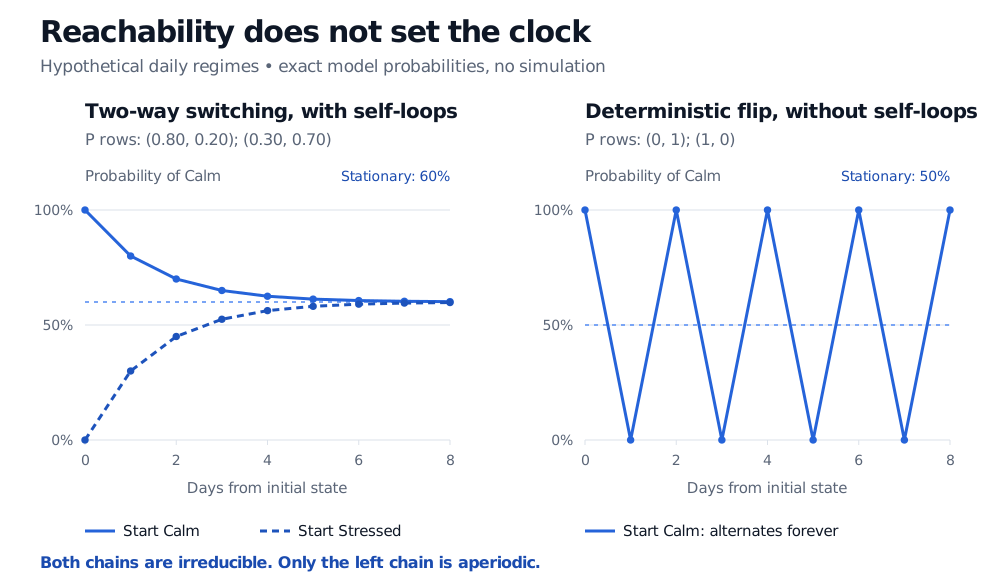
A Calm day is followed by a Stressed day with probability 20%; a Stressed day is followed by a Calm day with probability 30%. Both directions are possible, so the chain is irreducible. These are stipulated teaching probabilities, not fitted market estimates.
Starting Calm, let be the probability of being Calm days later. Conditioning on today's state gives
With , the solution is
| Days after starting Calm | Probability of Calm | Probability of Stressed |
|---|---|---|
| 0 | 100% | 0% |
| 1 | 80% | 20% |
| 2 | 70% | 30% |
| 4 | 62.5% | 37.5% |
Those weights describe a distribution unchanged by another transition. They do not freeze the realised state: the model keeps switching regimes. Nor does starting Calm make tomorrow's distribution stationary; the table shows the approach over time.
What follows from irreducibility
To see the difference, remove the possibility of staying put:
This chain is still irreducible: each state reaches the other immediately. Its unique stationary distribution is . But starting Calm, it alternates Stressed, Calm, Stressed, Calm forever. Returns to the starting state occur only at even times, giving period two; the single-date distribution never converges. Starting in the stationary mixture would instead keep that mixture unchanged at every date.
The finite-state qualification also matters. For a countably infinite chain, irreducibility alone guarantees neither a stationary probability distribution nor finite expected return times. Positive recurrence is the additional condition that supplies a stationary probability law.
A model assumption worth checking
Conversely, observing no transitions between two regimes in a short sample does not establish that the transition probability is exactly zero. Irreducibility depends on possible routes, so it can change when a tiny probability is set to zero. It gives no useful finite-horizon guarantee that all regimes will actually be visited.
Sources
- Lancaster University, MATH332, §4.2: Class structure, especially Definition 4.2.7: irreducibility as a single communicating class.
- Lancaster University, MATH332, §4.3: Analysing Markov chains: matrix powers and row-vector propagation.
- Richard Durrett, Essentials of Stochastic Processes, third edition (2016), §§1.3–1.4, 1.6 and 1.11: finite-state recurrence, stationary distributions, convergence conditions and infinite-state distinctions.