An absorbing state cannot be left once entered. See why a credit-default flag turns a matrix endpoint into cumulative default probability, and distinguish default by a year from default during it.
Absorbing state
An absorbing state is a state that a stochastic model cannot leave once it enters. In a discrete-time, time-homogeneous Markov chain, state a is absorbing when its one-step probability of remaining there is Paa=1. Every other entry in that row is zero.
For credit risk, this turns a default flag into a record of an event: once the model says a borrower has defaulted, later probability mass cannot flow back into the performing population. That is what lets a default-state probability measure default by a horizon, rather than only default at one observation date.
Read the row, then ask what the state records
Use the row convention for a transition matrix: Pij is the probability of moving from state i to state j in one step. An absorbing state's row has a single 1 on its diagonal. Its column can still receive probability from other states. No exit does not mean no entry.
Absorption belongs to the model's definition of a state. A company can restructure after default, and creditors can receive recoveries. If D means “has experienced the first default,” those later events do not undo entry into D. A model of current credit standing that allows a cured borrower to return to Performing needs a different transition rule. An absorbing default flag by itself says nothing about loss given default.
The distinction also matters for a trading stop. “Strategy permanently terminated” can be absorbing. “Position currently flat” usually is not, because a later trade can reopen it.
Five years of a 2% annual default probability
Consider a hypothetical annual chain with two states, Performing (C) and Default (D), in that order. Stipulate the same transition probabilities every year:
P=(0.9800.021).
Start Performing at time zero. Conditional on still being Performing, the probability of default during the next year is 2%. The Default row keeps anyone who has already defaulted in that state. These are teaching assumptions, not an estimated rating model.
To remain Performing after n years, the borrower must survive every annual transition. The survival function is therefore 0.98n, and the complementary default probability is
P(Xn=D∣X0=C)=1−0.98n.
At year 5 this gives 1−0.985=0.0960792032, or 9.6079% to four decimal places in percentage units. Matrix propagation gives the same result:
(1,0)P5=(0.9039207968,0.0960792032).
Why not 5×2%=10%? The 2% applies each year to the population that has survived to that year's start. Borrowers who defaulted earlier cannot default for the first time again. The surviving population shrinks.
Define the first-passage time to Default as T=min{n≥1:Xn=D}, given X0=C. Default during year 5 means surviving four years and then defaulting:
P(T=5)=0.984×0.02=0.0184473632,
or 1.8447%. Default by year 5 adds the mutually exclusive first-default events in years 1 through 5. Because Default is absorbing, {Xn=D}={T≤n} for this starting state. That event identity is the reason the matrix endpoint answers the cumulative question.
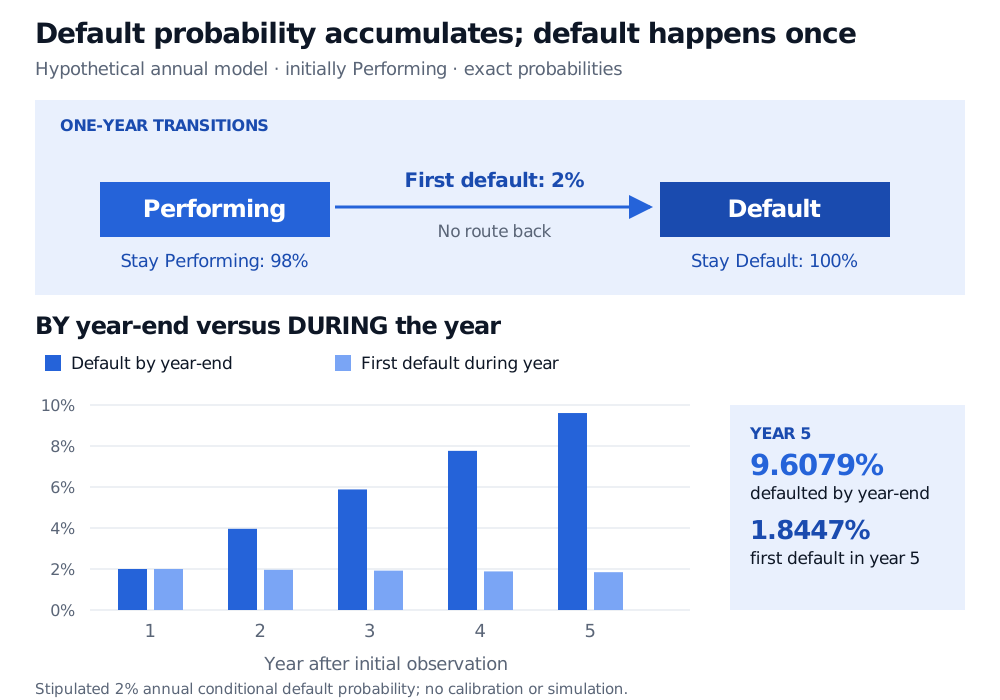
Hypothetical annual chain: Performing stays Performing with probability 98% or enters Default with probability 2%; Default stays Default with probability 100%. Default by year 5 is 9.6079%, while first default during year 5 is 1.8447%.
Exact probabilities under a stipulated, constant 2% annual conditional default model. The dark bars accumulate all first defaults to date; the light bars count first defaults during each year.
Here T has a geometric distribution on 1,2,…, with mean E[T]=1/0.02=50 years. The mean describes this unlimited-horizon model; it is not a predicted default date for a particular borrower. A finite-maturity exposure requires its own horizon, and a changing annual default probability requires changing the survival calculation.
An absorbing state does not guarantee arrival
The definition is local: it specifies what happens after entry. Merely including Default in a chain does not ensure that it is reachable from every other state. A model could contain another closed group of states that never reaches Default. A closed group can allow switching among its members; an absorbing state is a closed group containing just one state.
For a finite, time-homogeneous chain in which an absorbing state is reachable from every state, eventual absorption into some absorbing state has probability one. With several absorbing states, the endpoint can depend on the starting state and transition probabilities. These qualifications separate an absorbing state from the stronger structure called an absorbing chain. Grinstead and Snell's treatment develops this distinction and the matrix methods for absorption probabilities and expected times.
To build the transition model behind the example, Markov Chains — Transition Matrices and the Markov Property explains how to specify states and check their outgoing probabilities. Its full lesson requires membership; the public page provides a preview.
Sources
Dimitri P. Bertsekas and John N. Tsitsiklis, Introduction to Probability, second edition (2008), §7.4, “Absorption Probabilities and Expected Time to Absorption”: absorbing states, first-step equations and the role of transient starting states.
Charles M. Grinstead and J. Laurie Snell, Introduction to Probability, §11.2, CHANCE Project version dated 4 July 2006: absorbing-state and absorbing-chain definitions, eventual absorption in a finite chain, and expected absorption times.