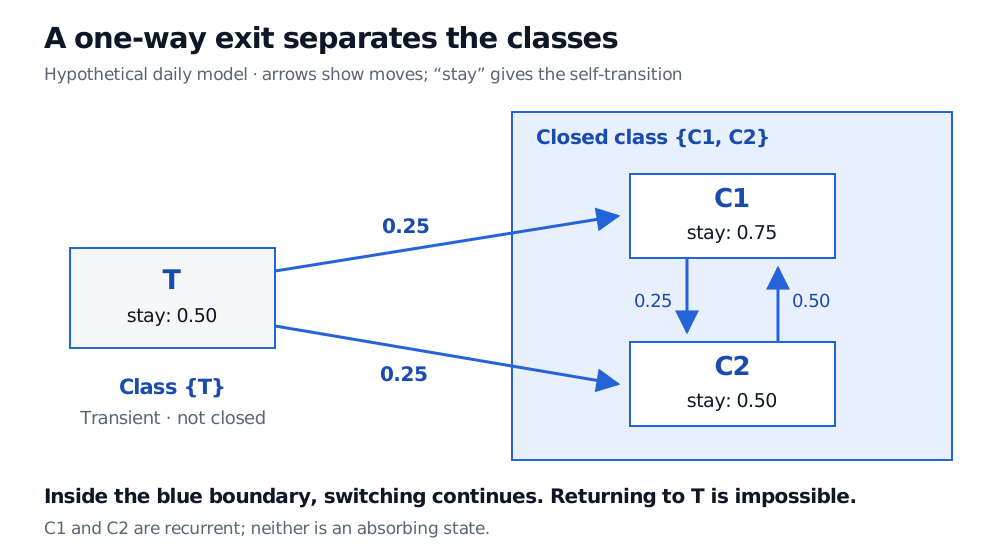
A communicating class groups Markov states that can reach one another. A three-regime example separates mutual access, a closed class and an absorbing state.
Communicating class
A communicating class is a maximal group of states in a Markov chain such that every state can reach every other state with positive probability in finitely many steps. “Maximal” means no additional state can join without losing that mutual reachability.
For a regime or credit model, this identifies which changes can eventually be reversed. A model may allow a transition into a set of states while ruling out every route back. Treating the whole model as one freely connected system would hide that restriction.
Reachable in both directions
Use a time-homogeneous, discrete-time chain with transition matrixP, where row i describes the next state conditional on the current state being i. Write
i→j⟺(Pn)ij>0 for some integer n≥0.
This is accessibility. Communication requires both directions:
i↔j⟺i→j and j→i.
The outward and return routes may take different numbers of steps. Direct arrows in both directions are sufficient, but unnecessary: a route through intermediate states counts. Taking P0=I makes every state accessible from itself, so a singleton can be a communicating class even if it cannot return after leaving.
The mutual relation is reflexive, symmetric and transitive, so its equivalence classes partition the state space. In a directed transition graph, they are the strongly connected components. Lancaster University's class-structure notes develop this graph interpretation.
An initial regime that cannot come back
Consider three hypothetical daily regimes: an initial transitional regime T and two continuing regimes C1,C2. The probabilities are stipulated, not estimates from market data. In state order (T,C1,C2),
P=0.50000.250.750.500.250.250.50.
Starting in T, the next day remains in T with probability 50%, or moves to either continuing regime with probability 25% each. Both continuing regimes have zero probability of moving to T. Their transitions to each other are positive.
Communicating class
Why its states belong together
Closed?
{T}
No other state can reach T
No: it can leave for either continuing regime
{C1,C2}
Each can reach the other
Yes: both rows assign zero probability outside this pair
The three-state hypothetical daily chain has classes {T} and {C1, C2}. T stays with probability 0.50 and moves to either C1 or C2 with 0.25 each. C1 moves to C2 with 0.25, C2 moves to C1 with 0.50, and neither can return to T. Only {C1, C2} is closed.
A closed class can contain movement. The boundary encloses both recurrent states, while the transient singleton T has outgoing transitions and no route back.
A closed class has no transition to any state outside it. Here, T can reach C1 and C2, but that one-way access does not put all three states in one communicating class.
Nor does “closed” mean frozen. Within the closed pair, C1 can switch to C2 and back. An absorbing state is the special case of a closed singleton, with self-transition probability one. This model has no absorbing state.
What the partition tells a risk modeller
Starting in T, being there after n days requires staying there on every step:
P(Xn=T∣X0=T)=(0.50)n.
After four days that probability is 1/16=6.25%, and it tends to zero. Departure happens eventually with probability one. The probability of a first return to T at a strictly positive time is only 0.50: staying on the next day counts as a return, while leaving makes a return impossible. Thus T is a transient state, despite forming a communicating class.
In a finite chain, every state in a closed communicating class is a recurrent state: starting there, it returns with probability one. This applies to C1 and C2. The finiteness condition matters; a closed communicating class with infinitely many states need not be recurrent.
The full chain is reducible because it has two classes. An irreducible Markov chain has just one. Before interpreting long-run regime weights, identify these classes and which ones the initial state can reach; a single global connectivity assumption can conceal irreversible transitions.
For a broader treatment of state graphs and periods, the Classification of States lesson provides worked finite-chain examples. Its full text requires membership; a public preview is available.
Finally, class structure depends on which probabilities are exactly zero, not on how large positive probabilities are. A rare positive return route can merge classes that otherwise look separate. A zero count in a short historical sample does not establish an impossible transition, so estimated matrices require particular care before imposing permanent barriers between regimes.
Sources
Richard Durrett, Essentials of Stochastic Processes, third edition (2016), §1.3, Classification of States, especially Theorems 1.5, 1.7 and 1.8: irreversible reachability, recurrence in finite closed irreducible sets, and finite-state decomposition.
Lancaster University, MATH332, §4.2: Class structure: accessibility, mutual communication, equivalence classes, closed classes and irreducibility.