Interdealer brokers (IDBs) arrange wholesale trades between dealers and, on some venues, other eligible institutions. A dealer looking to reduce inventory or offset a client trade can use an IDB to find a buyer or seller. On an anonymous venue, the dealer can show a price and quantity without attaching its name to that interest. For a quant, the venue explains where the match happened. The broker's capacity explains which legal entity belongs in the trade record. New York Fed, discussion of the Treasury cash market and all-to-all trading
Follow the contracts
In an agency name-passing arrangement, the broker finds matching interest and passes the names. The dealers contract directly once any required credit approval is in place. In matched-principal broking, the broker buys from the seller and sells to the buyer through two back-to-back trades. Each dealer faces the broker as its execution counterparty. The matched trades offset each other economically when both legs perform, but if the seller fails to deliver, the broker can still owe delivery to the buyer. BGC brokering-services disclosure · BGC Group 2025 Form 10-K
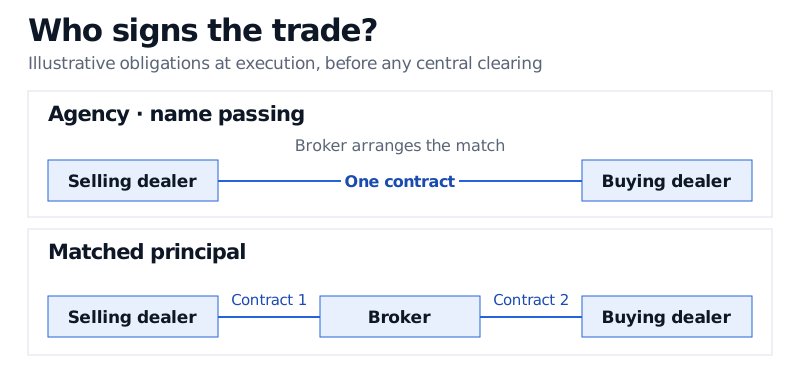
The blue lines show who contracts with whom at execution. Each dealer has a direct obligation to the other in the top panel and to the broker in the bottom panel.
Voice, electronic and hybrid describe how the trading interest reaches the other side. A voice broker relays or confirms quotes, an electronic system can match eligible orders, and a hybrid service can combine a screen with broker assistance. A screen alone tells you little about when names are disclosed. In BGC’s name-passing example, names are generally shared once terms other than credit approval are agreed. In the New York Fed’s BrokerTec cash Treasury example, participants face the intermediary and the ultimate buyer and seller remain anonymous to each other. BGC Group 2025 Form 10-K · BGC brokering-services disclosure · New York Fed, BrokerTec example
Clearing is a separate function. A central counterparty may take over contractual obligations for an eligible, accepted trade under its rules. The execution confirmation and the clearing record can therefore identify different counterparties. The Market Participants lesson traces the roles from execution through settlement. The preview is public and the full lesson requires membership.
One match, one illustrative fee
Two dealers match on USD 10 million of notional. Suppose the broker invoices a single fee of 0.5 basis points of notional for the entire match. One basis point is one ten-thousandth, so the invoice is
If the same rate were instead charged to each dealer on that notional, each would pay USD 500 and the broker would receive USD 1,000 in total. The example specifies a hypothetical billing rate. Its result belongs in the explicit transaction cost ledger, separate from the agreed trade price and the position’s risk exposure. Actual billing can differ by service and contract. BGC describes cases where its matched-principal brokerage charge is reflected in the all-in price and cases where it is invoiced separately. BGC brokering-services disclosure
Sources
- BGC, Understanding BGC Brokering Services, March 2026. Name passing, matched principal and fee treatment.
- BGC Group, 2025 Form 10-K. Voice, hybrid and fully electronic broking and principal transaction risk.
- Federal Reserve Bank of New York, interview with Ellen Correia Golay, September 2026. Anonymous execution and separate clearing in the Treasury market.