In U.S. federal securities law, insider trading liability under Exchange Act § 10(b) and Rule 10b-5 can arise when someone buys or sells a security while aware of material nonpublic information (MNPI) in breach of a duty of trust or confidence. Liability can also arise when an insider breaches a duty by tipping someone for personal benefit and the recipient trades with the requisite knowledge of the breach. For a quant team, the same earnings number can arrive first under an obligation of confidence and later through a public feed. Those timestamps support different conclusions about who could use the information and when. Rule 10b5-1(a)–(b) · Dirks v. SEC, pp. 659–664
The same earnings result at two trade times
At 09:00 Eastern time, the CFO of a fictional U.S. public company sends an outside consultant the final quarterly earnings table to check its presentation. The consultant has signed an agreement to keep it confidential. The table shows a USD 0.40 loss per share after the company had publicly guided for a profit. Assume there is a substantial likelihood this would significantly change a reasonable investor’s overall picture of the company. That makes the result material in this example. At 09:00 it is also nonpublic because the exact result has reached only authorised recipients. SEC adopting release, § II.B.2
Compare a hypothetical 13:00 sale of the consultant’s own shares with a separate hypothetical sale at 10:00 the next day. At 16:05 Eastern time, the company makes the same result broadly available through a public Form 8-K and a widely distributed earnings release. Assume these channels reach investors generally at that time and the consultant has no other MNPI about the company. SEC adopting release, §§ II.B.2, II.B.4
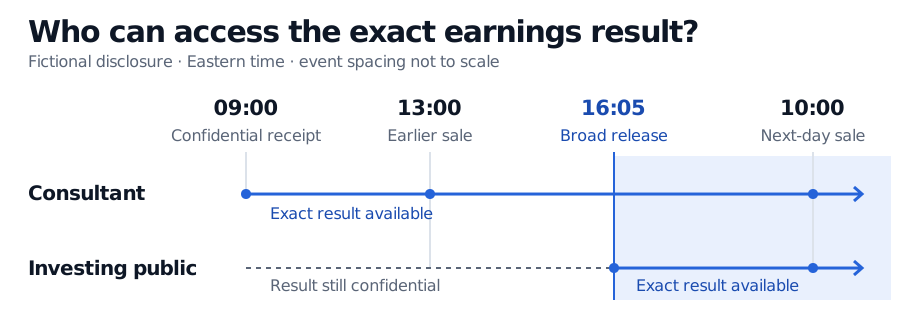
The two access records diverge before the release and overlap afterward. A private receipt timestamp cannot serve as a public-data timestamp.
At 13:00, suppose the consultant secretly sells while aware of the earnings result, in breach of the duty owed to the company that provided it. Those facts fit the misappropriation theory. Rule 10b5-2 identifies an agreement to keep information confidential as one basis for that duty. In the classical theory, by contrast, the CFO’s own undisclosed sale while aware of the result would involve the CFO’s duty to the company’s shareholders. In both cases Rule 10b5-1 generally treats awareness at the time of the sale as trading on the basis of the information, subject to specified affirmative defences such as a qualifying pre-existing Rule 10b5-1 trading plan. United States v. O’Hagan, pp. 651–655 · Rule 10b5-2(b)(1) · Rule 10b5-1(b)–(c)
By 10:00 the next day, the disclosed result lacks the nonpublic element. The sale is assessed against the information available at its own time. The evening release has no bearing on whether the exact figure was public at 13:00. A strategy built from public announcements would also introduce look-ahead bias if its backtest used the result at the earlier time. Rule 10b5-1(a)–(b) · SEC adopting release, § II.B.2
When the CFO passes the number as a tip
Change the morning facts. The CFO gives the unreleased result to her sister as a gift, expecting her to sell before the announcement. The sister knows the source, that the number is still confidential and that the CFO disclosed it to give her a trading advantage. If she sells at 13:00, that is the classical tipper–tippee pattern. In the SEC proceeding in Dirks, the Court tied the breach to the tipper’s personal benefit and asked whether the recipient knew or should have known of that breach. Salman confirms that giving a trading relative confidential information as a gift can supply the personal benefit even without any payment to the tipper. The sister in this example actually knows the facts of the breach. Dirks v. SEC, pp. 659–664 · Salman v. United States, opinion §§ II.B–C
Three neighbouring questions
- What did the issuer have to disclose? Regulation FD requires public disclosure when a covered issuer or its representative selectively shares MNPI with specified recipients, subject to exceptions. For covered disclosures, the timing is simultaneous if intentional and prompt if unintentional. A recipient who expressly agrees to keep the information confidential falls within an exception. That exception concerns the issuer’s disclosure obligation. The consultant’s own trade still raises the duty question. Regulation FD, §§ 243.100–243.102
- What did the analyst actually learn? Expert networks and mosaic research can help an analyst form an earnings estimate from public inputs and legitimately sourced immaterial facts. If the analyst then receives the exact confidential result as confirmation, that new input has its own source, materiality and access history. The SelfMadeQuant Ethics and responsible data use lesson works through a related feature-store decision. The preview is public and the full lesson requires membership. SEC adopting release, § II.B.2 · SEC examination staff risk alert, p. 3
- What does an insider filing show? Form 4 reports changes in ownership for covered insiders and can supply public inputs for an insider transaction signal. A disclosed sale may be lawful. The filing records the transaction and leaves open what the insider knew when it occurred. SEC Form 4 and general instructions
Sources
- 17 CFR § 240.10b5-1, paragraphs (a)–(c), and 17 CFR § 240.10b5-2, preliminary note and paragraphs (a)–(b). Current text checked 8 November 2026.
- United States v. O’Hagan, 521 U.S. 642 (1997), pp. 651–656.
- Dirks v. SEC, 463 U.S. 646 (1983), pp. 659–665.
- Salman v. United States, 580 U.S. 39 (2016), opinion § II and note 2.
- 17 CFR Part 243, Regulation FD, §§ 243.100–243.102. Current text checked 8 November 2026.
- SEC, Selective Disclosure and Insider Trading, Release No. 33-7881 (2000), §§ II.B.2 and II.B.4.
- SEC Division of Examinations, Investment Adviser MNPI Compliance Issues (2022), p. 3.
- SEC Form 4 and general instructions, revision 03-26, form and filing instructions.