Build a signal from public insider disclosures while separating open-market trades from exercises, withholding, plans, amendments and information-availability delays.
Insider transaction signal
An insider transaction signal is a quantitative feature built from publicly disclosed purchases, sales or other ownership changes by a company's directors, officers or other reporting insiders. It asks whether those disclosed actions help predict subsequent returns or corporate developments. A researcher must first separate an investment decision from compensation mechanics, then start the test when the disclosure became usable.
Here, “insider” identifies the reporting person; it does not mean the strategy trades on confidential information. Analysing public filings is a different activity from insider trading liability. Nor does an unusual disclosed purchase establish that the buyer committed misconduct.
Four rows, two different economic stories
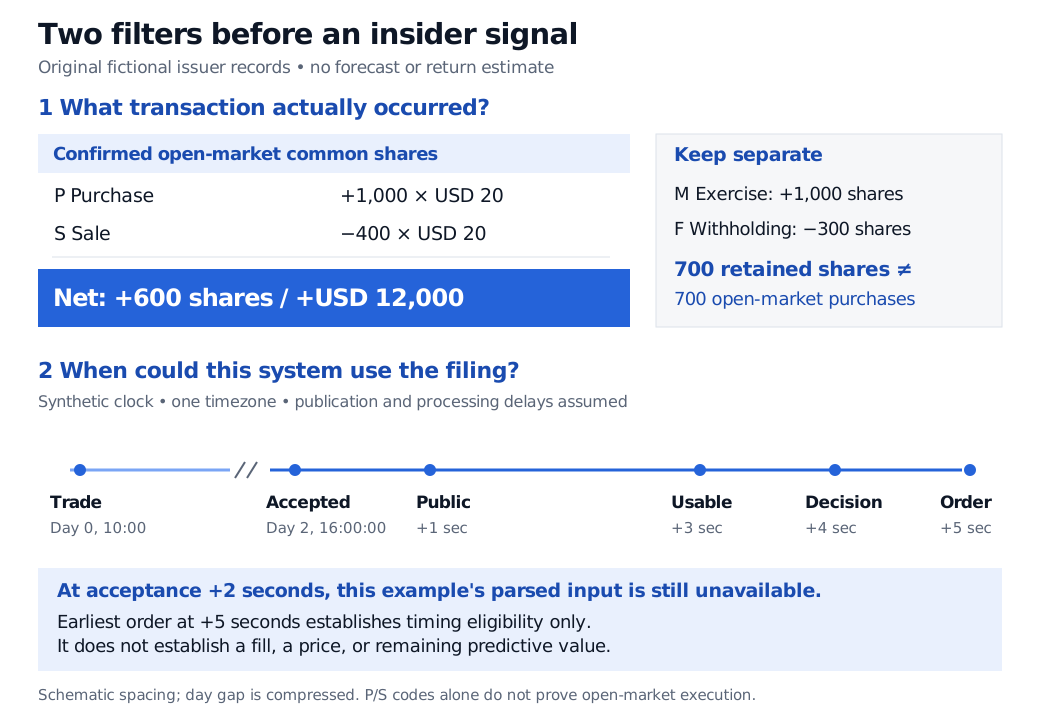
Consider fictional records for one US issuer, all available before a research cutoff. Footnotes establish that the first two rows are open-market transactions in the same common-share class, with no duplicate reporting of the same underlying trade.
Record
Disclosed activity
Treatment in this example
P
Purchase of 1,000 common shares at USD 20
Add USD 20,000 of purchase notional.
S
Sale of 400 common shares at USD 20
Subtract USD 8,000 of sale notional.
M
Option exercise delivering 1,000 common shares
Keep outside the open-market purchase feature.
F
Withholding of 300 shares to satisfy tax on that exercise
Keep outside the open-market sale feature.
The chosen feature is signed open-market transaction notional, so its value is
X=1,000(20)−400(20)=12,000 USD,
corresponding here to 600 net shares purchased. The separate exercise and withholding leave 700 shares retained under the stated assumptions. Those 700 shares are not another open-market purchase. Adding them to the 600 would mix different decisions.
This is a constructed feature, not an estimate of expected profit. It is also a flow over a chosen window, not the insider's total ownership or the fraction of personal wealth invested. With unequal transaction prices, dollar netting and share netting answer different questions.
The SEC's investor bulletin explains the common codes and notes that sales can reflect liquidity or diversification needs. An acquisition is therefore not automatically a bullish cash commitment, and a sale need not express a negative forecast.
A code is a starting point. In the current Form 4 instructions, P and S include private transactions and derivatives as well as open-market trades. M denotes an exempt derivative exercise or conversion; F covers securities delivered or withheld for specified exercise-price or tax obligations. Table I holds non-derivatives and Table II derivatives. An exercise can appear through linked entries across both tables. Read security titles and footnotes before classifying or aggregating.
Fictional open-market purchase of 1,000 shares and sale of 400 at USD 20 yield 600 net shares and USD 12,000. A separate exercise less withholding leaves 700 shares excluded from that feature. The synthetic clock puts public access one second, usability three seconds and earliest order five seconds after acceptance.
Original fictional ledger and synthetic clock. The day gap is compressed; second-scale delays are assumptions, not measured SEC dissemination performance. Timing eligibility does not establish a fill or a return.
The market cannot copy an undisclosed trade
For a backtest, the relevant clock starts with the information available to the simulated strategy. Keep at least the reported transaction date, EDGAR acceptance timestamp, observed public availability, feed receipt and completion of required parsing. An acceptance timestamp is evidence about a filing event; it is not evidence that a particular vendor or strategy had processed the contents at that instant.
In the figure's synthetic example, a transaction occurs on day 0 at 10:00. Acceptance occurs on day 2 at 16:00:00; public access is assumed at one second after acceptance, the strategy's parsed input is usable at three seconds, calculation ends at four seconds and its order arrives at five seconds. A decision using this input at two seconds after acceptance is premature. A return measured from the insider's day-0 purchase price would also give the copying strategy an unavailable entry price: look-ahead bias.
As checked on 30 October 2026, Rule 16a-3(g) generally requires Form 4 before the end of the second business day after execution. Specified plan and discretionary transactions can use a deemed execution date tied to notification, subject to the rule's limits. Certain transactions remain eligible for deferred Form 5 reporting under paragraph (f). A reporting deadline is neither an observed publication timestamp nor a guarantee of timely filing.
If historical data contain only a filing date, use a declared conservative session rule and test sensitivity; do not manufacture precise intraday availability. The owned Observation, Event and Availability Timestamps lesson develops this causal chain and feasible-entry checks. Its preview is public; the full lesson requires membership.
“Opportunistic” is a research classification
Why might any information remain after disclosure? Managers and directors may have a different assessment of their firm's prospects, but their trades also reflect recurring compensation, diversification and liquidity needs. Separating those motives imperfectly is the empirical problem.
Cohen, Malloy and Pomorski's 2012 Decoding Inside Information reports that historical predictive performance differed sharply between routine and opportunistic insider groups. These are statistical labels, not legal findings about individual trades.
Their author appendix, Exhibit A1, explains a key distinction: a history of trading in the same calendar month in three consecutive years establishes routine status in the main classification. Once established, that status applies to subsequent trades; their separate trade-level analysis distinguishes trades in the routine month from those outside it. A current P code or large dollar amount cannot reproduce that history-based classification.
The appendix's Table A7 tests delayed portfolio formation in the 1989–2007 sample, beginning returns on the 11th day of the following month. That is a historical availability robustness check, not a measurement of today's filing-to-price reaction. Neither result proves that a modern strategy can earn the historical return after its own receipt delays, spreads, fees and market impact. As disclosures are disseminated and acted on faster, a delayed copier may have less of a price adjustment left to capture; this does not supply a universal decay rate.
Preserve the filing's context through the test
Plans and versions change the interpretation. The SEC's 2023 amendments guide describes the Form 4/5 indication for transactions under arrangements intended to satisfy Rule 10b5-1(c), with disclosure of the adoption date; compliance for those form changes began on 1 April 2023. A checked box indicates intended reliance on an affirmative defence, not a regulatory certification of legality or a guarantee that the trade is uninformative. A recurring-trade classifier and a plan flag measure different things. Historical absence of a flag before the requirement is not evidence that no plan existed.
Corrections are new information. Form 4 instruction 9 distinguishes amended rows from newly added rows and unchanged rows. Resolve a Form 4/A against its original filing rather than adding the entire amendment as fresh buying. Preserve what each version said and when it became available. Otherwise a later correction can silently rewrite an earlier point-in-time dataset.
Ownership is not a row count. Direct and indirect holdings, trusts and joint reports can create several records about the same economic stake. The form's ownership fields and footnotes matter when deciding whether three reports represent three independent buyers. Share-class changes and splits also need consistent identifiers and units.
Only after those choices are fixed does it make sense to compare a net-notional feature with alternatives such as distinct-buyer counts or purchase intensity scaled by previously known ownership. Use a declared formation window, keep the sale and purchase components available for diagnosis, and evaluate subsequent returns from feasible entry prices on data withheld from feature design. The USD 12,000 above tells us what was disclosed under one convention; whether that convention forecasts anything is a separate test.