Regulation FD is a U.S. Securities and Exchange Commission rule that requires a covered issuer to make the same information public when it or someone acting on its behalf gives material nonpublic information (MNPI) about the issuer or its securities to a covered outside recipient, subject to specified exceptions. The public release must be simultaneous for an intentional disclosure and prompt for a non-intentional one. For a quant using public earnings guidance, the relevant publication time is when a public channel actually makes the guidance broadly available. An analyst can receive it earlier. 17 CFR §§ 243.100–101
The same earnings guidance on two Friday timelines
Consider a fictional U.S. reporting company that has just cut its earnings forecast. Assume there is a substantial likelihood that the cut would significantly change the overall picture for a reasonable investor, and the new guidance is still held inside the company. Those facts make it material and nonpublic. In both scenarios the recipient is a broker-dealer analyst who has given no confidentiality undertaking and owes no duty of confidence to the company. All times are Eastern on Friday, November 6, 2026, unless noted. 17 CFR § 243.100 · SEC adopting release (2000), § II.B.2
The officer tells the analyst at 15:45. On a one-on-one call, the investor relations officer knowingly gives the analyst the unreleased cut. Regulation FD requires the company to disclose the cut publicly at the same time. If the officer tells the analyst at 15:45 and the company first makes the cut public in a wire release at 18:00, the company has missed the simultaneous requirement. Under the rule, the disclosure is intentional if the speaker knows, or is reckless in failing to recognise, that the information is both material and nonpublic. 17 CFR §§ 243.100(a)(1), 243.101(a) · SEC adopting release (2000), § II.B.3(a)
The officer sends the wrong attachment at 15:45. The officer reasonably believes the attachment contains only the already-public deck. Assume the mistake is non-intentional under the rule. The clock starts when a senior official learns of the disclosure and knows, or is reckless in failing to recognise, that the information was both material and nonpublic. In this case the trigger comes at 17:00, when the CFO learns that the new deck went out and knows that the guidance is both material and nonpublic. The issuer must disclose the same information as soon as reasonably practicable, with an outer deadline at the later of 24 hours after the trigger or the start of the next day's trading on the New York Stock Exchange (NYSE). Here the two candidates are Saturday, November 7 at 17:00 and Monday, November 9 at 09:30, so Monday's open sets the outer deadline. Assume 18:00 on Friday is the earliest the company can reasonably get the full revision onto a widely distributed wire. It releases the guidance then. 17 CFR §§ 243.100(a)(2), 243.101(d), (f) · SEC adopting release (2000), § II.B.3(b) · NYSE holidays and trading hours
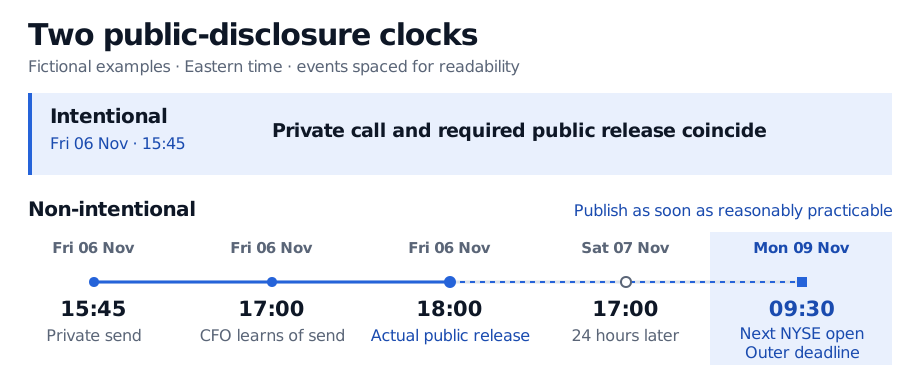
The intentional case ties the public release to the private call. In the non-intentional case, the CFO's discovery starts the clock and the wire release makes the forecast public before either candidate for the outer deadline.
The issuer can furnish or file a Form 8-K containing the guidance with the SEC. It can also use a method, or combination of methods, designed to distribute the information broadly without excluding members of the public. A widely distributed press release or a webcast that investors can access with adequate advance notice can serve that purpose. For a public-news backtest of the second scenario, 18:00 is the publication time if the wire broadly distributes the revision then. The strategy's usable time can be later if its feed receives or parses the item after release. The SelfMadeQuant lesson on Observation, Event and Availability Timestamps works through that delay from release to order. The preview is public and the full lesson requires membership. 17 CFR § 243.101(e) · SEC adopting release (2000), § II.B.4
Who sent it, and to whom?
Issuer coverage turns on Exchange Act registration under § 12 or a reporting obligation under § 15(d). The definition includes qualifying closed-end investment companies and excludes other investment companies, foreign governments and foreign private issuers. A senior official or another officer, employee or agent who regularly deals with specified market professionals or security holders can act on the issuer's behalf. Covered outside recipients include broker-dealers and associated persons, investment advisers, specified investment managers and funds, and security holders when it is reasonably foreseeable that they will trade the issuer's securities on the information. 17 CFR §§ 243.100(b)(1), 243.101(b)–(c)
A company can give the same draft to a person who owes it a duty of trust or confidence, or to a recipient who expressly agrees to keep the draft confidential, without triggering Regulation FD's public-disclosure duty for that communication. The confidentiality agreement can itself create a duty relevant to insider trading liability. If an employee passes the guidance in breach of a duty of trust or confidence owed to the issuer, Regulation FD treats that employee as acting outside the issuer's behalf for that disclosure. Any liability for trading or tipping is a separate question. 17 CFR §§ 243.100(b)(2)(i)–(ii), 243.101(c), 243.102 · 17 CFR § 240.10b5-2(b)(1)
An analyst might infer weaker earnings from public shipment data and a genuinely immaterial detail learned through an expert network. The forecast is then the analyst's own inference. If an issuer representative privately conveys the actual, material forecast, splitting it into hints or using an intermediary can leave the substance of the disclosure intact. The distinction turns on what the issuer conveyed and who acted on its behalf. SEC adopting release (2000), §§ II.B.1(b), II.B.2
Sources
- 17 CFR Part 243, Regulation FD, current rule text checked November 8, 2026.
- SEC, Selective Disclosure and Insider Trading, Release No. 33-7881, August 15, 2000, §§ II.B.1–5 and II.B.7. The adopting release explains the rule's rationale and includes the Friday timing example in § II.B.3(b).
- 17 CFR § 240.10b5-2, duties of trust or confidence, current rule text checked November 8, 2026.
- NYSE, Holidays & Trading Hours, 2026 exchange calendar and NYSE equities core session.