See how a paid industry consultation can inform a shipment forecast, and why an offered confidential issuer figure changes the analysis under U.S. law.
Expert Networks and the Mosaic Theory
An expert network connects investors with specialists for paid consultations. Mosaic theory describes drawing an investment conclusion from public information and properly sourced, individually immaterial information. A quant can use a consultation to understand what a public measure captures and turn that understanding into a testable model assumption. The fee pays for expertise. The expert’s authority to share particular information depends on its source and the duties attached to it. SEC’s Regulation FD adopting release, § II.B.2 · SEC staff risk alert on expert networks
From public capacity to estimated shipments
Mina, a fictional analyst covering a listed U.S. ceramics manufacturer, wants to estimate shipments from a new plant. A public release gives the plant’s design capacity. An independent process engineer with no connection to the issuer explains, from general experience, that customer qualification can delay shipments after installation and that early production can have lower yields. The engineer is free to discuss these general processes. Mina uses the explanation to set an uncertain ramp-up assumption and estimates that this quarter’s shipments could be below what the design capacity implies. Actual yields, qualification dates and customer demand could change the estimate.
In a separate call, another consultant offers the issuer’s exact, unreleased shipment total from a confidential internal report. In this example, investors follow shipments closely. The offer is a potential source of material nonpublic information (MNPI), including if Mina were to use the number only to check her estimate. In the fictional firm’s process, Mina ends that line of discussion before hearing the figure and refers the incident to compliance.
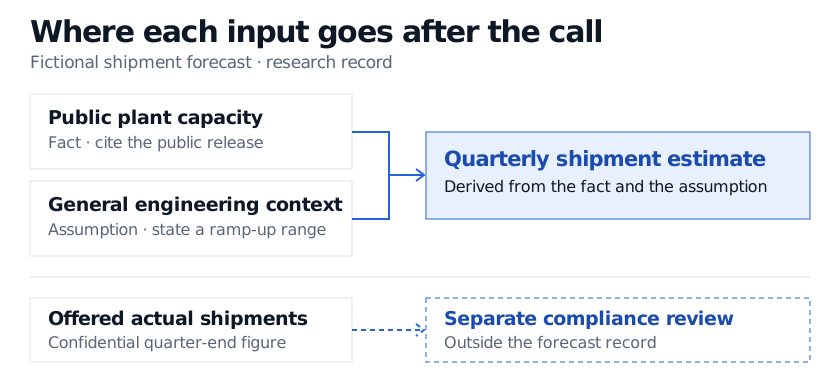
Fictional forecast record. Public plant capacity is logged as a fact and general engineering context informs a ramp-up assumption. Both feed the shipment estimate. An offer of confidential actual shipments goes to separate compliance review outside the model.
The forecast record distinguishes a cited fact, a model assumption and a derived estimate. The confidential offer follows a separate path.
The distinction is easier to review if the research record shows when each input arrived, who supplied it and how it changed the model. In a 2022 risk alert, SEC examination staff cited deficiencies in adviser controls such as logging expert calls and reviewing detailed notes. The alert reports examination observations. SEC Division of Examinations, 2022 risk alert, p. 3
The SelfMadeQuant Ethics and responsible data use lesson works through a related feature-store decision involving an issuer call. The preview is public and the full lesson requires membership.
U.S. law asks two separate questions
What did the issuer disclose?Regulation Fair Disclosure (Regulation FD) requires a covered issuer to disclose information publicly when it or someone acting on its behalf selectively discloses MNPI to a covered recipient, subject to exceptions. The required disclosure is simultaneous for intentional disclosures and prompt for non-intentional ones. The SEC’s 2000 adopting release explains that an immaterial fact can help an analyst reach a material conclusion. It also explains that an issuer cannot make a material message immaterial by splitting it into pieces. The test asks whether the information would significantly change the overall picture for a reasonable investor. Regulation FD, §§ 243.100–243.102 · SEC adopting release, § II.B.2
What did the recipient know and do? Regulation FD’s definition of someone acting on behalf of the issuer excludes employees who disclose MNPI in breach of a duty to the issuer. A leak of that kind raises a separate U.S. insider-trading question. In a tipping case such as Salman, it matters whether the source breached a duty in providing the tip for a personal benefit and what the recipient knew about the breach. Rule 10b5-1 generally looks to awareness of MNPI at the time of a trade for its “on the basis of” inquiry, subject to its specified defences. An analyst can independently develop a forecast and later receive a tip. Adding the tip to an existing mosaic leaves its source, materiality and any applicable duties in play. Regulation FD, § 243.101(c) · Salman v. United States · Rule 10b5-1(a)–(b)
In the SEC’s civil action involving Primary Global Research, the agency alleged that consultant Winifred Jiau passed confidential Marvell earnings information to fund managers. The civil case against Jiau ended in a final judgment on consent. In the parallel criminal case, a jury convicted her, and the Second Circuit affirmed her conviction in 2013. The appellate opinion describes fund managers comparing unreleased company earnings data with published analyst expectations. The public benchmark helped them judge the earnings surprise while the unreleased data supplied the actual result. SEC Litigation Release No. 22308 · United States v. Jiau, Background and Conclusion