Form 4 is the public filing used to report changes in beneficial ownership under Section 16(a) of the U.S. Securities Exchange Act. For a domestic issuer with an equity class registered under Section 12, Section 16(a) covers directors, officers and beneficial owners of more than 10% of a registered, non-exempt equity class. A Form 4 row can identify what changed and when. An analysis of the market's response to that disclosure starts when the filing becomes public. Exchange Act § 16(a) · Rule 16a-3
For an ordinary reportable stock purchase, Form 4 is due by the end of the second business day after execution. Rule 16a-3 provides a deemed execution date for certain plan transactions, and it allows some transactions to be reported later on Form 5. Form 3 records initial holdings when a reporting obligation begins. Rule 16a-3(a), (f) and (g)
Read the three code fields separately
A fictional officer of a domestic public company buys 2,000 common shares at USD 25 per share on Monday, 13 July 2026. The original Table I row reports P in the transaction-code field, A in the acquired-or-disposed field and D in the ownership-form field. Each field answers a different question. SEC Form 4, Table I and Instructions 4, 5 and 8
| Field | Original entry | Meaning |
|---|---|---|
| Transaction code | P | An open-market or private purchase. The code alone leaves the venue unspecified. |
| Acquired or disposed | A | The row records an acquisition. D in this field means disposed. |
| Ownership form | D | The filing reports direct ownership. I means indirect ownership. Use the nature-of-ownership field and footnotes to identify the arrangement. |
The reported share price gives gross purchase consideration of , before fees. The post-transaction share balance is a separate field. An award or an option exercise can also produce an acquisition, so a filter for purchases needs the transaction code as well as the acquisition field. Read Table II for derivative transactions and the footnotes for the terms of the particular row. SEC Form 4, Tables I and II and Instructions 4, 5 and 8
The form also has a checkbox for transactions under a contract, instruction or written plan intended to satisfy Rule 10b5-1(c). The explanation section gives the plan adoption date when the box applies. The checkbox records that reported status and intent. SEC Form 4, Instruction 10
Keep both filing versions
Suppose the original Form 4 first becomes public on EDGAR at 16:20 Eastern time on Wednesday, 15 July. Assume the regular session closed at 16:00 Eastern time. A strategy using public filings cannot use the row at that close. On Friday, 17 July, a Form 4 amendment corrects D to I because the shares were acquired through a trust. The trade date, quantity and price stay the same. SEC EDGAR submissions documentation · SEC Form 4, Instruction 9
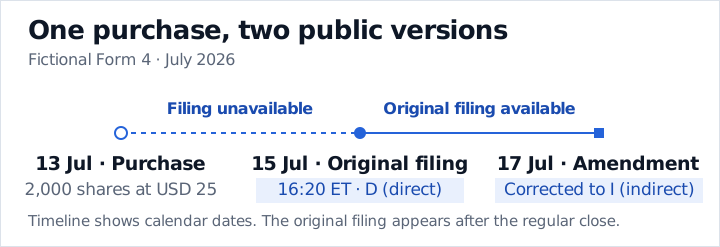
One purchase enters the public record on 15 July. The ownership correction becomes available only when the amendment appears.
An amendment that corrects a line contains that complete line as corrected. One that adds a line provides the missing transaction information. Both can omit unchanged original lines. Keep the original and amendment as separate versions, reconcile the amended lines, and apply each change from the time it was usable in your feed. Counting the correction as a second purchase inflates the share count. Backdating it introduces look-ahead bias. The SelfMadeQuant lesson traces the clock from public release to usable input. SEC Form 4, Instruction 9 · Observation, Event and Availability Timestamps (public preview, full lesson for members)
Use Form 4 for reportable insider transactions, Form 13F for covered institutional managers' reportable quarter-end positions, and Schedules 13D and 13G for qualifying stakes in an issuer. Section 16 uses separate beneficial ownership tests for identifying a more-than-10% owner and for determining which holdings and transactions are reportable. The latter test generally follows the person's economic interest in the securities. Rule 16a-1(a)