Beneficial ownership disclosure under U.S. Exchange Act Sections 13(d) and 13(g) is public reporting to the SEC of a person's or group's beneficial stake in a covered class of equity securities. For a covered acquisition of registered voting shares, the reporting threshold is more than 5% of the class. Schedule 13D is the default for such acquisitions, and eligible holders can use Schedule 13G. In an event study, the trade that crosses the threshold and the filing that tells the market about it can fall in different sessions. Rule 13d-1 · SEC staff interpretation 103.10
What counts towards 5%
Rule 13d-3 counts a person as a beneficial owner if they directly or indirectly have or share either voting power or investment power. Voting power means the ability to vote or direct a vote. Investment power means the ability to dispose of shares or direct their disposal. A nominee can appear as the holder of record while the investor who directs the vote beneficially owns the shares for this rule. Rule 13d-3(a) · SEC and FINRA bulletin on street-name registration
Add up the shares beneficially owned across accounts or other forms of holding for the same class. The denominator starts with all outstanding shares of that class, including shares held by other large investors. Certain acquisition rights can bring the underlying shares into the numerator before exercise and, for shares yet to be issued, into that holder's denominator as well. Rule 13d-3(c) and (d)(1) · SEC staff interpretations 101.02 and 103.08
A fictional purchase from 4% to 6%
A company has 100 million Class A voting shares outstanding, registered under Section 12. One investor who beneficially owns 4 million shares buys 2 million more from other holders in a single trade. All 6 million were acquired within twelve months, both the resulting stake and the outstanding share count stay fixed through the filing, and there are no other positions, acquisition rights, group holdings or applicable acquisition exemptions. Exchange Act § 13(d)(6)(B) · Rule 13d-1(a)
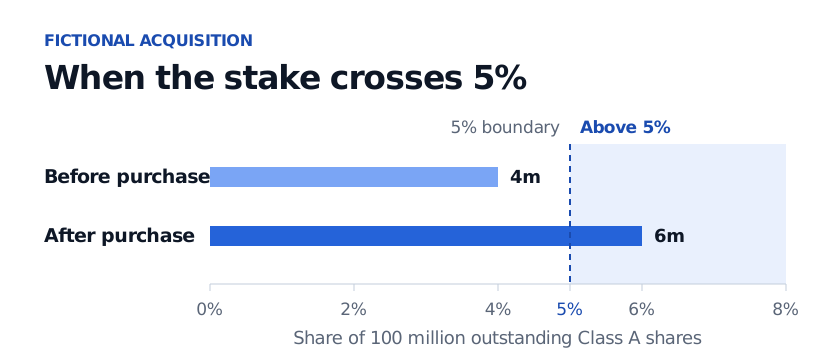
Exactly 5 million shares is 5% of this class. The purchase takes the holder above that boundary, and the initial report covers the full 6 million shares.
Which schedule and when
If the fictional investor bought the stake to replace directors in a campaign of shareholder activism, Schedule 13D is the applicable filing on these facts. Item 4 reports the acquisition's purpose and any covered plans or proposals, including a planned change to the board. If the holder instead qualifies for passive-investor treatment under Rule 13d-1(c), the short-form Schedule 13G reports the stake and separates sole and shared voting and disposition powers. Schedule 13D, Items 4 and 5 · Schedule 13G, Items 4 and 10
| Initial filing | When it applies | Deadline |
|---|---|---|
| 13D, Rule 13d-1(a) | Default for a covered acquisition resulting in ownership above 5%. | Within five business days after the triggering acquisition. SEC staff uses the trade date for a securities purchase. |
| 13G, Rule 13d-1(c) | Eligible passive investor with a stake under 20% and no purpose or effect of changing or influencing control. | Within five business days after the triggering acquisition. |
| 13G, Rule 13d-1(b) | Qualifying institution that acquired shares in the ordinary course of business without a purpose or effect of changing or influencing control. | Generally within 45 calendar days after quarter-end if above 5% at quarter-end. The first month-end above 10% starts a five-business-day deadline. |
| 13G, Rule 13d-1(d) | Exempt investor who has a reporting obligation under this paragraph, for example a holder whose stake predates the class's registration. | Within 45 calendar days after the relevant quarter-end if above 5% at quarter-end. |
The SEC adopted the shorter deadlines in 2023. The amendments took effect on 5 February 2024, and compliance with the revised Schedule 13G deadlines began on 30 September 2024. Amendments follow separate rules. A material change to facts already reported on a Schedule 13D starts a two-business-day amendment deadline. Schedule 13G generally uses a 45-calendar-day deadline after quarter-end for material changes as of quarter-end, with additional triggers for certain filers. Rules 13d-1 and 13d-2 · SEC's 2023 final rule, Table 1 and Section II.G
Use the filing's contents to classify a campaign. An exempt holder can report on 13G because of how the stake arose. For institutional and passive filers, SEC staff guidance looks at the purpose and effect of the holder's conduct. For example, a 13G filer can ask for clarification about a public issuer disclosure and retain eligibility when that is the extent of the engagement. SEC staff interpretations 103.01 and 103.10–103.15
Putting the disclosure on a research timeline
To measure the market's reaction to the filing, anchor event time to when the document became publicly available on EDGAR. Keep the triggering event date in a separate field. For example, a purchase can cross the threshold in one session and be disclosed after the close in a later session. A backtest that uses the filing details on the purchase date introduces look-ahead bias unless those details were independently public by then. The SelfMadeQuant lesson shows how to align a release timestamp with the first trading session that can reflect it. Event Definition (public preview, full lesson for members) · SEC EDGAR submission data
Form 13F answers a different research question. It gives a quarterly view of specified holdings under a covered institutional manager's investment discretion. Schedules 13D and 13G report beneficial ownership in a particular issuer's class under their own triggers. Corporate Transparency Act reports to FinCEN and customer due diligence at financial institutions use separate rules to identify the people who own or control covered entities. SEC Form 13F FAQ · FinCEN BOI rule · FinCEN customer due diligence rule
Sources
- 15 U.S.C. § 78m(d) and (g), reporting requirements and statutory exemptions
- 17 CFR § 240.13d-1, filing of Schedules 13D and 13G
- 17 CFR § 240.13d-2, filing amendments
- 17 CFR § 240.13d-3, determination of beneficial ownership
- 17 CFR § 240.13d-101, Schedule 13D
- 17 CFR § 240.13d-102, Schedule 13G
- SEC final rule on modernization of beneficial ownership reporting (2023)
- SEC staff interpretations on Regulation 13D-G
- SEC and FINRA investor bulletin on holding securities
- SEC EDGAR submission data
- SEC staff Form 13F FAQ
- 31 CFR § 1010.380, FinCEN beneficial ownership information reports
- 31 CFR § 1010.230, FinCEN customer due diligence for legal-entity customers