Form 13F is the U.S. Securities and Exchange Commission (SEC) filing through which covered institutional investment managers report quarter-end positions in designated securities over which they exercise investment discretion. The public reports are a source of institutional holdings data for studying which managers report positions in the same securities. The reporting date describes the position. A later public release determines when researchers can first observe it. Exchange Act § 13(f) · SEC Form 13F
Which securities count
Rule 13f-1 sets the trigger for a covered manager at at least USD100 million in aggregate fair market value of Section 13(f) securities under investment discretion, measured on the last trading day of any month in the calendar year. The test uses the securities on the SEC's Official List, which the SEC updates quarterly. The threshold concerns the designated holdings across the relevant accounts. Rule 13f-1(a) and (c) · SEC Official List
Meeting the threshold in a given calendar year triggers a filing for that December quarter and for the following March, June and September quarters, even if the manager subsequently falls below the threshold. Each report is due within 45 days after period-end, with a deadline that lands on a weekend or holiday moving to the next business day. Rule 13f-1(a)(1) · SEC staff FAQ, Questions 25 and 27–29
Read one common-stock row
Suppose a fictional manager reports 800,000 shares of a reportable common-stock class for 31 March 2026. The stock closed at USD25 per share on the last trading day of the quarter. The reported position value is
The current Information Table rounds the value to the nearest dollar, so the value field would show 20,000,000. The SEC switched from thousands of dollars to whole dollars for filings starting 3 January 2023. Historical ingestion needs the filing's own value convention. The USD20 million is the value of this common-share position at the specified close. The row leaves purchase prices and trading dates unknown. Form 13F, Special Instructions 8 and 11 · SEC staff FAQ, June 2022 amendments update
Short stock positions and written options are excluded. A manager with a short position in the same security still reports the full reportable long stock position. Held options can appear when the options themselves are on the Official List. The Information Table expresses their amounts and values in terms of the underlying security, so check the PUT or CALL designation before treating a share count as common stock held outright. These rules make the public rows a partial view of the manager's exposures. Short position disclosures are governed by separate rules. Form 13F, Special Instructions 10 and 11 · SEC staff FAQ, Questions 41 and 43–44
The cover page matters when attributing holdings. A manager's notice can point to other managers' filings for all reportable holdings, and a combination report can do so for some holdings. Confidential treatment can delay public disclosure of individual positions. The form also permits certain small positions to be omitted, so an absent row alone cannot establish a zero holding. Form 13F, General Instruction 2, Special Instructions 5–7 and 9 and Confidential Treatment Instructions
Date the signal at disclosure
Suppose the fictional row first appears on EDGAR on 8 May 2026, 38 calendar days after quarter-end. A decision on 30 April cannot use it. A decision after public release and any feed and processing delays can use it as a March observation. Assigning it to April on the strength of the quarter-end date introduces look-ahead bias.
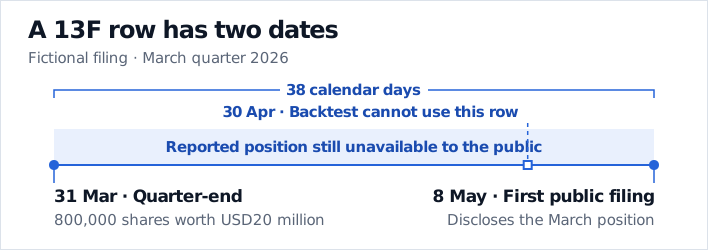
The quarter-end date tells you what the row measures. The public release sets the earliest possible use of the row in a public-data strategy.
Keep the reporting period and usable timestamp for each filing or amendment. A restatement replaces the prior report for the period, while an amendment that adds holdings supplements it. Apply the change to your historical information set from the amendment's usable time. The SelfMadeQuant lesson follows a public release through receipt, processing and order placement. Its preview is public and the full lesson requires membership. SEC staff FAQ, Questions 58b–58d · Observation, Event and Availability Timestamps
To study a specific insider transaction, use Form 4 where the transaction is reportable. The SEC publishes aggregate data from Form PF, but its confidential fund-level risk filings are separate from the public holdings table.
Sources
- The statutory basis for quarterly holdings reporting. Securities Exchange Act § 13(f), 15 U.S.C. § 78m(f)
- The threshold, filing cycle, amendments and eligible securities under paragraphs (a) and (c). Rule 13f-1
- Cover page, Information Table and Confidential Treatment Instructions. SEC Form 13F
- Reportable security classes and historical list vintages. SEC Official List of Section 13(f) Securities
- Staff guidance on filing deadlines, value units, positions and amendments, checked 8 November 2026. SEC Form 13F FAQ