Form PF is the confidential U.S. regulatory filing that covered investment advisers submit about the private funds they manage. Depending on the fund and the adviser, it can describe investment exposures, borrowing, counterparties and liquidity. The Securities and Exchange Commission (SEC) uses the information for oversight and makes it available as needed to the Financial Stability Oversight Council (FSOC) to assess systemic risk. Investment Advisers Act § 204(b) · SEC May 2023 amendments
The general filing trigger applies to advisers registered or required to register with the SEC that advise private funds and meet the USD 150 million private fund asset threshold at their latest fiscal year-end, subject to the form's aggregation rules. The requirement also covers certain advisers dually registered with the Commodity Futures Trading Commission (CFTC). The adviser files through the Private Fund Reporting Depository (PFRD). Fund type and adviser size determine which sections apply and whether the adviser submits annual or quarterly updates. Some advisers also have event-reporting obligations. SEC Rule 204(b)-1 · Form PF General Instructions in IA-6297 · PFRD filing guidance · Joint rule IA-6992
A collateral call and a public holdings table
Suppose Cedar Quay Advisers is a fictional large hedge fund adviser that manages a qualifying hedge fund. Cedar Quay determines that the fund cannot meet a margin call for additional collateral. Under Section 5, it files a current report as soon as practicable, within 72 hours of the event or of reasonably concluding that it occurred. The report includes the call amount and identifies the counterparty. Such reports can help supervisors see when several funds are struggling to post collateral at the same time. If those funds sell similar assets to raise cash, the sales can drive prices lower and put pressure on other holders. Form PF Section 5, Item D in IA-6297 · Arbitrage Crashes and Forced Deleveraging (public preview, full lesson for members)
Cedar Quay separately qualifies as a Form 13F filer. Its public holdings table on EDGAR shows quarter-end quantities and values for designated securities under its investment discretion. A researcher can observe those reported positions, but the holdings table leaves the collateral call, its size and the counterparty unobserved. SEC Form 13F instructions
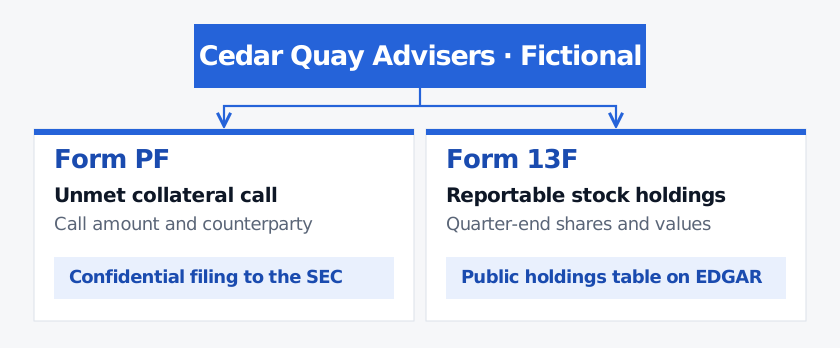
The margin report is tied to a specific fund and event. The holdings table is filed at the manager level.
Section 204(b) exempts the reports from ordinary public-disclosure requirements and provides for sharing with FSOC and other authorised recipients under confidentiality safeguards. The SEC publishes aggregate statistics such as fund counts and gross and net assets for the reporting population. Those series let public researchers study the sector at an aggregate level. They leave individual funds' submissions confidential. Investment Advisers Act § 204(b)(7)–(10) · SEC Private Fund Statistics
Which changes apply?
- The May 2023 SEC amendments are in force. Section 5 current reporting for qualifying hedge funds and Section 6 quarterly event reporting for covered private equity fund advisers took effect on 11 December 2023. Section 6 covers events such as the completion of an adviser-led secondary transaction. The other changes in that rule took effect on 11 June 2024. SEC May 2023 final rule, IA-6297
- The broader February 2024 SEC and CFTC amendments have a compliance date of 1 July 2027 under the joint extension issued on 31 August 2026. Filers continue to use the version in effect before the February 2024 amendments. Joint final extension, IA-6992 · PFRD filing guidance
- As of 8 November 2026, the April 2026 SEC and CFTC proposal to narrow filing obligations and streamline reporting remains a proposal. Joint proposed rule, IA-6959