Short position disclosure regimes specify which short positions must be reported, who receives the reports and when the public can see them. They can cover exposures created through short selling or through derivatives. For a quant measuring crowded shorts, the regime determines whether a data row describes one holder’s net exposure, an aggregate of open shorts or trading activity over a period.
How the EU calculates a reportable position
Under the EU Short Selling Regulation (SSR), an in-scope equity position is measured for a given holder and issuer. Subtract eligible long exposure from short exposure to the same issuer, then divide the net short share equivalents by the issuer’s total issued share capital measured in shares. A free float estimate answers a different question. SSR Article 3 and Delegated Regulation (EU) No 918/2012, Article 10 and Annex II.
In-scope derivatives enter as delta-adjusted share equivalents, while cash shares have a delta of one. An option with qualifying positive share exposure offsets a cash short by its delta-adjusted share count. A change in the option’s delta can therefore move the position across a reporting threshold even if the holder has made no new trade. Changes to issued share capital can also move the percentage. Delegated Regulation (EU) No 918/2012, Annex II, Part 1.
| EU equity obligation, checked 8 November 2026 | First threshold | Higher thresholds |
|---|---|---|
| Confidential notification to the relevant national competent authority | 0.1% | Each further 0.1 percentage point |
| Public disclosure identifying the holder and position | 0.5% | Each further 0.1 percentage point |
Reaching a threshold from below, moving above it from below, or falling below it from at or above triggers the corresponding obligation. The position is measured at midnight ending the trading day. Notification and disclosure are due by 15:30 on the following trading day, using the time in the competent authority’s Member State. The initial confidential threshold was lowered from 0.2% to 0.1% by Delegated Regulation (EU) 2022/27. SSR Article 5, Article 6, Article 9 and Delegated Regulation (EU) 2022/27.
A public exit can leave 45,000 shares net short
Suppose a fictional in-scope holder has 120,000 shares of short exposure to one issuer and a legally nettable long exposure of 20,000 shares. The issuer has one class of shares and 10 million shares issued throughout the example.
If the previous snapshot was 40,000 shares net short (0.40%), the move to 1.00% triggers both confidential notification and named public disclosure. If a later snapshot falls to 45,000 shares net short (0.45%), it triggers another notification and a public disclosure of the fall below 0.50%. The holder still has a short exposure after that exit from the public tier. SSR Articles 5 and 6 and Finansinspektionen’s short selling register guidance.
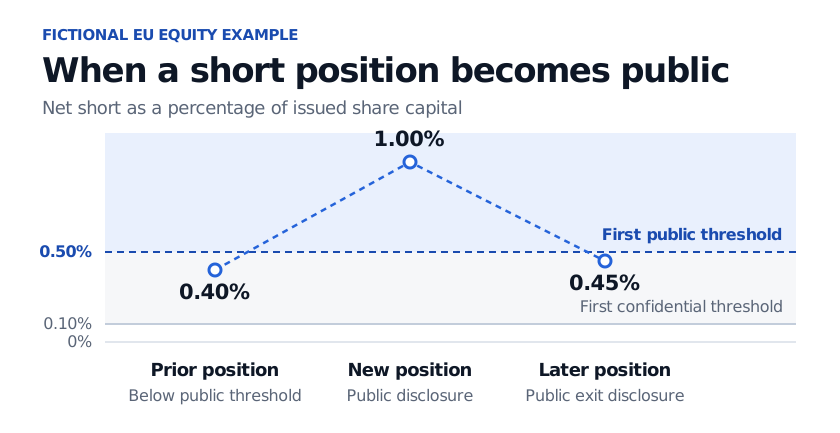
Three fictional trading-day snapshots for one holder and issuer. The dashed path connects snapshots. The horizontal lines mark the first confidential and public thresholds.
A public register can miss holders below its threshold and changes within a threshold band. For a backtest, keep the position date and the time the disclosure became usable by the strategy as separate fields. Preserve an exit disclosure as an event and leave unobserved exposure unknown. The SelfMadeQuant lesson on distinguishing publication, receipt and usable time gives a worked timing audit. The preview is public and the full lesson requires membership. Observation, Event and Availability Timestamps.
What the U.S. series measure
FINRA’s short interest data aggregates open short positions reported by member firms at designated settlement dates, twice a month. FINRA’s daily short-sale volume counts publicly disseminated off-exchange short-sale trades within the file’s coverage. A short sale covered before the next snapshot can appear in the volume series without adding to that snapshot’s short interest. FINRA Rule 4560 and FINRA’s short interest guide.
The SEC adopted a separate monthly reporting regime under Rule 13f-2 and Form SHO for qualifying institutional investment managers. The rule calls for gross short positions and specified trading activity. It provides for delayed public aggregates by security, with manager identities kept confidential. As checked on 8 November 2026, the SEC’s 3 December 2025 order grants temporary relief from compliance ending on 2 January 2028. That reporting design and its timing differ from the EU’s named net position disclosures. SEC adopting release and SEC temporary exemptive order.
Sources
- Regulation (EU) No 236/2012 in the ESMA Single Rulebook, Article 3, Article 5, Article 6 and Article 9.
- European Commission, Delegated Regulation (EU) 2022/27, Article 1 and Delegated Regulation (EU) No 918/2012, Article 10 and Annex II, Part 1.
- Finansinspektionen, Short selling, sections on notification thresholds and the register.
- FINRA, Rule 4560 and Short Interest — What It Is, What It Is Not.
- U.S. SEC, Rule 13f-2 and Form SHO adopting release and Temporary exemptive order, Sections II–III.