Beneficial ownership describes who enjoys the benefits of a security or exercises powers attached to it, even when someone else is named on the issuer’s share register. The powers that count depend on the rule being applied. For an analyst estimating who can influence a shareholder vote, an entry for a nominee on the register identifies the registered holder and leaves the underlying voting authority to be traced. SEC and FINRA investor bulletin on holding securities
What your brokerage statement shows
With street-name registration, the company or its transfer agent lists an intermediary or its nominee as the holder of record. In the U.S., that name is often Cede & Co., the nominee of the Depository Trust Company. Your broker’s records show your position, your broker credits cash dividends to your account, and you typically send voting instructions through the broker. With direct registration, the issuer’s records show your own name. SEC and FINRA investor bulletin · SEC guidance on proxy voting
The SelfMadeQuant lesson follows the broker’s role through execution, clearing, settlement and custody. Market Participants (public preview, full lesson for members)
What 6% measures
For U.S. Exchange Act Sections 13(d) and 13(g), Rule 13d-3 looks at who directly or indirectly has or shares the power to vote or direct votes, or to dispose of securities or direct their disposal. Either power can qualify. A person aggregates the shares of the same class they beneficially own across forms of holding. Certain rights to acquire shares can count before exercise. 17 CFR § 240.13d-3(a), (c) and (d)
Suppose an investor can direct the votes on 6 million shares held in street name. The fictional issuer has 100 million Class A shares outstanding, all with one vote per share. Assume those 6 million shares are the investor’s entire position that counts under Rule 13d-3 and no acquisition rights affect the denominator.
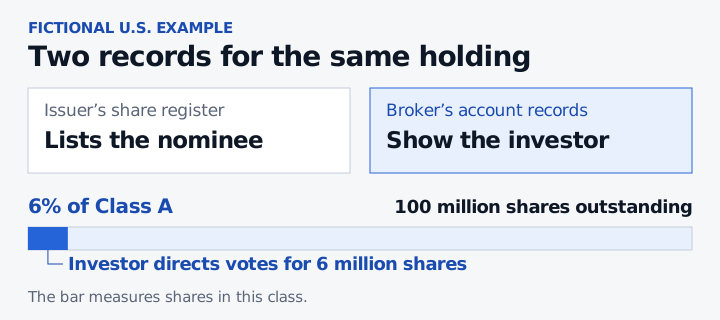
The register and the brokerage account record the same holding at different levels. The bar uses the entire Class A share count as its denominator.
Six per cent is above Regulation 13D-G’s more-than-5% threshold for covered classes. Whether a filing is due and which schedule applies also depend on the class, how the stake arose and which filing provisions or exemptions apply. A stake disclosed on Schedule 13D can matter when analysing a takeover defence, where a rights plan can define beneficial ownership for its own trigger. 17 CFR § 240.13d-1 · Twitter’s April 2022 rights agreement, § 1
A standard cash-settled total return swap with no power to vote or dispose of the reference shares and no right to acquire them gives price exposure. The SEC staff explains that entering into the swap alone does not confer beneficial ownership of the reference shares, including shares the dealer buys as a hedge. SEC staff interpretations, questions 105.08–105.09
Why a bank asks a different question
Under FinCEN’s customer due diligence rule, covered financial institutions generally identify and verify individuals behind an in-scope legal-entity customer. Subject to the rule’s exceptions, this covers each individual who directly or indirectly owns at least 25% of its equity and one individual with significant responsibility for managing or directing it. 31 CFR § 1010.230 · FinCEN customer due diligence FAQs, B.1 and B.5
The Corporate Transparency Act reporting rule applies separately. FinCEN’s final rule, effective 14 August 2026, keeps U.S.-formed entities exempt and limits reporting to qualifying foreign-formed entities registered to do business in the U.S. Those entities are exempt from reporting U.S. persons as beneficial owners. A domestic company can therefore be exempt from reporting to FinCEN while its bank still has customer due diligence duties. FinCEN’s August 2026 final rule · 31 CFR § 1010.380(b)(5), (c) and (d)
For U.S. dividend withholding, the question is who beneficially owns the income under the applicable tax rules. The first intermediary to receive the payment may be acting for someone else. IRS instructions for Form W-8BEN, definition of beneficial owner
Sources
- SEC and FINRA investor bulletin on holding securities
- SEC investor guidance on proxy materials and voting instructions
- 17 CFR § 240.13d-3, determination of beneficial owner
- 17 CFR § 240.13d-1, filing of Schedules 13D and 13G
- SEC staff interpretations on Regulation 13D-G
- Twitter’s 15 April 2022 rights agreement
- 31 CFR § 1010.230, customer due diligence
- FinCEN customer due diligence FAQs
- FinCEN’s August 2026 final BOI rule
- 31 CFR § 1010.380, reports of beneficial ownership information
- IRS instructions for Form W-8BEN