See how dividend withholding and treaty relief change the cash an investor can reinvest, and why a later refund differs from relief at source.
Dividend Withholding Tax and Treaty Rates
Dividend withholding tax is tax deducted from a gross dividend when it is paid or credited. A withholding agent sends the deducted amount to the source country’s tax authority and the shareholder receives the balance. A bilateral income tax treaty can limit the source country’s tax for an eligible beneficial owner. Two investors holding the same stock can therefore receive different amounts to reinvest and earn different total returns. IRS Publication 515
What arrives on payment day
For a gross dividend of D and an applied withholding rate of w, the investor receives D(1−w). Take a fictional gross dividend of 100 currency units and two stipulated rates. Withholding 30% sends 30 to the tax authority and leaves 70 in the account. Applying 15% at source sends 15 to the tax authority and leaves 85. The difference in cash on payment day is 15.
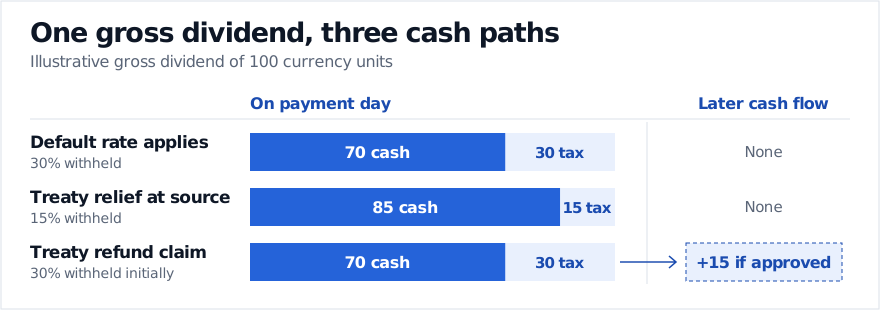
Three paths for a gross dividend of 100 currency units. The default rate leaves 70 in cash and withholds 30. Treaty relief at source leaves 85 in cash and withholds 15. A later reclaim leaves 70 in cash and withholds 30 at first, with 15 returned later if approved.
Relief at source makes the extra 15 available on payment day. A successful reclaim makes it available later.
When a treaty rate applies
The U.S. generally withholds 30% on ordinary U.S.-source portfolio dividends paid to a nonresident alien individual. Under the U.S.–U.K. treaty, Article 10(2)(b) caps U.S. tax at 15% of the gross dividend in the ordinary portfolio case. For example, assume a nonresident alien individual who is a U.K. treaty resident directly holds shares in a U.S. operating company, beneficially owns the dividend and qualifies for the treaty benefit. Article 23 treats an individual treaty resident as a qualified person, and the conditions in the dividends article still apply. The rates depend on the source country, the treaty in force at payment and the type of dividend and beneficial owner. 26 U.S.C. § 1441, U.S.–U.K. income tax treaty, Articles 4, 10 and 23
Relief at source means the withholding agent applies the lower rate at payment. In this U.S. example, an eligible individual typically documents foreign status and claims treaty benefits with Form W-8BEN before payment. A reclaim is a request for a refund of tax withheld in excess of the source-country liability. An eligible nonresident individual can claim a U.S. refund on Form 1040-NR, with Form 1042-S as evidence of the income and withholding. In the illustration, a successful reclaim of 15 brings cumulative cash from 70 to 85 before any home-country tax. IRS Form W-8BEN instructions, IRS Form 1040-NR instructions
The residence country can also tax the dividend. A foreign tax credit, where available, reduces tax due in the residence country. In this example, Article 24(4)(a) provides for a credit for U.S. tax payable in accordance with the treaty against U.K. tax on the same income, subject to U.K. law. The credit and any U.S. refund belong in separate entries. The cum-ex and cum-cum article shows why evidence of remittance and evidence of refund entitlement are separate checks. U.S.–U.K. income tax treaty, Article 24
From dividend cash to portfolio return
If the fictional holding starts the period at 2,500 currency units and its ending market value is the same in both rate scenarios, the extra 15 contributes 0.60 percentage points to the period’s cash-based return after source withholding. This comparison assumes the dividend is received within the period, kept as cash and measured before any reclaim or residence-country tax. In a backtest, record a refund when it arrives so it cannot finance an earlier purchase.
The SelfMadeQuant lesson on corporate actions works through dividend entitlement, payment and double counting in a backtest. The preview is public and the full lesson requires membership. Corporate Actions and Survivorship