Cum-ex schemes seek dividend withholding tax credits or refunds without a matching tax payment. A classic case is two claims against a single tax payment. Cum-cum arrangements seek to reduce the effective withholding burden on a single dividend by shifting dividend income to a party with more favourable tax treatment. For a quant or risk analyst, the distinction matters when reconciling dividend cash and tax claims. The first question is how much tax was paid. The second is who qualifies for relief. ESMA’s September 2020 inquiry
A share trades cum dividend when it carries the upcoming dividend entitlement and ex dividend once that entitlement has detached at the ex-dividend date. With dividend withholding tax, part of the gross dividend is deducted at source. An eligible recipient may be entitled to a credit against tax owed or to a refund, depending on the applicable rules. ESMA found that cum-cum participants generally sought to share the benefit of a lower tax burden. ESMA’s discussion of withholding and dividend arbitrage
One dividend, two claims
In a fictional ledger, an issuer pays a gross dividend of 100 currency units. The tax authority receives 25, leaving the investor with 75 in cash. Two hypothetical refund claims of 25 each would seek , which exceeds the remittance by 25. If both were paid, the tax authority would have a net outflow of 25 on this ledger.
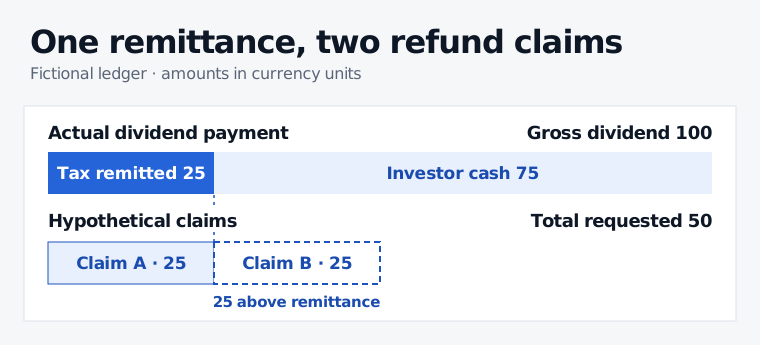
The dashed block marks the part of the hypothetical claims with no matching tax remittance.
Comparing total claims with the tax actually paid would flag this mismatch. A single claim of 25 would pass that amount check. Establishing the claimant’s entitlement requires separate evidence about who earned the dividend and who qualifies for relief.
What Germany’s sources establish
On 28 July 2021, Germany’s Federal Court of Justice held that the refund applications and tax filings it examined, arising from cum-ex trades in 2007–2011, constituted tax evasion. They asserted withholding that had never occurred for the amounts at issue. Judgment 1 StR 519/20, paragraphs 48–50
Under Germany’s current Income Tax Act, § 36a limits full withholding tax credits for the income it covers. Subject to exceptions, it requires a minimum period of economic ownership, exposure to a specified share of downside risk and limits on obligations to pass the dividend on. These conditions concern the claimant’s entitlement even when tax was collected. German Income Tax Act, § 36a
Sources
- European Securities and Markets Authority, 23 September 2020. Sections 2 and 3, especially paragraphs 21–37. Final report on Cum/Ex, Cum/Cum and withholding tax reclaim schemes
- German Federal Court of Justice, 28 July 2021. Headnote 1 and paragraphs 48–50. Judgment 1 StR 519/20
- German Income Tax Act, checked 8 November 2026. Paragraphs 1–3 and 5. § 36a, restrictions on crediting withholding tax