A transfer agent acts for a securities issuer to record changes in ownership. For a U.S. public company, the recordkeeping transfer agent maintains the official share register and updates it when shares move between registered holders. It may also handle cash dividends and shareholder communications. An analyst can use the register to identify the holders of record for a distribution. To attribute holdings to individual investors, the analyst may need records from intermediaries as well. SEC overview of transfer agents · SEC and FINRA bulletin on holding securities
Ten shares move on the register
Suppose a fictional company has 100 shares outstanding in a single class, all held directly by A and B. A starts with 70 and B with 30. Once A’s transfer of 10 shares to B is recorded, the transfer agent debits A’s share balance and credits B’s. A now holds 60 and B holds 40. The company issued or retired no shares in this transfer, so 100 shares remain outstanding. SEC recordkeeping rule, 17 CFR § 240.17Ad-10(a)(1)
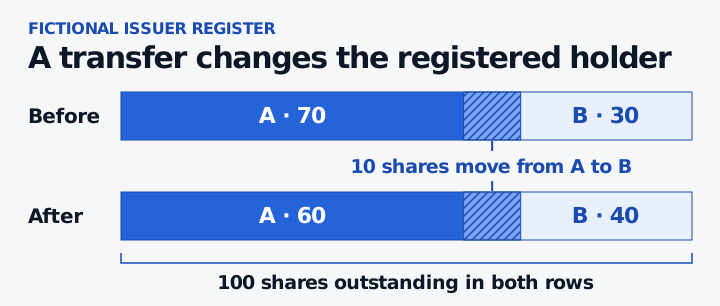
The hatched block tracks the same 10 shares under A before the transfer and under B afterwards.
The registrar function monitors issuance to prevent unauthorised shares from entering circulation. A transfer agent can perform that function as well. The issuer authorises changes to the control book, which records the authorised and issued quantities. Comparing the register with the control book helps detect a mismatch in share counts. Securities Exchange Act § 3(a)(25) · 17 CFR § 240.17Ad-9(b), (d) and (g) · 17 CFR § 240.17Ad-10(e)
When the broker’s books change
In direct registration, the investor’s name appears on the issuer’s books and the holding is recorded electronically. In street name, the register can show an intermediary or nominee such as Cede & Co., the nominee of the Depository Trust Company (DTC). The broker keeps the customer’s position in its own records. The investor is the beneficial owner even though the nominee appears on the issuer’s register. For a cash dividend, the broker credits the street-name investor’s account after the payment passes through the intermediary chain. SEC and FINRA bulletin on holding securities
A broker arranges or executes the client’s trade. Settlement completes the exchange of securities and cash. DTC can move securities between participant accounts while the issuer’s register still shows the same nominee with the same aggregate holding. Moving shares from street name into the investor’s own name is different. It changes the registration, even if the same investor continues to hold the shares. DTCC securities settlement service · SEC and FINRA bulletin, direct registration FAQ
The SelfMadeQuant lesson traces the jobs that take a trade from the broker’s order to the resulting custody position. Market Participants (public preview, full lesson for members)