Trade settlement is the process that discharges a trade’s obligations through transfers of cash and/or assets. For a purchase of securities, it normally means the buyer receives the securities and the seller receives payment. A quant system needs this distinction: a confirmed fill creates a position and payment obligation, but does not establish that the securities or cash have arrived. The ECB’s settlement definition also recognises that settlement can be provisional or final.
The price is agreed before the transfer is complete
Consider a fictional purchase of 100 shares at USD 50 per share, with no fees or taxes, settled through delivery versus payment (DvP). The parties execute on artificial day 0 and contract to settle on artificial day 1. These labels are assumptions for this example, not a universal T+1 market rule.
The agreed cash consideration is
At execution, the buyer owes USD 5,000 and is entitled to receive 100 shares; the seller has the opposite obligations. In this delayed-settlement example, execution itself has transferred zero shares and zero cash. A fill record therefore answers “what was traded?” rather than “what has already been delivered?”
Suppose the entire trade settles successfully on the agreed day 1. The transfer ledger is:
| Party | Change in settled shares | Change in settled cash |
|---|---|---|
| Buyer | +100 | −USD 5,000 |
| Seller | −100 | +USD 5,000 |
These are changes caused by settlement, not the parties’ total account balances. The shares and cash each balance across the two parties. The USD 5,000 is the purchase consideration, not a trading profit or an extra charge on top of the purchase price.
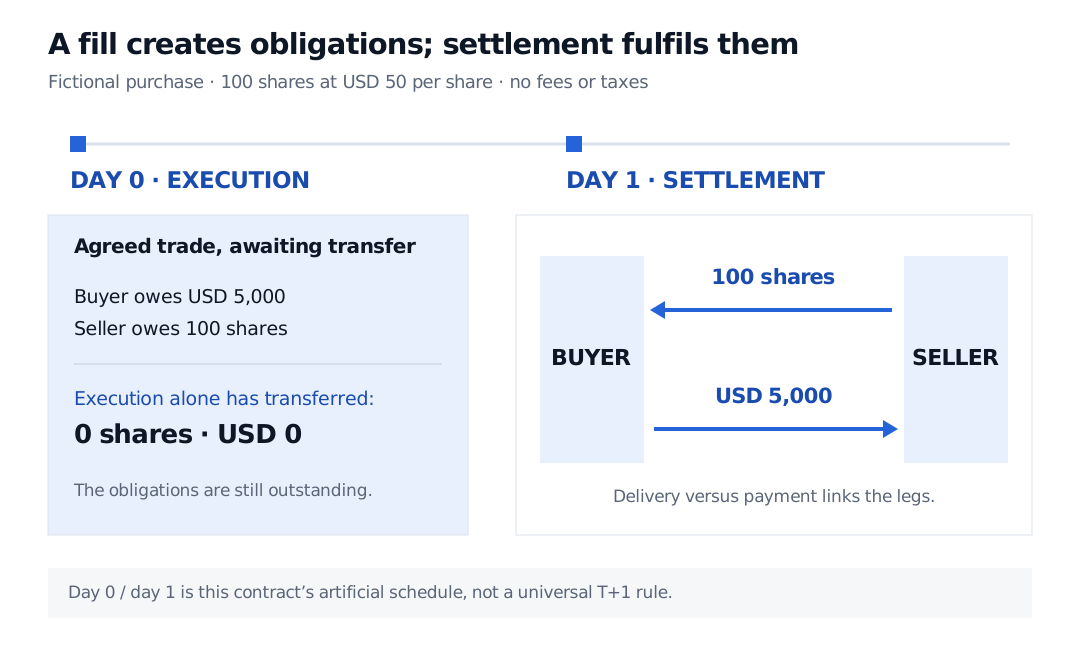
Original synthetic trade, excluding fees and taxes. Day0 execution and day1 settlement are artificial contractual assumptions; successful full settlement is stipulated. The two arrows show linked delivery versus payment, not two independent transfers.
The trade date records execution. The agreed settlement date tells operations when delivery and payment are due. Real scheduling requires the instrument’s applicable market and jurisdictional rules, contractual terms and eligible settlement calendar, including holidays. An agreed due date is not evidence that settlement happened.
Clearing prepares obligations; settlement fulfils them
Clearing can match or reconcile trade details and calculate obligations, including net obligations where the arrangement permits. A clearing house may also manage counterparty risk. Establishing what each participant owes is a different job from transferring the assets that discharge those obligations. See the ECB’s clearing entry.
The worked ledger deliberately shows one trade without netting. In a net settlement arrangement, the amount transferred can reflect several offsetting obligations, so the day’s cash movement need not equal every trade’s gross purchase consideration added together.
For a securities exchange, DvP links the securities and funds transfers so that each leg completes only if its corresponding leg completes. It addresses the danger of handing over one leg without receiving the other; it does not guarantee timely settlement. This is the mechanism described by the ECB’s DvP entry.
Keep an unsettled trade visible
Missing cash, unavailable securities or processing problems can leave a transaction unsettled. If it misses its contractual date, it is a settlement failure, even if it completes later. DvP can leave both legs pending while protecting against an unmatched exchange. A cash-settled contract, by contrast, discharges its specified cash obligation without delivering the underlying security.
A useful trading ledger keeps executed exposure, outstanding delivery/payment obligations and completed transfers as separate states. Risk can begin at execution while the funding and delivery work remains unfinished. Recording settlement too early can overstate usable cash or securities and hide settlement risk.
Final settlement adds a further requirement: under the relevant legal and system framework, the transfer is unconditional and irrevocable. A provisional credit or a “matched” status alone does not prove that finality has been reached. The ECB’s final-settlement entry distinguishes the finality of an instruction from the finality of the transfer itself.
To place the institutions around these states, Market Participants traces execution, clearing, settlement and custody. The full lesson requires membership; its public preview is available without membership.
Sources
- Frank J. Fabozzi and Francesco A. Fabozzi, Bond Markets, Analysis, and Strategies, 10th edition, MIT Press, 2021, Chapter 2, “Pricing of Bonds”, “Calculating Accrued Interest”: execution versus completion and the exchange of ownership for payment. Historical settlement-cycle examples in the book are not treated as current rules.
- ECB payments and markets glossary — S: settlement, settlement cycle and settlement risk.
- ECB payments and markets glossary — D: delivery and delivery versus payment.
- ECB payments and markets glossary — F: failed transaction and final settlement.
- ECB payments and markets glossary — C: clearing and clearing house.
- ECB payments and markets glossary — N: netting and net settlement.