A takeover defence is a measure a company uses to deter, delay or change the terms of an unwanted attempt to acquire control. A poison pill, also called a shareholder rights plan, can make it costly for a bidder to build a stake without the target board’s approval. In a flip-in design, once the rights become exercisable, eligible holders can buy target shares at a discount and the triggering acquirer’s rights are void. The prospect of dilution alone can push a bidder toward negotiation. In merger arbitrage, that can change the odds, timing and terms of a deal. Twitter’s April 2022 rights agreement, §§ 7(e) and 11(a)(ii)
What happens to the bidder’s stake?
Suppose a fictional target has 100 identical common shares outstanding, of which a bidder owns 20. Assume the rights are exercisable, the bidder is excluded, and each eligible share carries a right to buy one new share. All eligible holders exercise, so the company issues 80 shares to those holders.
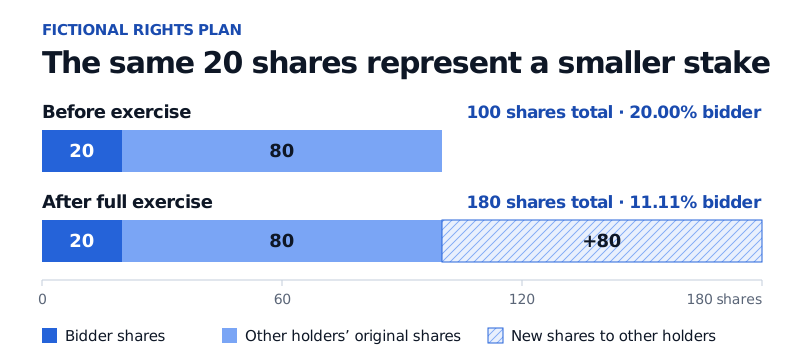
Both bars use the same share-count scale. The hatched segment shows the 80 shares issued on full exercise.
The extra shares dilute the bidder by increasing the share count used to measure its stake. This is an ownership calculation. Valuing the bidder’s position would also require the exercise proceeds and the value of the equity after issuance.
The filing determines the outcome
The ownership threshold, the definition of beneficial ownership and the timing of exercise come from the agreement. Twitter’s historical April 2022 plan specified a 15% threshold, subject to exceptions, and calculated the flip-in share entitlement using the exercise price and a defined market price. It also provided for redemption or exchange in specified circumstances. When Twitter agreed to the merger later that month, it amended the plan to exempt that transaction on the terms set out in the amendment. Twitter rights agreement, §§ 1, 7, 11 and 23–24 · Amendment No. 1, 25 April 2022
In Delaware, a court reviewing a defensive rights plan under Unocal asks whether the board had reasonable grounds to identify a legitimate threat and whether the response was reasonable in relation to it. In Williams, the Court of Chancery held that the board failed to justify the combination of restrictions in its plan. The Delaware Supreme Court affirmed. The Williams Companies Stockholder Litigation, 2021 · Delaware Supreme Court affirmance
What else can stand between a bid and control?
A staggered board spreads director elections across different years, which can slow a bidder’s effort to replace a majority. A supermajority provision raises the votes needed for covered transactions. Airgas had both alongside a pill. Separately, antitrust review can delay a deal even when both boards support it. Air Products v. Airgas, opinion pp. 16–19 · Twitter merger announcement, Form 8-K, Item 1.01
Takeover protection in convertibles concerns the bondholder’s payoff. For example, a change-of-control put can let a bondholder sell the bond back to the issuer on specified terms. The SelfMadeQuant lesson shows how that put and the conversion terms affect the bond’s payoff across deal scenarios. Merger, Reset and Convergence Hedges (public preview, full lesson for members)
Sources
- Twitter, Preferred Stock Rights Agreement, 15 April 2022, §§ 1, 7, 11 and 23–24.
- Twitter, Amendment No. 1 to the Preferred Stock Rights Agreement, 25 April 2022, § 1.
- Twitter, Form 8-K reporting the merger agreement, 26 April 2022, Item 1.01.
- The Williams Companies Stockholder Litigation, Delaware Court of Chancery, 2021, Parts II.B–C and III.
- The Williams Companies Stockholder Litigation, Delaware Supreme Court, 2021, affirmance.
- Air Products and Chemicals, Inc. v. Airgas, Inc., Delaware Court of Chancery, 2011, Part I.B.