Antitrust review examines how a proposed merger or acquisition could affect competition. Under the U.S. Hart–Scott–Rodino (HSR) Act, parties to reportable deals generally must notify the federal antitrust agencies before closing and observe a waiting period. A Second Request is a formal demand for more information that extends that wait. In merger arbitrage, it can change both when the position pays out and whether the deal closes. FTC merger review guide
What starts the next waiting period?
Both the Federal Trade Commission (FTC) and the Justice Department’s Antitrust Division (DOJ) receive the HSR filings. Through a clearance process, one agency takes the lead on the federal antitrust review. The initial waiting period is normally 30 calendar days from receipt of the required filings. During that window the reviewing agency can issue a Second Request for material such as internal strategy documents, sales data or information about competing products. The request itself keeps the wait in effect while the relevant responses are outstanding. FTC merger review guide · 16 C.F.R. § 803.10 · 16 C.F.R. § 803.20
Substantial compliance is the milestone when a recipient has adequately responded to the request, taking any agreed modifications into account. If the agency identifies deficiencies, the date of receipt can move to when it receives a compliant response. In a typical merger where both parties receive requests, the post-compliance period runs for 30 calendar days from the agency’s receipt of the last qualifying response and certification. Cash tender offers and acquisitions covered by 11 U.S.C. § 363(b) generally have a 15-day initial period and a 10-day post-compliance period, with the buyer’s response controlling that second period. The rules account for weekends and federal holidays at expiration and preserve the original expiration date if it would come later. The agencies can terminate a wait early, and a federal district court can extend it where a response falls short of substantial compliance. 15 U.S.C. § 18a · 16 C.F.R. § 803.10 · 16 C.F.R. § 803.20 · FTC timing guidance
Take a fictional ordinary merger. The required HSR filings arrive on day 0, the reviewing agency issues a Second Request on day 20, and the last relevant party substantially complies on day 65. Day 20 starts the response phase. Day 65 is the reference point for the next waiting period.
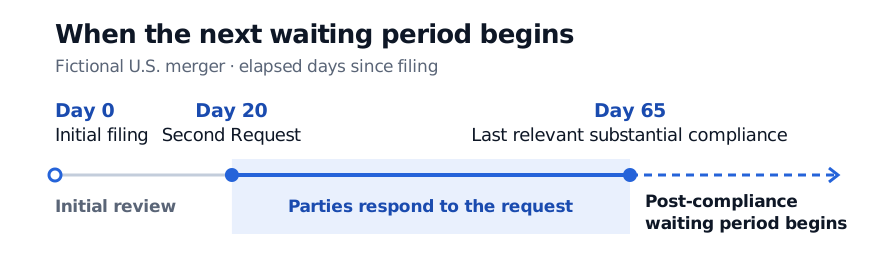
Illustrative milestones. The dashed arrow shows the start of the post-compliance period without assigning a closing date.
How the wait becomes deal risk
A negotiated timing agreement can set production milestones and commit the parties to delay closing beyond the statutory HSR wait. The FTC distinguishes that commitment from a statutory extension. The DOJ’s July 2026 model illustrates how the two can coexist, with separate provisions for production, compliance and the earliest permitted closing under the agreement. FTC timing guidance · DOJ model timing agreement, July 2026
The agency can close its investigation, seek a negotiated remedy such as a divestiture, or challenge the deal and ask a federal court to prevent closing. FTC merger review guide
Expiration of the HSR wait removes that procedural barrier while leaving other legal and contractual conditions in play. The filed Kroger–Albertsons agreement, for example, separately required the HSR wait and any no-close agreement to end, and also required the absence of an injunction or other restraint. A federal court later granted the FTC’s motion for a preliminary injunction. 15 U.S.C. § 18a(f), (i) · Kroger–Albertsons merger agreement, § 7.1 · FTC statement on the injunction
For a cash deal, a later closing date reduces the present value of the same payment at a positive discount rate, even if the probability of closing holds steady. A wider spread after a Second Request can reflect a longer expected wait, a higher chance of failure, or both. The merger agreement adds its own closing conditions and termination rights. An outside date may give a party a right to terminate, subject to extensions and other conditions. Any reverse termination fee depends on the deal’s specified triggers. Kroger–Albertsons merger agreement, §§ 8.1 and 8.4
Merger, Reset and Convergence Hedges applies the close, delay, repricing and break scenarios to a target’s convertible bond (public preview, full lesson requires membership).
Sources
- 15 U.S.C. § 18a, subsections (a), (b), (e)–(g), (i) and (k).
- 16 C.F.R. § 803.10 and § 803.20, on timing and information requests.
- FTC merger review guide and FTC timing guidance.
- DOJ model timing agreement, July 2026, sections I, III and VI.
- Kroger–Albertsons merger agreement, 13 October 2022, sections 7.1, 8.1 and 8.4, and FTC statement on the preliminary injunction, 10 December 2024.