A material adverse change (MAC) clause, often called a material adverse effect (MAE) provision, sets out which serious adverse developments can affect the parties’ obligations under a signed merger agreement. A buyer’s duty to close may depend on the absence of an MAE between signing and closing. The same definition can set the threshold for how inaccurate a seller’s representations can be before a separate closing condition fails. In merger arbitrage, the news that puts a condition in doubt can also change what the target’s shares are worth if the deal falls through. Akorn–Fresenius agreement, §§ 6.02 and 8.12
The same drop can tell two stories
Set a fictional target’s pre-signing earnings index to 100. Both scenarios start at 80 after signing, a decline. In one, earnings recover to 100 after two periods. In the other, earnings stay at 80 through period 4.
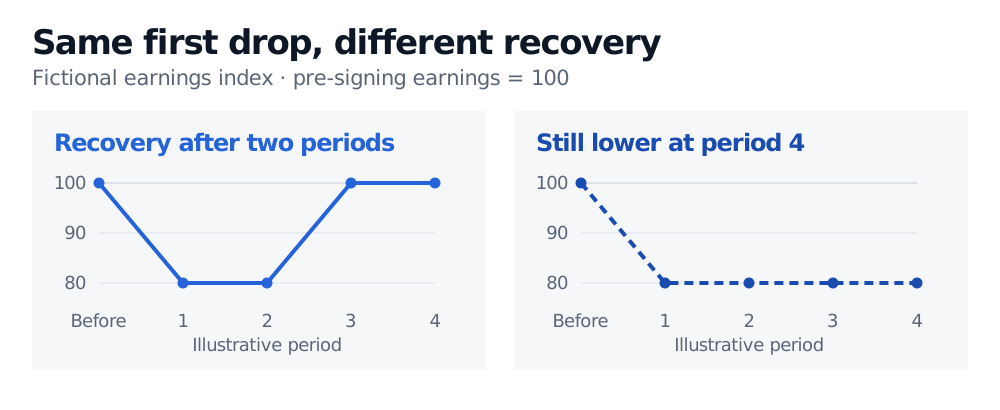
Both paths start with a 20% drop. Their recovery assumptions first differ in period 3.
The first reading measures the size of the drop. To assess its significance, ask what caused it and how long that cause is likely to depress earnings. In Akorn, the Delaware Court of Chancery considered the decline’s effect on long-term earnings power. The downturn had persisted for a year, and the court considered evidence of lasting pricing pressure from new competition and the loss of a key contract. Whether either fictional path would qualify depends on the facts behind it, the signed definition and the governing law. Chancery opinion, pp. 129–31 and 135–38
Follow the definition into the closing and termination clauses
The 2017 Akorn–Fresenius agreement covered material harm to Akorn and its subsidiaries as a whole, as well as effects that materially interfered with the deal or Akorn’s performance under the agreement. It carved out broad economic and industry shocks. If such a shock hit Akorn harder than its industry peers, the agreement let the parties count the incremental disproportionate harm. Missing a forecast was also carved out, while its underlying cause could count if that cause fell outside the exclusions. Signed agreement, § 8.12
The Delaware Supreme Court affirmed that Akorn’s business deterioration excused Fresenius from closing under the stand-alone MAE condition. The right to terminate before the contractual deadline came through a separate provision. Akorn’s inaccurate statements about its regulatory compliance could reasonably be expected to cause an MAE, so they failed the condition requiring those statements to remain accurate at closing to the agreed standard. The termination clause had cure requirements and barred a buyer then in material breach. The Supreme Court left the trial court’s additional ordinary-course covenant ground undecided. Signed agreement, §§ 6.02(a), 6.02(c) and 7.01(c)(i), Supreme Court order, pp. 2–3
An ordinary-course covenant is a promise about how the target runs the business between signing and closing. A merger clearance condition asks whether the deal has obtained required approvals or cleared applicable waiting periods. The agreement can set distinct tests for covenant compliance, regulatory clearance and the absence of an MAE. The termination and remedies clauses then determine what follows, including notice, any right to cure, any termination fee, and whether a party can seek a court order to enforce the agreement. Signed agreement, §§ 5.01, 6.01–6.02, 7.01–7.03 and 8.08, AB Stable, pp. 34–37
For a cash deal, separate the chance of closing on signed terms from the value of the target on a break. Evidence of lasting damage can lower the second estimate even if the first holds steady. If the parties agree to a lower price, model closing under the amended terms as its own outcome. Signed agreement, §§ 2.01(c) and 8.02
Sources
- Akorn–Fresenius Kabi Agreement and Plan of Merger, 24 April 2017, §§ 2.01, 3.18, 5.01, 6.01–6.02, 7.01–7.03, 8.02, 8.07–8.08 and 8.12.
- Akorn, Inc. v. Fresenius Kabi AG, Delaware Court of Chancery, 1 October 2018, pp. 1–7, 112–16, 129–31 and 135–38.
- Akorn, Inc. v. Fresenius Kabi AG, Delaware Supreme Court, 7 December 2018, pp. 1–3.
- AB Stable VIII LLC v. MAPS Hotels and Resorts One LLC, Delaware Supreme Court, 8 December 2021, pp. 34–37.