A Rule 10b5-1 trading plan is a written arrangement adopted before a person becomes aware of material nonpublic information (MNPI), so later trades under the arrangement can qualify for an affirmative defense in a U.S. insider trading case. The person must show that the transaction meets the rule's conditions. A plan can let an executive sell company stock for diversification even if they learn material news after adoption. For a researcher studying insider sales, the distinction matters because the decision to sell may predate both the trade and its public disclosure. Rule 10b5-1(b)–(c)
The trade decision must be made in advance
The arrangement can set the amount, price and trading dates directly or determine them with a written formula, algorithm or program. Another permitted structure gives trading discretion to someone else while barring the adopter from later influencing whether, when or how trades occur. Anyone exercising that delegated discretion must be unaware of the MNPI when doing so. For a director or officer adopting a written plan, the plan itself must contain their certification about lack of MNPI awareness and good faith at adoption. Rule 10b5-1(c)(1) also recognizes qualifying binding contracts and instructions to another person. Rule 10b5-1(c)(1)(i)–(ii)
The person must adopt the plan in good faith and without a scheme to evade the rule, act in good faith with respect to it, and trade according to its terms. For example, an officer who pushes back the release of bad news to benefit a scheduled sale can jeopardize the defense even if the broker executes the order exactly as written. Changing the quantity, price or timing terminates the old plan and counts as adopting a new one. The replacement must meet the adoption conditions again, including any required cooling-off period. Selectively cancelling trades can also put the defense for earlier plan trades in doubt if it calls the adopter’s good faith into question. SEC Release No. 33-11138, sections II.A.1 and II.A.4 · SEC staff interpretations, Questions 120.16 and 120.18
For people other than the issuer, the rule also limits overlapping plans for open-market trades and plans designed to trade the full amount in one open-market transaction. Eligible sales to cover tax withholding solely from award vesting are among the exceptions. Rule 10b5-1(c)(1)(ii)(D)–(E)
When can the broker start?
Under the amendments effective February 27, 2023, a director or officer of a domestic issuer must wait until the later of 90 days after adoption or the end of two full business days following the Form 10-Q or Form 10-K filing that discloses results for the completed fiscal quarter of adoption. The required wait is capped at 120 days after adoption. SEC staff guidance counts the next business day after the filing date as day one. A Monday filing therefore gives a Thursday start if the filing-based wait controls and there are no intervening federal holidays. Rule 10b5-1(c)(1)(ii)(B)(1) · SEC Release No. 33-11138 · SEC staff interpretation, Question 120.29
Suppose a fictional CFO adopts a written plan on Monday, January 5, 2026, while unaware of any MNPI about the issuer or its stock. It sets day orders to sell 500 shares at a limit of USD 40 on April 30, May 7 and May 14. The issuer's fiscal quarter ends March 31, and it files the quarter's Form 10-Q on Monday, April 27. The 90-calendar-day minimum ends on April 5. With no intervening federal holidays, Tuesday and Wednesday, April 28 and 29, are the two business days following the filing. The later test permits trading on Thursday, April 30, before the May 5 cap.
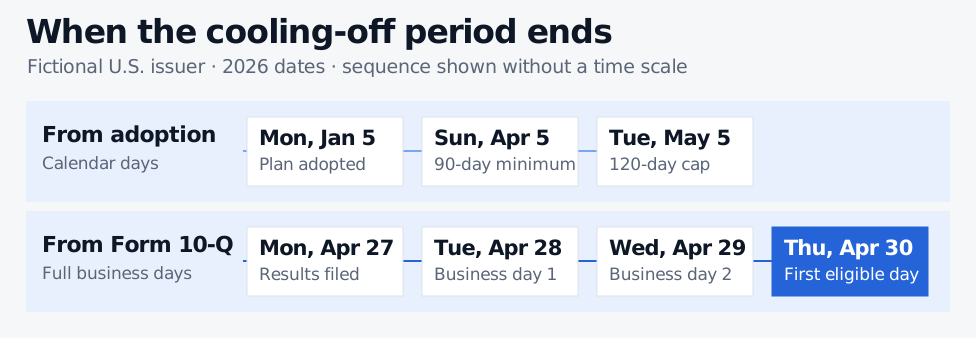
The filing-based wait ends later than the 90-day minimum and before the 120-day cap. It determines when this plan can start trading.
On April 28, the CFO learns that a major customer is leaving. Assume the news is material and still private on April 30. The broker fills the scheduled April 30 sale at USD 42 without any intervention from the CFO. The defense can apply to that fill because the trading decision preceded the CFO's awareness, provided the plan and trade meet the other conditions. A call to the broker on April 28 to sell early would take the resulting trade outside those instructions. Rule 10b5-1(c)(1)(i)–(ii)
What appears in public filings
A covered domestic issuer uses Regulation S-K Item 408(a) to disclose whether a director or officer adopted or terminated a covered arrangement during the quarter, including changes treated as termination and readoption. It identifies whether the arrangement is intended to qualify and provides material terms such as the date, duration and aggregate number of securities, with pricing terms excluded from that disclosure requirement. Look in Form 10-Q for an interim quarter and Form 10-K for the fourth quarter. A reportable fill shows up separately on Form 4. The checkbox signals that the transaction was under an arrangement intended to satisfy the defense, and the explanation gives the plan adoption date. Establishing the defense depends on the actual plan and conduct. Regulation S-K Item 408(a) · SEC Release No. 33-11138, section II.B.1.c · SEC Form 4, Instruction 10
In the example, the April 27 Form 10-Q can disclose the January 5 adoption before the April 30 sale happens. The sale enters the public filings when the Form 4 is disseminated. Keep the adoption, execution and public availability times as separate fields. A backtest using the reported sale can use it once the filing is available to the strategy. The SelfMadeQuant lesson works through the delay from release to usable input. SEC EDGAR submissions documentation · Observation, Event and Availability Timestamps (public preview, full lesson for members)
Sources
- 17 CFR § 240.10b5-1, current rule
- SEC Release No. 33-11138, Insider Trading Arrangements and Related Disclosures
- SEC staff interpretations of Exchange Act rules
- Regulation S-K Item 408, insider trading arrangements and policies
- SEC Form 4, cover page and instructions
- SEC EDGAR application programming interfaces