In investing, a fund is an arrangement that pools investors’ money and invests it under a stated mandate. Investors hold interests in the pool, commonly shares or units. For a quant, the fund connects a trading strategy to an investable product: its charges, valuation rules and exit terms affect the returns an investor actually receives.
Three separate questions
A fund’s name can mix together its organisation, method and investments. Keep these questions separate:
| Question | What to establish |
|---|---|
| What is the vehicle? | The legal arrangement, such as a trust or investment company, and the rights attached to its shares or units. |
| What is the strategy? | How investments are selected and managed: for example, discretionary selection or an index fund strategy. |
| What is the exposure? | The asset classes, markets and risks the portfolio actually holds or obtains through derivatives. |
An exchange-traded fund has interests that trade on an exchange. That trading arrangement does not, by itself, identify its strategy or exposure. Two funds with different names can hold substantially overlapping portfolios. Owning both therefore need not add much diversification. A narrowly focused fund can remain concentrated even when it owns many securities.
ASIC Moneysmart’s managed-fund guide explains the distinction between a stake in a fund and direct ownership of the underlying investments. The precise legal rights depend on the vehicle and jurisdiction.
One pool, many units
Consider a synthetic fund with one class of identical units, valued at a single instant:
| Fund ledger | Amount |
|---|---|
| Assets | USD 1,020,000 |
| Liabilities | USD 20,000 |
| Net assets | USD 1,000,000 |
| Units outstanding | 100,000 |
Its net asset value (NAV) per unit is
An investor holding 100 units has 0.1% of the units and a USD 1,000 NAV interest. This is a claim through the fund, with rights set by its documents; the calculation does not give the investor direct title to 0.1% of every security in the portfolio.
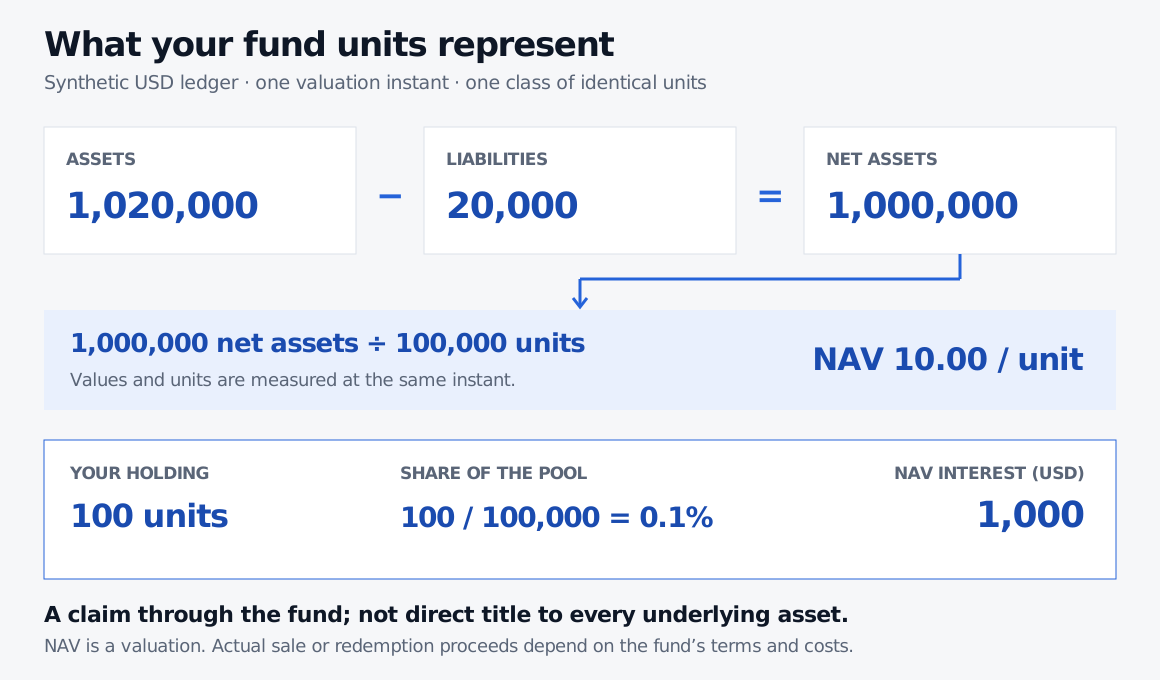
Original synthetic USD ledger at one valuation instant, assuming one class of identical units. The investor’s interest is a proportion of net assets; NAV is not a guaranteed exit price.
NAV accounts for liabilities, including accrued expenses where applicable. Deducting an already accrued charge again would double-count it. Distinct share classes can have different fees and NAVs, so use the class actually held. A fund’s distributions also matter: a change in NAV alone does not capture the investor’s total return.
The exit route belongs in the analysis
Not every fund trades on an exchange, and “fund” does not promise continuous redemptions. For a U.S. open-end mutual fund, the SEC describes redemption at the next calculated NAV, less applicable redemption fees. An exchange investor instead sells a traded fund interest to a market buyer, at a price that can differ from NAV.
Read the dealing dates, cut-offs, notice requirements and withdrawal restrictions in the fund documents. ASIC’s frozen-fund guidance documents Australian schemes whose withdrawals have been suspended or cancelled. A reported valuation and the ability to turn an investment into cash are separate facts.
The fund manager’s job is also distinct from the fund itself and from custody or brokerage. For the surrounding institutional roles, Market Participants explains managers, brokers and custodians; its public preview is open, while the full lesson requires membership.
When comparing fund returns, identify the share class, include distributions, and establish which expenses are already reflected. When modelling an exit, use the actual dealing route and costs rather than treating reported NAV as immediately available cash.
Sources
- ASIC Moneysmart: What is a managed fund, updated 1 July 2026 — pooling, fund interests, strategy and exposure, and liquidity risks.
- SEC Investor.gov: Mutual Funds — U.S. open-end mutual-fund interests, NAV, distributions and expenses.
- ASIC: Frozen funds — Information for responsible entities, INFO 249 — Australian withdrawal suspensions and restrictions.
- SEC Investor.gov: Mutual Fund Classes — class-specific fee and expense arrangements.
- Elton, Gruber, Brown and Goetzmann, Modern Portfolio Theory and Investment Analysis, 9th edition, Wiley, 2014, Chapter 2, pp. 18–19 and Chapter 25, pp. 648–650 — indirect investing, proportional interests, fund structures and dealing. Ledger and diagram are original and synthetic.