Estimate a derivative by stepping forward, and see how curvature, bump size and numerical noise change a price sensitivity.
Forward difference
A forward difference compares a function at x with its value one positive step ahead, x+h. The raw difference is Δhf(x)=f(x+h)−f(x). Dividing by the step gives the forward-difference approximation to the derivative:
Dh+f(x)=hf(x+h)−f(x),h>0.
In risk calculations, this is the basic “bump up and reprice” operation. For a price V(S), the quotient [V(S+h)−V(S)]/h estimates delta while holding the other model inputs fixed. If the base price is already available, it needs one additional valuation. “Forward” describes the direction of the input step; it does not mean a forecast of a future price.
A slope with some curvature left in it
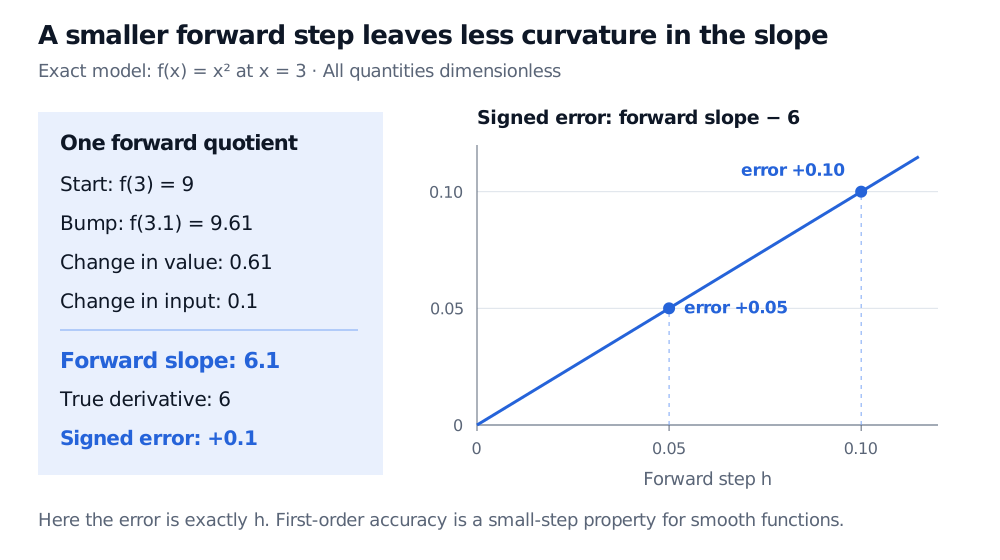
Use the dimensionless test function f(x)=x2 at x=3. Its derivative is f′(3)=6. With h=0.1,
D0.1+f(3)=0.13.12−32=0.19.61−9=6.1.
The secant measures the average slope across the interval from 3 to 3.1. The quadratic is getting steeper over that interval, so the result exceeds the tangent slope at its left endpoint.
Step h
Bumped value f(3+h)
Forward slope
Signed error: approximation minus 6
0.1
9.61
6.1
+0.1
0.05
9.3025
6.05
+0.05
Here the arithmetic is exact in decimal notation. Expanding the square shows why halving the step halves the error:
h(x+h)2−x2=2x+h.
Exact dimensionless quadratic at x=3: forward slopes 6.1 and 6.05 have signed errors plus 0.1 and plus 0.05 for steps 0.1 and 0.05; the true derivative is 6.
Original exact quadratic example. The straight error line is specific to this model; it is not an observed market relationship.
Why the two-point formula is first order
If f has a continuous second derivative on the interval, Taylor's theorem gives
Dh+f(x)−f′(x)=2hf′′(ξ),x<ξ<x+h.
If ∣f′′∣≤M throughout a fixed neighbourhood of x, the absolute truncation error is at most Mh/2. This is first-order accuracy: the error is O(h) as h shrinks. An approximately twofold reduction on halving h is expected when the leading curvature term is nonzero and truncation dominates. A straight-line function has zero truncation error already.
The error's sign follows the curvature. A convex smooth price function gives an upward-biased forward slope relative to its derivative at the base point; concavity reverses that comparison. If both sides of the input are admissible, a central difference cancels the leading curvature term and normally has O(h2) truncation error under sufficient smoothness.
Choosing the step in a pricing calculation
A smaller bump reduces truncation error, but it also makes the numerator a subtraction of closer prices. Floating-point arithmetic, solver tolerances and valuation noise can then dominate. Even the sample point can disappear: in ordinary binary64 arithmetic, 3+10−18 rounds to 3. The direct quadratic quotient then returns zero because the two computed nodes coincide, although the derivative is 6.
With exact sample locations, if each evaluated function value has an absolute error bounded by ε, their contribution to the quotient error is bounded by 2ε/h. A Monte Carlo standard error is a stochastic scale, not such a deterministic bound. Compare several meaningful bump sizes and account separately for simulation uncertainty; the smallest representable step offers no accuracy guarantee.
Keep the bump's units explicit. A quotient has units of output per unit input; a volatility input recorded as a decimal requires a bump in decimal volatility units. At a lower domain boundary a forward stencil can be convenient; at an upper boundary, a backward difference may be the admissible choice. At a kink, a forward quotient may approach a right derivative even when a two-sided derivative does not exist. It cannot certify smoothness or the stability of a full differential-equation solver.
The Numerical Differentiation lesson develops the Taylor formulas, Greek bumps and step-size trade-off. The preview is public; the full lesson requires membership.
Sources
Rüdiger U. Seydel, Tools for Computational Finance, 6th ed., Springer, 2017, §4.2.1, pp. 183–184: one-sided and central difference approximations and their error orders.