Truncation error is the difference introduced by replacing an exact mathematical operation with a finite approximation, even if every arithmetic operation is performed exactly. A finite price bump approximates a derivative; a finite grid approximates a continuous pricing equation. Keeping more digits does not remove the approximation itself.
For a risk report, this distinction matters: two implementations can agree to machine precision and still report the same inaccurate sensitivity because they use the same oversized bump.
A bond slope with no computer rounding
Consider a synthetic payment of USD 100 exactly one year from today. Its price under annual effective discounting is
where is the annual effective yield expressed as a decimal. At , the price is USD 100 and the exact yield derivative is
A unit decimal yield change means a change of . One basis point is in these coordinates. The derivative therefore corresponds to a local slope of minus USD 0.01 per basis point; this is a derivative scaling, not an exact finite-shock price change.
Suppose a risk routine uses a positive forward bump . Its slope is
Define signed approximation error as approximation minus exact derivative. Here it is known without numerical estimation:
| Yield bump | Decimal | Forward slope | Signed truncation error |
|---|---|---|---|
| 100 basis points | 0.01 | −99.009901 | +0.990099 |
| 10 basis points | 0.001 | −99.900100 | +0.099900 |
Both slope and error columns are in USD per unit decimal yield, rounded to six decimal places. The exact errors are and . The finite-bump slope is less negative than the derivative because the price curve bends upward: the forward secant averages slopes over higher yields.
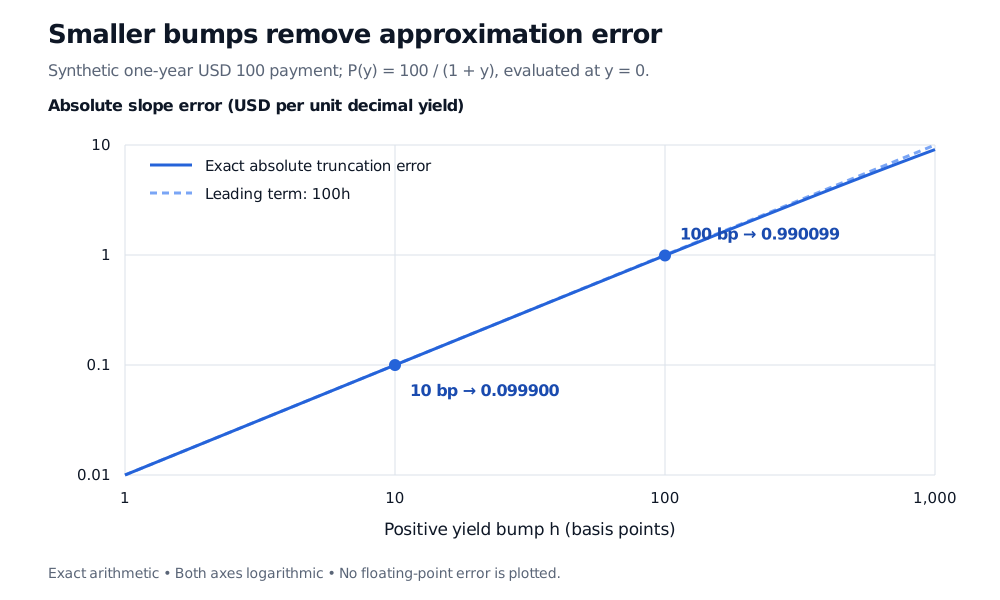
Original exact-arithmetic example for a one-year USD 100 payment at zero annual effective yield. The dashed line is the leading term ; no computer-rounding error is plotted.
What “first order” promises
A Taylor series explains the error in a forward finite difference. For a twice continuously differentiable function on the relevant interval,
for some between and . If the second derivative is bounded nearby, the error is as . This is a first-order approximation. Smooth central differences have error when the required higher derivatives exist. These orders describe small-step behavior; they are not error bounds with a universal constant. A linear function, for example, has zero forward-difference truncation error.
In the bond example, . Reducing the bump tenfold reduces the error by a factor approaching ten. For the two displayed bumps, the actual factor is , not exactly ten. The absolute error is ; changing the signed-error convention reverses the sign, not its magnitude or order.
Why shrinking the bump eventually stops helping
The table isolates truncation error. Actual evaluations also incur rounding error. If each price evaluation has absolute error bounded by , its contribution to a forward slope can be as large as , before accounting for subsequent arithmetic. Subtracting nearby computed prices can expose these errors through catastrophic cancellation. A smaller bump reduces the smooth truncation term while potentially amplifying valuation noise or rounding.
Check several sensible bump sizes in the stated input units, compare with an analytic derivative when available, and distinguish convergence of the approximation from numerical agreement at one setting. For derivations and the bump-size trade-off, SelfMadeQuant's Numerical Differentiation lesson offers a public preview; the full lesson requires membership.
Sources
- Seydel, R. U. (2017). Tools for Computational Finance, 6th edition. Springer. Section 4.2.1, pp. 183–184: difference approximations and Taylor error terms; Section 4.2.2, pp. 184–185: grid and domain approximation.
- Driscoll, T. A. and Braun, R. J. Fundamentals of Numerical Computation, Section 5.5: Convergence of finite differences. Definitions of truncation error and order, and the interaction with roundoff. The signed error above uses approximation minus reference, the reverse of this source's convention.
- University of Illinois Urbana-Champaign, CS 357. Finite Difference Methods. Forward and central differentiation formulas and the truncation-versus-roundoff trade-off.