Absolute error is the nonnegative distance between an approximation and a specified reference value. For a quant comparing two valuations, it answers a concrete question: how many dollars apart are they?
If is the reference and the approximation, define
Here is the signed error, with the convention approximation minus reference. A negative value means an underestimate. Absolute error removes that sign, so it cannot tell you which valuation is higher. It is zero exactly when the two values agree.
A price miss in dollars
Suppose a synthetic instrument has a stipulated model reference value of USD 100.00, while a faster approximation returns USD 99.80. Then
The approximation is twenty cents below the reference. An approximation of USD 100.20 has the same absolute error, but a positive signed error. Keeping both measures prevents a report of “0.20 error” from hiding the direction of a pricing discrepancy.
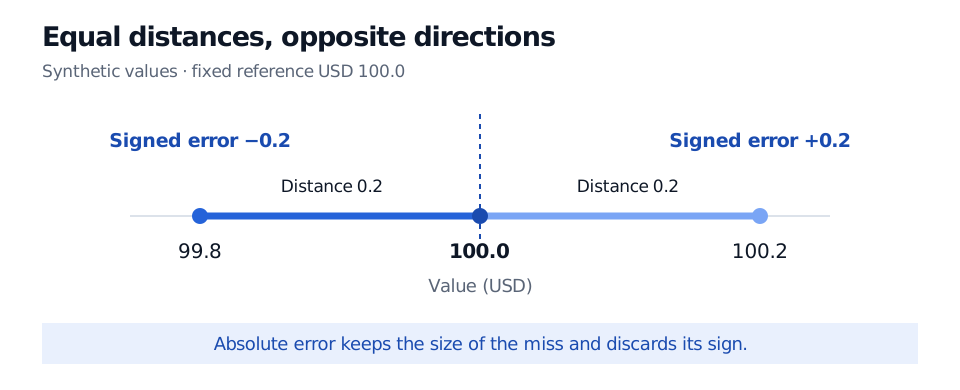
Original synthetic comparison. Distance is nonnegative; direction is retained only by the signed error. Values and distances are in USD.
Absolute error keeps the units of the quantity being compared. Express the same prices in cents and the absolute error becomes 20 cents, with no change in the economic discrepancy. Comparing an error in dollars with one in volatility points requires a decision about scale and purpose; the raw numbers alone do not rank their importance.
To put the price miss on a proportional scale, use relative error:
Relative error is dimensionless. Its denominator is the magnitude of the reference, including when the reference is negative. At a zero reference it is undefined: a computed USD 0.20 against USD 0 still has absolute error USD 0.20, but there is no corresponding percentage error under this definition. Even exact agreement at zero does not make a valid relative error.
Name the reference before judging the error
A closed-form model value, a carefully computed benchmark and an observed market quote answer different questions. The calculation above measures disagreement with the stipulated model reference. It does not establish that the instrument's true market value is known to within twenty cents. If the benchmark itself is approximate, report its precision or error bound separately.
Likewise, an observed absolute error is not a standard error, a confidence interval or an error bound. Those describe uncertainty or guarantees under additional assumptions. A small difference between two algorithms can also reflect a shared mistake.
For how input sensitivity and computation affect a valuation, continue to numerical stability. The SelfMadeQuant lesson Numerical Conditioning and Stability connects these distinctions to hedge ratios and covariance calculations; its preview is public and the full lesson requires membership.
Sources
- David Bindel, Cornell CS 4220: Sensitivity, conditioning, and floating point (2 February 2026), “Absolute and relative error”.
- Lloyd N. Trefethen and David Bau III, Numerical Linear Algebra, SIAM, 1997, Lecture 14, “Accuracy”, p. 103.